They took one look and said, "You got lucky." That's when I reali...
Facts 21/05/2026 21:32
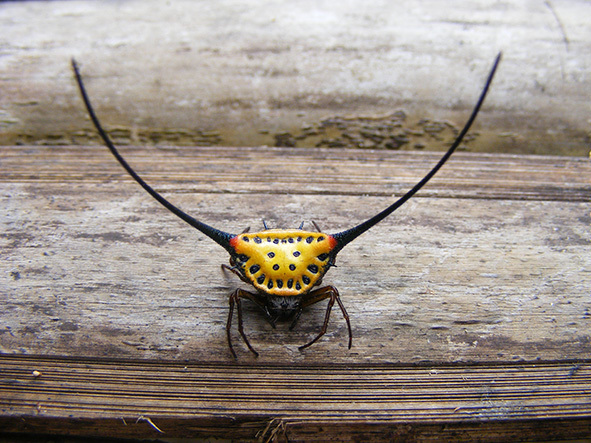
Last night, I went into the garage, turned on the light, and saw this on the wall.
I’m a grown man, but honestly, I got really scared.
Then, once the fear passed, I started looking at it more carefully, trying to understand what it was, but I couldn’t figure it out.
Does anyone know what this is?
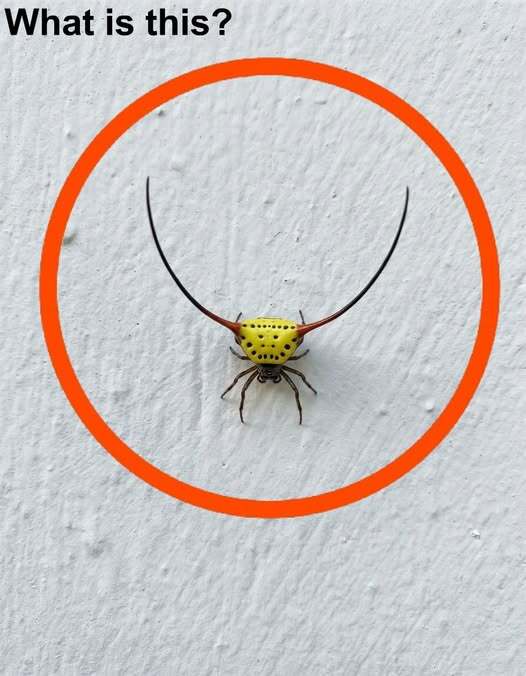
Spiders belonging to the genera Gasteracantha and Macracantha are among the strangest and most visually striking spiders found in tropical regions of Asia and other warm climates.
Many people become frightened immediately after seeing them because of their unusual body shapes, bright colors, sharp-looking spines, and alien-like appearance.
Some species look almost unreal, with hard shell-like bodies covered in spikes or long horn-like extensions sticking outward from the abdomen.
However, despite their frightening appearance, these spiders are generally far less dangerous than most people assume.
The first thing most people notice about Gasteracantha spiders is their hard, crab-like abdomen covered with sharp spines.
Depending on the species, the abdomen may be white, yellow, black, orange, or red, often decorated with spots or patterns that make the spider highly visible.
The spines serve several important survival purposes.
One major reason for the spikes is defense against predators.
Birds, lizards, frogs, and larger insects are less likely to swallow a spider that appears sharp or difficult to eat.
The unusual shape also helps confuse predators because the spider no longer resembles the typical body shape many predators instinctively recognize as prey.
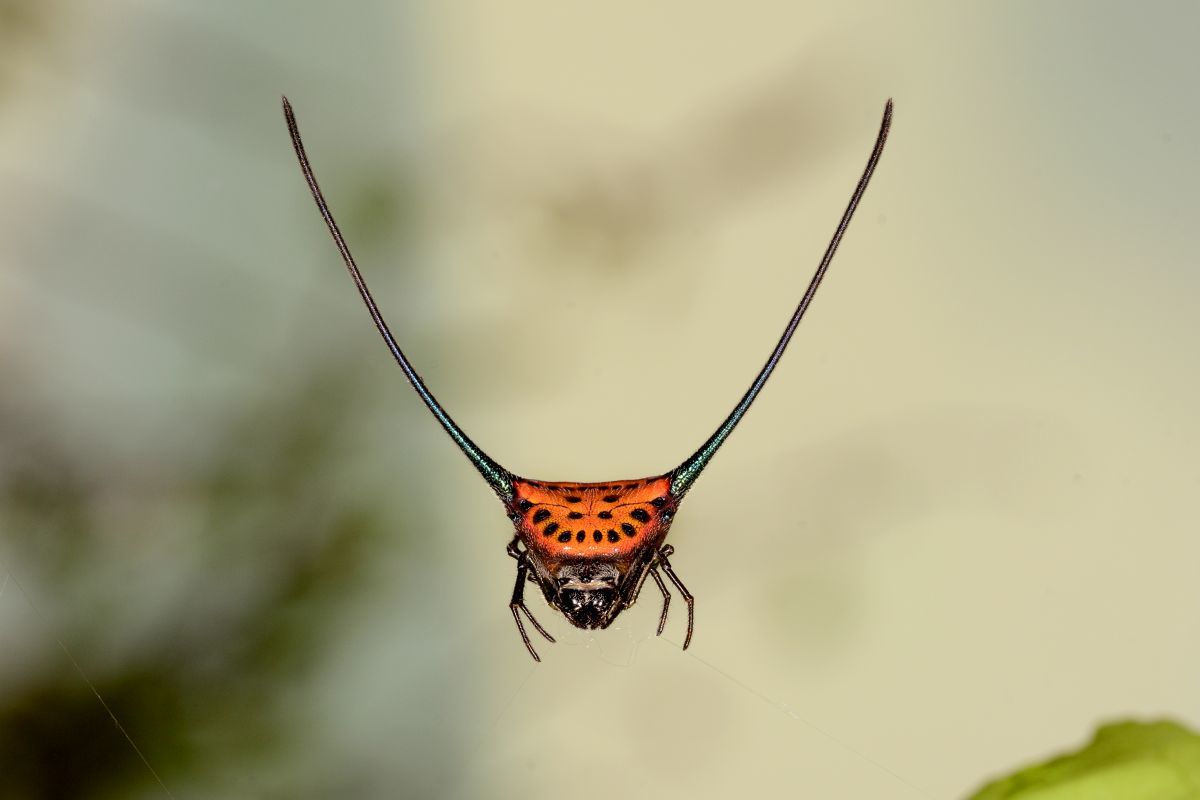
Macracantha spiders are especially famous for their extremely long side spines that can extend far wider than the spider’s actual body.
Some people call them “long-horned orb-weavers” because of these dramatic projections. Their appearance can seem intimidating, but the long horns mainly function as defensive structures and visual camouflage rather than weapons for attacking humans.

Both Gasteracantha and Macracantha belong to the orb-weaver family. Orb-weavers are known for building large circular spider webs that often appear in forests, gardens, farms, or near vegetation. Their webs are highly organized and incredibly strong relative to the spider’s size. At night or during early morning, the web can become covered with dew drops that make it look almost artistic under sunlight. These spiders usually remain motionless in the center of the web waiting for insects to become trapped.
One important fact that surprises many people is that these spiders are not aggressive toward humans. Unlike hunting spiders that actively move around searching for prey, orb-weavers rely on their webs for survival. They prefer staying still and avoiding unnecessary confrontation. If disturbed, most species immediately attempt to escape, drop from the web, or hide rather than attack.
Are they venomous? Technically, yes. Almost all spiders possess venom because venom helps them immobilize insect prey. However, the venom of Gasteracantha and Macracantha spiders is considered very mild and not medically dangerous to healthy humans. Their venom is designed for tiny insects, not large mammals. In most cases, even if one bites a person, the symptoms are usually limited to minor localized reactions similar to a mild bee sting or mosquito bite.
The reason people rarely get bitten by these spiders is because their fangs are relatively small and weak compared to larger dangerous spiders. In many situations, their fangs may not even penetrate human skin effectively unless the spider is pressed directly against the body or accidentally trapped inside clothing. Most bites happen only when someone grabs the spider with bare hands or accidentally crushes it.
If a bite does occur, the typical symptoms are usually mild pain, slight redness, swelling, or temporary itching around the bite area. Some people may experience minor irritation lasting several hours or a day or two. Severe reactions are extremely uncommon unless the person has unusual allergic sensitivity.
If someone is bitten, the first recommended step is to wash the area gently with soap and clean water. Cleaning reduces the risk of bacterial infection from surface contamination. After washing, applying a cold compress or ice pack wrapped in cloth can help reduce swelling and discomfort. Most mild symptoms improve naturally without serious treatment.
It is also important to avoid scratching the bite excessively because damaged skin increases the chance of infection. If itching becomes uncomfortable, antihistamine creams or oral allergy medication may help reduce irritation. Pain relievers can also be used if necessary.
Medical attention should be considered if symptoms become unusually severe, such as difficulty breathing, spreading rash, intense swelling, fever, dizziness, or signs of infection like pus or worsening redness. However, such reactions are very rare with these spider genera.
One reason these spiders attract so much attention is because their appearance triggers instinctive fear in humans. Sharp spines, strange body shapes, multiple eyes, and sudden movements naturally activate defensive reactions in the human brain. Evolutionarily, humans became cautious around unusual insects and spiders because some species truly can be dangerous. As a result, even harmless-looking orb-weavers often frighten people much more than necessary.
In reality, these spiders actually provide important ecological benefits. They are highly effective natural pest controllers because they trap large numbers of flying insects every night. Mosquitoes, flies, moths, beetles, and agricultural pests frequently become trapped in their webs. In gardens and forests, orb-weavers help maintain insect populations naturally without chemicals. Farmers and gardeners often benefit from their presence even if they do not realize it.
Their webs themselves are also fascinating from a scientific perspective. Orb-weaver silk is incredibly strong relative to its thickness. Scientists have studied spider silk for years because of its remarkable combination of flexibility and strength. Some spider silks are proportionally stronger than steel while remaining extremely lightweight. The complex web designs created by Gasteracantha and Macracantha spiders demonstrate highly advanced instinctive engineering abilities despite the spiders’ tiny brains.
Another interesting feature is sexual dimorphism. In many orb-weaver species, females are dramatically larger and more colorful than males. The large spiny spiders people usually notice are often females. Males can be much smaller, thinner, and harder to spot. The female’s larger body helps support egg production and web construction.
These spiders are most commonly found in tropical and subtropical environments including Southeast Asia, forests, rural gardens, farms, and humid vegetation-rich regions. They prefer places where flying insects are abundant and where vegetation provides good support for web construction. Many species become especially active during warm rainy seasons because insect populations increase significantly.
Despite their frightening appearance, Gasteracantha and Macracantha spiders are generally peaceful animals that want nothing to do with humans. Their strange armor-like bodies and dramatic spines are defensive adaptations shaped by millions of years of evolution rather than signs of aggression. In most cases, if people simply leave them alone, the spiders quietly continue building webs and controlling insect populations without causing harm.
The biggest danger these spiders pose is usually psychological rather than physical. Their appearance makes people panic, but biologically they are among the less dangerous spider groups humans may encounter. Understanding their behavior often replaces fear with curiosity because these creatures are actually remarkable examples of how diverse and specialized nature can become.