
Life stories 21/05/2026 00:22
He Paid His Mother Every Month to Care for His Wife. Then He Came Home Early and Found the Truth Hiding in the Kitchen. 002
Mateo thought the worst sound he would ever hear was his wife crying over a bowl of spoiled rice.
He was wrong.
The worst sound came moments later, from upstairs — his mother laughing on the phone.
That Tuesday in Guadalajara began like an accident of mercy. The heat pressed down over the city until the streets shimmered, and inside the automotive plant where Mateo worked as a supervisor, machines roared beneath metal roofs that trapped the air like an oven.
Then, just before eleven, a transformer exploded.
The entire facility went black.
Workers shouted. Sparks flew. Alarms screamed.
By the time management dismissed everyone, most men complained about losing hours.
But Mateo felt something close to relief.
For the first time in weeks, he could go home early.
He could surprise Sofia.
His wife had given birth to their son, Leo, one month earlier after a long, difficult delivery that left her weak, pale, and constantly exhausted. Mateo had hated leaving her every morning, but his mother, Doña Carmen, had insisted she would move in temporarily to help.
“Work, hijo,” Carmen had told him. “You have a family to provide for now. I will take care of Sofia.”
So Mateo worked.
Overtime. Double shifts. Saturdays.
Every month, he transferred 15,000 pesos to Carmen for Sofia’s food, vitamins, recovery meals, and baby supplies.
He never questioned it.
Because she was his mother.
And trusting your mother should have been the safest thing in the world.
On the way home, Mateo stopped near San Juan de Dios Market and filled two bags with everything the doctor had recommended: imported milk, fresh chicken, beef, vegetables, papaya, yogurt, iron supplements, and special tea for Sofia’s recovery.
As he drove home, he imagined her face lighting up.
Maybe Leo would be asleep.
Maybe Sofia would smile.
Maybe, for one quiet afternoon, they could feel like a family again.
But when Mateo reached the house, the first thing he noticed was the gate.
Unlocked.
The second was the front door.
Half open.
He stepped inside carefully.
“Sofia?”
No answer.
The house was strangely silent.
No television.
No baby crying.
No sound of Carmen moving in the kitchen.
Mateo set the grocery bags down and walked toward the back of the house.
Then he saw her.
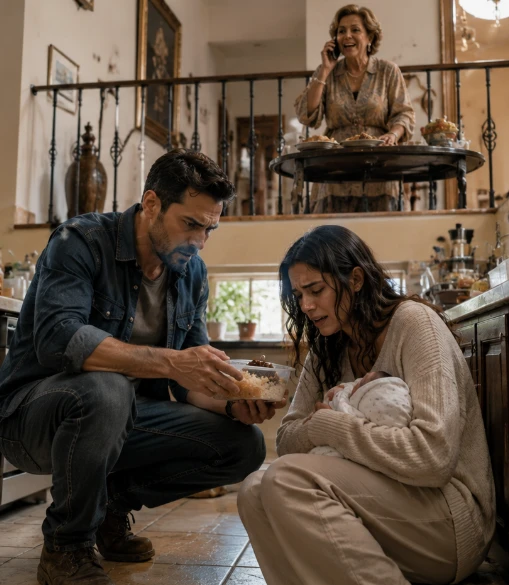
Sofia was crouched in the far corner of the kitchen, curled inward like someone trying to disappear.
Her hair was messy. Her cheeks were hollow. Her oversized cream sweater hung loosely over her thin frame.
In her trembling hands was a plastic bowl.
She was eating from it desperately.
Fast.
Almost like she was afraid someone would take it away.
Tears fell straight into the bowl.
Mateo froze.
“Sofia?”
She jumped so violently the spoon slipped from her hand and clattered across the tile.
When she saw him, her face went white.
“Mateo…” Her voice broke. “Why are you home?”
He stared at her.
Noticed her shaking hands.
Her sunken eyes.
The fear.
“Why are you hiding?”
“I’m not,” she whispered quickly, trying to push the bowl behind her. “I was just eating a little lunch.”
Mateo stepped forward.
“Sofia. Give me the bowl.”
“No.”
That single word hit him harder than he expected.
She wasn’t embarrassed.
She was terrified.
“Sofia,” he said softer, “please.”
Her fingers loosened.
Mateo took the bowl.
And when he looked inside, the world stopped.
It wasn’t lunch.
It was spoiled yellow rice, clumped together and sour-smelling, mixed with dry fish heads, sharp bones, and scraps that looked pulled from garbage.
Mateo couldn’t breathe.
For one impossible second, his mind refused to understand what his eyes were showing him.
This was what his wife was eating?
The woman who had nearly died giving birth to his son?
The woman he had worked himself half to death to protect?
His hands began to shake.
“Sofia…” His voice barely came out. “Who gave you this?”
She lowered her head.
That silence answered before she did.
Mateo looked around the kitchen.
That was when he saw the rest.
A stack of dirty plates near the trash bin — plates smeared with sauce, meat grease, and cake frosting. A half-empty bottle of expensive wine hidden behind a rice sack. A tray upstairs, visible through the open staircase, holding untouched fruit and pastries.
Someone in this house had been eating well.
Just not Sofia.
Mateo’s chest tightened until it felt like something inside him might break.
“I sent money every month,” he whispered. “Fifteen thousand pesos.”
Sofia began crying harder.
“I didn’t want to tell you.”
“Why?”
“She said…” Sofia swallowed painfully. “She said if I complained, you would think I was ungrateful. She said I trapped you with a baby. She said a real wife doesn’t bother her husband while he works.”
Mateo’s face went cold.
“She said that?”
Sofia nodded, trembling.
“She told me the money was hers because she was helping. She said I should eat whatever was left. She said after childbirth, women always exaggerate pain.”
Mateo backed away as if struck.
For weeks, every time he called home, Carmen had told him Sofia was “resting.”
For weeks, Sofia had sounded weaker, quieter, smaller.
And he had believed his mother.
Then a soft sound floated from upstairs.
Laughter.
Carmen’s laughter.
Mateo slowly turned toward the staircase.
His mother’s voice drifted down clearly.
“Yes, yes, he still sends it every month,” Carmen said into the phone. “Poor boy thinks she needs special food. I told you, young women today are dramatic. I use the money properly — I deserve comfort too.”
Mateo stood motionless.
Sofia whispered, “Mateo, please don’t…”
But he was already moving.
The camera of that moment would track behind him in one continuous shot — from the kitchen floor where Sofia sat trembling, past the overturned spoon, past the grocery bags filled with food she should have been eating all along, up the narrow staircase toward the second floor.
Every step sounded like judgment.
At the top, Carmen sat in the guest room beside an open window, wearing a clean floral dress, gold earrings, and slippers Mateo had bought her last Christmas.
On the table beside her sat grilled meat, fresh fruit, sweet bread, and a glass of juice.
She was laughing into her phone.
Then she looked up.
Her smile vanished.
“Mateo?”
He stared at the tray.
Then at her.
Then at the phone in her hand.
“Hang up.”
Carmen blinked. “What are you doing home?”
“Hang. Up.”
Something in his voice made her obey.
She ended the call slowly.
For several seconds, neither spoke.
Then Carmen forced a smile.
“You scared me, hijo. The factory finished early?”
Mateo’s voice was dangerously quiet.
“What has Sofia been eating?”
Carmen’s expression tightened.
“What?”
“What has my wife been eating with the money I send you?”
His mother stood.
“Careful how you speak to me.”
Mateo laughed once, without humor.
That sound frightened even him.
“Careful?” he repeated. “I found Sofia crying in the kitchen with rotten rice and fish bones.”
Carmen’s eyes flickered.
Only for a moment.
Then she lifted her chin.
“She is exaggerating. She has always been dramatic.”
Mateo stepped closer.
“She is starving.”
“She is lazy,” Carmen snapped. “She lies around all day with that baby while you break your back. Someone had to teach her gratitude.”
Mateo felt something inside him go completely still.
“That baby is your grandson.”
“And she uses him to control you.”
Mateo stared at his mother as if seeing her for the first time.
The woman who raised him.
The woman he trusted.
The woman he paid to protect his wife.
And standing there now, she looked less like a mother than a stranger wearing his childhood memories as a mask.
“Where is the money?”
Carmen crossed her arms.
“I spent it on this household.”
Mateo looked at the tray of food beside her.
“This household?”
“I am your mother.”
“She is my wife.”
“I gave you life!”
“And she nearly gave hers bringing my son into this world!”
The words cracked through the room.
Downstairs, Leo began to cry.
Mateo turned toward the sound instantly.
Sofia’s weak voice followed, trying to soothe him.
Carmen scoffed.
“See? Always noise. Always trouble.”
Mateo turned back slowly.
“Pack your things.”
Her face changed.
“What?”
“You are leaving this house today.”
Carmen stared at him, stunned.
“You would throw out your own mother for that woman?”
Mateo’s voice dropped.
“No. I am throwing out the person who abused my wife while I trusted her.”
Carmen’s mouth trembled with rage.
“You will regret this.”
“I already do.”
He walked past her and opened the closet.
Inside, hidden behind clothes, he found shopping bags from boutiques, receipts for jewelry, expensive skincare products, and envelopes of cash.
His breath slowed.
Carmen stepped forward. “That is mine.”
Mateo picked up one receipt.
Paid in cash.
Same date as his last transfer.
Then another.
Then another.
His stomach turned.
“How long?”
She said nothing.
“How long, Mamá?”
Carmen’s face hardened.
“If you had married someone from a decent family, I would not have needed to protect what belongs to us.”
Mateo looked at her.
There it was.
The truth beneath everything.
Not money.
Not concern.
Hatred.
Carmen had never accepted Sofia because Sofia came from a poorer neighborhood. Because her father was a mechanic. Because she had loved Mateo before he had a promotion, before he had stability, before he had anything worth taking.
“You didn’t protect me,” Mateo said. “You poisoned my home.”
Carmen’s eyes filled with furious tears.
“I did everything for you.”
“No,” he said. “You did everything to own me.”
He took out his phone and called his sister, Lucia.
“Come to my house,” he said. “Now. And bring Tía Elena.”
Carmen’s expression changed instantly.
“Why would you call Elena?”
Mateo noticed the fear.
His aunt Elena had always been the one person Carmen avoided.
Forty minutes later, Lucia arrived with Tía Elena, a stern woman in her sixties who had worked as a nurse for most of her life. The moment Elena saw Sofia downstairs, weak and trembling with baby Leo in her arms, her face turned white with rage.
“This woman needs a doctor,” Elena said.
“I’m fine,” Sofia whispered.
“No, mija. You are not.”
Mateo called a private clinic.
Then Lucia went upstairs.
Minutes later, she came down carrying a small notebook she had found in Carmen’s purse.
“Mateo,” she whispered. “You need to see this.”
Inside were handwritten records.
Every transfer Mateo sent.
Every peso Carmen spent.
Food for Carmen.
Jewelry for Carmen.
Cash withdrawals.
And beside Sofia’s name, repeated over and over:
Rice. Leftovers. No extra.
Mateo’s vision blurred.
But then he turned the page and saw something worse.
A note dated two weeks earlier:
If Sofia gets weaker, convince Mateo she has postpartum depression. Suggest clinic away from baby.
Mateo’s blood went cold.
Carmen had not only starved Sofia.
She had been planning to make him believe his wife was mentally unstable.
He looked up at his mother.
Carmen stood at the foot of the stairs, face pale now.
Tía Elena grabbed the notebook from Mateo and read the page.
Then she looked at Carmen and whispered, “You haven’t changed.”
The room went silent.
Mateo turned to his aunt.
“What does that mean?”
Carmen’s voice sharpened. “Elena, don’t.”
But Elena’s eyes burned.
“He deserves to know.”
Mateo’s heart started pounding again.
“Know what?”
Elena looked at him with grief.
“Your mother did the same thing to your father’s first wife.”
The room froze.
Mateo stared at her.
“My father was married before?”
Carmen’s face collapsed.
Lucia whispered, “What?”
Elena nodded slowly.
“Before your mother, your father was married to a woman named Isabel. She became pregnant. Carmen was working in their house then.” Elena’s voice shook with anger. “Isabel became weak after birth. Everyone thought she was sick. But later we learned someone had been withholding food and medicine.”
Mateo felt the floor tilt beneath him.
“What happened to her?”
Elena’s eyes filled.
“She died.”
Carmen screamed, “Lies!”
But nobody moved toward her.
Elena continued, quieter now.
“Your father married Carmen less than a year later. He never knew the full truth. None of us could prove it.”
Mateo looked at his mother.
The woman who had raised him.
The woman who had kissed his scraped knees.
The woman who had now almost done the same thing to Sofia.
His voice came out broken.
“Was there a baby?”
Elena nodded.
“A girl.”
Mateo’s breath stopped.
“What happened to her?”
Elena looked toward Sofia.
Then back at Mateo.
“She disappeared from the family records. Your mother said she had gone to distant relatives.”
Carmen’s face turned gray.
Mateo understood then.
The twist struck him so violently he had to grip the wall.
“Where is she?”
Carmen said nothing.
“Where is my sister?”
Sofia gasped softly.
Lucia covered her mouth.
For the first time, Carmen looked truly afraid.
Then baby Leo cried again from Sofia’s arms.
The sound sliced through the room like a warning from the future.
Mateo stepped toward his mother.
“You are going to tell me everything.”
Carmen backed away.
“There is nothing to tell.”
Mateo lifted the notebook.
“There is enough here for police.”
Her lips trembled.
He lowered his voice.
“You almost destroyed my wife. You almost took my son’s mother from him. And now I find out you may have stolen my sister from us too?”
Carmen’s eyes filled with panic.
Outside, the clinic car arrived.
Its horn sounded once.
Mateo turned to Lucia.
“Take Sofia and Leo to the clinic. Stay with them.”
Sofia reached weakly for his hand.
“Mateo…”
He knelt beside her.
His anger softened instantly.
“I am so sorry,” he whispered. “I should have seen it.”
Tears slid down her face.
“You trusted your mother.”
He shook his head.
“I forgot to listen to my wife.”
He kissed Leo’s forehead.
Then Sofia’s hand.
“I will fix this.”
Lucia helped Sofia outside.
Tía Elena stayed behind.
Carmen stood near the stairs, trapped between silence and exposure.
Mateo turned back to her.
“Now,” he said.
His mother’s shoulders sagged.
And finally, after thirty-two years of lies, Carmen whispered a name:
“Marisol.”
Mateo’s heart stopped.
Because he knew that name.
Everyone in the neighborhood knew Marisol.
She was the quiet woman who sold flowers outside the church every Sunday.
The woman with his father’s eyes.
The woman Carmen had always forbidden him to speak to.
Mateo sank slowly into a chair.
The betrayal had become too large for one life to hold.
That evening, after Sofia was admitted for severe malnutrition and dehydration, Mateo went to the church.
Marisol was there, arranging white lilies beneath the fading Guadalajara sun.
When she looked up, Mateo saw it immediately.
His father’s eyes.
His own mouth.
A family resemblance hidden in plain sight for decades.
“Marisol?” he asked.
She studied him carefully.
Then her hands began to tremble.
“You’re Mateo.”
His eyes filled.
“You know who I am?”
She smiled sadly.
“I always knew.”
“Why didn’t you tell me?”
Marisol looked down.
“Because Carmen said if I came near you, she would destroy the only life I had left.”
Mateo closed his eyes.
He thought of Sofia on the kitchen floor.
Of Leo crying.
Of Isabel dying unseen.
Of Marisol selling flowers outside a church while her brother passed her for years without knowing.
“I’m sorry,” he whispered.
Marisol’s face broke.
“You were a child.”
“So were you.”
For a long moment, neither moved.
Then Mateo stepped forward and held out his hand.
“I don’t know how to be your brother yet.”
Marisol stared at his hand.
Then slowly took it.
“I don’t know how to be your sister either.”
He nodded, tears falling freely now.
“Then we learn.”
Months later, Carmen faced charges for financial abuse, neglect, and falsifying family documents tied to Marisol’s disappearance. The investigation into Isabel’s death reopened.
Sofia recovered slowly.
Not just physically.
Emotionally.
Mateo never again allowed anyone to speak over her.
He cooked for her himself. Learned what foods strengthened postpartum recovery. Took nights with Leo. Sat beside her when she woke from nightmares. And every month, instead of sending money to Carmen, he placed savings into an account under Sofia’s name.
One Sunday, Sofia finally returned to the kitchen.
Not as a frightened woman hiding in a corner.
As the heart of her home.
Mateo stood beside her, chopping vegetables badly while Leo slept nearby and Marisol arranged flowers in a vase on the table.
Sofia watched him burn the tortillas and laughed for the first time in months.
Mateo froze.
That laugh.
He had missed it more than breathing.
“What?” she asked softly.
He smiled through tears.
“Nothing. I just remembered what home is supposed to sound like.”
Outside, Guadalajara glowed beneath the evening sun.
Inside, the house no longer belonged to secrets.
It belonged to truth.
To healing.
To the family Carmen had tried to starve, silence, and separate.
And for the first time since the day he came home early, Mateo understood something that would stay with him forever:
News in the same category
The mother was crying loudly and begging to be buried next to her daughter — but then she leaned in closer, noticed something, and screamed in horror
🎬 PART 2: «The Photo Was Proof of the Worst Night of Her Life»

The Billionaire Who Pretended He Couldn’t Walk

🎬 PART 2: «The Gate Was Locked From Inside»

The Police Dog at the Airport
Respect the Ones Who Served
Behind the Old Door
🎬 PART 2: «The Woman in the Coffin Had Tried to Warn Her»

🎬 PART 2: «The Ribbon in the Boy’s Hand Saved Her Life»
Part 2 : The Child Who Opened the Forbidden Royal Vault
🎬 PART 2: «The Test Was Never About the Room»
Part 2 : The Boy Who Opened What Was Never Meant to Open

The Billionaire Was Dying… Until a Little Boy Entered the ICU

On Their First Wedding Night, She Looked Down… And Froze In Horror

The Girl With the Silver Locket

PART 2: The King Who Saw at Last
Part 2 : I Came Back for the Woman Who Fed Me
🎬 PART 2: “Why Their Mother Sent Them”
News Post
A police officer noticed a coffin in the middle of the sidewalk: he got out of the car, approached the coffin, opened the lid, and froze in horror at what he saw
Life stories 21/05/2026 02:42
The mother was crying loudly and begging to be buried next to her daughter — but then she leaned in closer, noticed something, and screamed in horror
Life stories 21/05/2026 01:30
🎬 PART 2: «The Photo Was Proof of the Worst Night of Her Life»
Life stories 21/05/2026 01:01
The Billionaire Who Pretended He Couldn’t Walk
Life stories 21/05/2026 00:39
🎬 PART 2: «The Gate Was Locked From Inside»
Life stories 20/05/2026 22:51
The Police Dog at the Airport
Life stories 20/05/2026 22:26
Respect the Ones Who Served
Life stories 20/05/2026 21:21

Finding a Snake in Your House? Here's What to Do (And Why You Shouldn't Panic)
Facts 20/05/2026 16:47

Reaching 60 Without These Conditions
Health 20/05/2026 16:28
Behind the Old Door
Life stories 20/05/2026 16:28

Which Truck Is Braking: Your Answer Reveals How 'Difficult' You Are
Facts 20/05/2026 16:24
I Felt Something Crawling on My Back in Bed — But the Truth Was Much Less Terrifying
Facts 20/05/2026 16:16
Can You Find the 4 Hidden Objects
Facts 20/05/2026 16:11

Who Can Escape?
Facts 20/05/2026 16:03
🎬 PART 2: «The Woman in the Coffin Had Tried to Warn Her»
Life stories 20/05/2026 15:57

The First Three Colors You See Reveal What's Really Bothering You Deep Inside
Facts 20/05/2026 15:55
🎬 PART 2: «The Ribbon in the Boy’s Hand Saved Her Life»
Life stories 20/05/2026 15:47
Part 2 : The Child Who Opened the Forbidden Royal Vault
Life stories 20/05/2026 12:58
🎬 PART 2: «The Test Was Never About the Room»
Life stories 20/05/2026 10:21