PART 2: “WHAT DID YOU DO TO MY CAR?!”
Life stories 13/04/2026 00:45
The pancakes at Betty’s Diner weren’t famous for being good. They were famous for being made by Martha.
She had worked this counter for thirty-one years. She knew every regular’s name, their order, their bad habits. She poured coffee with shaking hands because of the arthritis, but she never spilled a drop. Not once.
Until that Tuesday morning.
I was in my usual booth — back to the wall, eyes on the door. Old habit. I’d earned every one of my scars doing exactly the opposite, and I wasn’t interested in adding more. I had my eggs and my coffee, and I had my mother weaving between tables in her orthopedic shoes, and that was enough.
“More coffee, sugar?”
“Thanks, Ma.” I let the hard lines of my face go soft. It was the only time they ever did. “Sit down for a minute. The morning rush can wait.”
“It can’t,” she said, tapping my shoulder, pouring without spilling. “And neither can you. Your eggs are getting cold.”
She bustled away. I watched her go. She was smaller than she used to be. When did she get so small?
The door chimed.
The atmosphere shifted — a ripple, like a stone dropped in still water.
The man who walked in took up space without being large. It was the walk. The particular, arrogant stride of someone who had learned the world would clear a path if he wore the right metal on his collar. His navy uniform was parade-ground crisp. Commander’s bars. Brand new. He smelled like expensive cologne and fresh promotion.
He didn’t wait to be seated. He marched to the booth directly in front of mine and dropped a leather portfolio on the table with a deliberate thud.
He didn’t look at the menu. He just started tapping his fingers.
“Excuse me!”
The diner noise cut in half. Ma looked up from the register. She grabbed the coffee pot and a menu and hurried over.
“Good morning, Officer, can I start you off with—”
“Commander.” He didn’t look up from his phone. “It’s Commander. Coffee. Black. I have a press conference.”
“Of course, Commander.” Ma smiled through it. She reached over to flip his mug.
I watched his body language. I watched the dismissal in every inch of him — the way he held himself as if her presence were a minor inconvenience. I breathed. Stay back. Don’t make a scene where she works.
Ma lifted the pot.
Her hand trembled — just a fraction — and the coffee tipped.
A splash. Three tablespoons. A small, dark stain on his sleeve.
The reaction was not proportional to the accident. It was never meant to be.
“YOU STUPID HAG!”
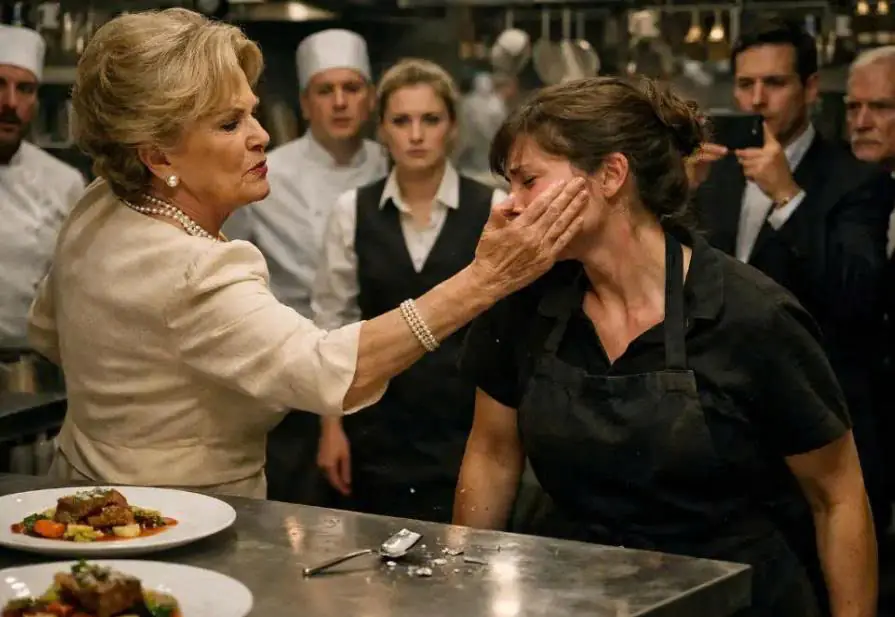
He was on his feet before the first word finished. His arm swung back and came forward fast, knuckles catching the side of Ma’s face with a sound that snapped through the diner like a whip cracking.
Ma didn’t scream. She gasped — small and fragile — and stumbled backward. The pot left her hands. Glass and coffee exploded across the linoleum. She grabbed the back of a booth and held on, one hand rising to her cheek, eyes wide and confused.
The diner went dead quiet.
Nobody moved. Forks stopped midway to mouths. The cook’s face appeared in the kitchen window.
“Look at this!” the Commander screamed, thrusting the sleeve in the air, advancing on her. “Do you have any idea who I am? I’ll have this place shut down! I’ll have you arrested for assaulting an officer!”
Ma was shaking. “I’m so sorry, sir… it was my hand, it’s the arthritis… I’m so sorry…”
“I don’t care about your hand!”
I put my fork down.
Clink.
I wiped my mouth with a napkin.
Everything got cold and very clear.
I stood up.
I’m six-four. I weigh two-sixty. The leather cut I wear has a patch that makes certain types of men very quiet, very quickly. The Commander was still yelling, feeding off his own rage, his back to me. He didn’t notice the shadow that fell over his table.
He didn’t notice until I said one word.
“Hey.”
He spun around. He looked at my chest first. Then he tilted his head back to find my face. Then his eyes dropped to the patches. The wings. The name. The bottom rocker.
Then the small square on my left breast.
PRESIDENT.
He opened his mouth. The words curdled.
“You got a little something on your uniform,” I said quietly.
“I…” He tried to puff his chest back out. “Listen. Citizen. She assaulted me. Back off, biker.”
“You slapped her,” I said.
The diner was watching. Twenty witnesses with phones already in their hands. The cook had come out holding his spatula like he was planning to use it.
“She spilled boiling liquid on a law enforcement officer,” Hayes said, getting his legs under him. “That’s assault. Back off before I have you in cuffs.”
“She’s sixty-eight years old with arthritis,” I said. “And you put your knuckles on her face.”
“STONE.”
A voice from the back booth. Tank, two hundred and sixty pounds of my most reliable and terrifying brother, unfolded himself from his seat like a building collapsing in reverse. He stood and crossed his arms and said nothing else. He didn’t have to.
Hayes took one step backward.
“You’re obstructing a law enforcement action,” Hayes said, voice climbing. He grabbed his radio.
“Call whoever you want,” I said. “Everyone in this room has already called someone.”
He looked around. Every single customer had a phone raised.
Hayes’s radio squawked. “Commander Hayes, we have reports of a 415 at Betty’s Diner—”
“I need a unit at this location,” Hayes barked into the mic. “Officer needs assistance. Hostile civilians.”
“Hostile,” Tank said from the back, with genuine amusement. “We’re eating breakfast.”
The blue lights arrived faster than I expected. Three units. Six officers. They came in hard, hands on weapons, and the diner turned to chaos — customers screaming, diving under tables, Ma pressing herself against Viper’s chest while he held an ice pack to her cheek and stared down a shotgun barrel with the expression of a man waiting for a bus.
I raised my hands to shoulder height and didn’t kneel.
Hayes was screaming. “Arrest them! All of them! Animals!”
Then the room changed.
A new voice. Not a rookie voice.
“STOW IT!”
Sergeant Frank Kowalski walked in the way a man walks when he’s spent thirty years cleaning up other people’s messes. He was gray-haired and granite-faced and tired all the way down to his bones. He pushed a gun barrel toward the floor and walked into the no-man’s-land between my club and his commander.
“Stone,” he said, nodding.
“Sergeant,” I replied.
The rookie near me looked between us, confused. “Sarge, you know this—”
“Lower your weapons,” Kowalski said. Not a suggestion.
Reluctantly, the guns came down.
Kowalski walked over to Ma. He squatted down to her level. He tilted her chin gently and looked at the bruise. The knuckle marks were already darkening against her pale skin.
“Did you fall, Martha?” he asked.
Ma looked at Hayes. Then at me.
“She didn’t fall,” I said.
Kowalski stood up. The tiredness was gone. He turned to Hayes with something cold behind his eyes.
“Commander. Did you strike this woman?”
“I reacted! It was a reflex! She assaulted me, and you will arrest him — that’s a direct order!”
But the room had shifted. The rookies were looking at Ma. Looking at the bruise. Looking at the spot on Hayes’s sleeve — barely visible on navy fabric — and looking at their Commander screaming about it.
I heard the safety on a shotgun click closed. Another officer holstered.
“Commander,” Kowalski said, very quietly, “I’m going to ask you to step outside.”
Hayes lost it.
He lunged, grabbing my cut, trying to drag me off balance. It was like trying to pull down a wall.
“Get your hands off my colors,” I said.
“I’ll put them wherever I want! You’re under arrest!”
Kowalski: “Stone — let us handle this.”
“He’s touching my patch, Frank.” I kept my voice level. “He put his hands on my mother. And now he’s putting them on leather he didn’t earn.”
Hayes swung a pair of cuffs out with his free hand. I caught his wrist. Not hard enough to break it. Hard enough that the cuffs hit the floor.
“LET GO! ASSAULT ON AN OFFICER!”
“Let him go, Stone,” Kowalski said, moving closer. “Don’t make me do something neither of us wants.”
“You might have to,” I said. “But tell me how you explain to the papers why you shot a man for defending his mother from a uniform that thinks the badge is a crown.”
I leaned down to Hayes’s ear.
“You want to take me in?” I said. “Fine. My lawyer eats guys like you before his morning coffee. But while I’m in that cell… one phone call gets made. And I have brothers in every state. I have brothers in the sanitation department and the shipping yards and riding right now.”
I let go.
Hayes stumbled. He was sweating through his crisp collar.
“You made a mistake today,” I said, loud enough for everyone. “You thought the badge was a free pass. But in this neighborhood, that badge is just tin if the respect isn’t there.”
I turned to Tank. “Get the car. We’re taking Ma to get that injury documented.”
“You are not leaving the scene of a crime!”
“I’m taking a victim to get medical attention.” I looked at every officer in the room. “Anyone here going to physically stop an elderly woman from seeing a doctor?”
Silence.
The rookie looked at his shoes. The shotgun cop stepped aside.
“Go ahead,” Kowalski said quietly. “Get her looked at.”
“MUTINY!” Hayes screamed. “I’ll have every badge in this room!”
I had Ma’s arm around my shoulder. She was still shaking, but she looked up at me and gave me the weakest, bravest smile.
“I’m okay, David.”
“I know,” I lied. “We’re going.”
We were three steps from the door when the rack of a pump-action shotgun froze the room.
KA-CLACK.
Hayes had taken the gun from the officer beside him. The barrel was shaking — pointed at my back.
“ONE MORE STEP,” Hayes panted, his eyes wild, “AND I WILL END THIS.”
I pushed Ma through the door. “Go to the car. Don’t look back.”
“David—”
“GO.”
I turned to face him. I spread my arms wide.
“You want to shoot me?” I asked. “Here I am.”
His finger was on the trigger. I could see it whitening. He was going to fire from sheer ego.
“DROP IT!” Kowalski roared, drawing his own weapon — pointing it at his own Commander.
Then the front window came in.
CRASH.
A brick. Wrapped in silver tape, with a note.
And behind it — the sound.
Low and rising. Deeper than thunder. A wall of V-twin engines tearing through the morning quiet. Not one. Not ten.
Hundreds.
The whole street disappeared under chrome and leather.
Kowalski looked out the shattered window and closed his eyes. “It’s the consequence of stupidity.”
Through the opening, the sunlight was blocked by bikes parked three deep in every direction. Hayes stared out at them and tried to understand what he was looking at.
“They can’t threaten law enforcement,” Hayes stammered. “Call SWAT. Call—”
“Your radio’s been dead for two minutes,” Kowalski said flatly. “Too much traffic. And SWAT is twenty minutes out. They are twenty feet away.”
Kowalski picked up the brick note. He read it. He turned it around for Hayes to see.
Five words, black Sharpie.
LET HIM WALK OR BURN.
Hayes swung the barrel at me, then at Kowalski, then at the window. He was coming apart.
Then Leo the cook put his head through the kitchen window.
“The gas line,” Leo said, his voice shaking. “When the table got hit — the fitting behind the wall cracked. I can smell it. If that gun fires—”
He didn’t finish the sentence. He didn’t need to.
We could all smell it now. The chemical rotten-egg odor creeping up through the floorboards.
Kowalski: “PUT IT DOWN! You’ll blow us all—”
Hayes’s shoulders sagged.
The barrel dropped, inch by inch, until it pointed at the floor.
“Secure it,” Kowalski barked.
Officer Miller crossed the room in two strides and stripped the gun from Hayes’s hands. He racked the live round out — it bounced on the linoleum — and engaged the safety.
Two other officers grabbed Hayes by the arms.
“Get off me! I’m your superior!”
“You’re relieved pending IA and a psych evaluation,” Kowalski recited. “Miller — cuff him.”
“With pleasure, Sarge,” Miller said.
The cuffs ratcheted closed.
Hayes was still screaming as they dragged him toward the door. “You’ll regret this! I’ll sue the city! Stone! This isn’t over!”
I walked over. I leaned in close.
“You’re right,” I said quietly. “It’s not over. Because I’m going to sue you. Sue the department. And I’m going to take every pension dollar and put my mother in a house on an island where she never has to pour coffee for another piece of garbage like you again.”
He spat on my vest.
I wiped it off with my thumb. “Get him out.”
They dragged him through the door. The wall of bikers outside broke into a slow, rhythmic clap.
Clap… Clap… Clap…
It was humiliating. It was perfect.
Kowalski holstered his weapon and wiped his forehead. “Gas leak. Really?”
I looked at Leo, who was standing in the kitchen doorway, trembling, giving me a tiny horrified thumbs-up.
There was no gas leak. The kid had improvised under fire to save our lives. I made a mental note to pay his tuition.
“We done here, Frank?” I asked.
“We’re done,” Kowalski said. “Get your people out before SWAT shows up.”
“Done.”
I pushed out the door into the sunlight. Tank was already coming forward, grinning wide enough to split the sun.
“Did you see his face? We got it all on video, Boss. That pig is finished—”
“Where’s Ma?” I asked.
Tank’s grin stopped.
“Viper took her to the truck. She needed air. He’s right—”
But Viper was already waving from across the lot. Frantically.
“BOSS!”
I ran.
Ma was in the passenger seat. Her head was lolled against the rest. Her skin was the color of ash. Her mouth was open but the sound coming out was wrong — a wet, struggling rasp. Her hand clutched her left arm.
“Ma.” I grabbed her hand. Ice cold.
“D-David,” she whispered. “My chest… it’s so heavy…”
“Viper. What happened?”
“She said her arm hurt, then she went down. Boss — I think it’s her heart. The stress—”
“CALL 911! NOW!”
“I did!” Tank ran up behind me. “But Boss — look.”
Three blocks away, sirens. Lights. An ambulance, visible and immovable.
Stopped behind three hundred motorcycles.
My blockade. My family reunion. My fortress that had kept the cops out and was now keeping the help out.
“MOVE THE BIKES!” I roared. “MOVE THEM!”
A logjam, handlebar to handlebar. Twenty minutes to clear.
Ma didn’t have twenty minutes.
“David…” she whispered. “Don’t let me go.”
“You’re not going anywhere.” I was already moving. “Viper — on the back. Hold her.”
“Boss?”
“We’re not waiting.” I lifted her. She weighed nothing. I placed her on my Road King seat, Viper behind her, locking her between us with his arms.
The engine woke up with a roar.
“MAKE A HOLE!” Tank bellowed, turning to the crowd. “PRESIDENT COMING THROUGH! MOVE YOUR ASSES!”
The sea parted. Men threw bikes onto sidewalks and into ditches and over each other just to open one lane of asphalt.
I dropped the clutch.
The rear tire screamed.
We launched.
I wasn’t riding as a club president. I wasn’t riding as an outlaw. I was a son, and I was racing something older and faster than me down the center of Main Street.
I saw the ambulance ahead. A quarter mile.
I saw the black sedan in my peripheral at the same moment the passenger window rolled down.
The gun barrel emerged.
Not Hayes. Hayes was in cuffs.
These were professionals. And I knew exactly who had sent them.
“INCOMING!” Viper screamed.
BANG.
The wind of the bullet passed my ear. I yanked right.
POP-POP-POP — Three more shots, sparking off chrome and tearing through leather.
Both hands on the bars, a dying woman on my back, no weapon in reach. We were flying targets.
Then, behind the sedan, a single headlight. Then two. Then a dozen.
Tank.
He was riding like a man who’d decided physics was optional. Bent low, beard horizontal, eyes locked on the car like a missile acquiring its target. Grease, Jojo, and Crowbar in tight formation behind him.
The shooter saw them and swung his gun backward.
Tank didn’t swerve. He reached into his vest and came out with a ball-peen hammer.
He pulled alongside the driver’s door. The car swerved to crush him against the median. Tank anticipated it, locked his brakes, then gunned forward to the window.
SMASH.
The glass disintegrated. Jojo and Grease simultaneously drove their boots into the passenger door. The sedan — blind, sandwiched, panicking — overcorrected, clipped a minivan, spun full circle, and folded itself around a concrete overpass pylon.
CRUNCH. Steam. Silence.
I didn’t stop. I tore the last two blocks to the ambulance and skidded to a stop at the back doors in a cloud of burning rubber.
“HELP! I NEED HELP HERE!”
Viper was already off the bike, Ma in his arms, running.
“She’s not breathing!”
The paramedics — two young women who looked barely old enough to drive — snapped into something hard and precise. The fear vanished. The training took over.
“Get her on the gurney! Now!”
They laid her down. Buttons popped. Hands on her chest.
“No pulse. Starting compressions.”
I stood straddling my bike, hands still shaking around the handlebars. I watched my mother’s body jerk with every compression.
“Clear!”
THUMP.
Her back arched.
I flinched.
“Still no rhythm. Go again. Push epi. Load her up — hospital six minutes out!”
The gurney slammed into the ambulance. The doors closed. The siren wailed.
I stared at the closed doors.
Viper’s bloody hand landed on my shoulder. “Go. Follow them. I’ll handle the scene.”
“Is she—”
“She raised you, didn’t she?” He gave my shoulder one squeeze. “She ain’t quitting.”
The doctor at St. Mary’s was young and honest. He used words like “critical” and “next twenty-four hours” and “extremely weak.” I nodded at all of them and asked to see her.
She was tiny under the machines. Ventilator taped in. Skin nearly transparent. The bruise Hayes had left her looked darker now, ugly purple against the pallor.
I pulled a chair close and took her hand.
“Hey, Ma.”
Beep. Beep. Beep.
“I’m right here. Don’t you leave. Not because of some scumbag cop and a cup of coffee. You’re tougher than that.”
I sat there a long time, her still hand against my forehead, thinking about every choice that had led us to this room. All my power, all my brothers, all the money I’d ever moved — none of it could buy her one extra heartbeat.
“Stone.”
Kowalski. In the doorway, hat in his hand.
“Go away, Frank.”
“Hayes is in custody,” he said quietly, walking in anyway. “Tank’s video went viral. Five million views. Governor issued a statement. Hayes is done. Felony assault. He’s never touching a badge again.”
“Good.” I didn’t look up. “That why you’re here?”
“No.” Kowalski pulled out a notepad. “I’m here about the sedan. Your boys did a number on it. Two occupants — critical, but they’ll live. They’re not local. Flew in from Chicago yesterday. Hired guns.”
“Who hired them?”
“Burner phone. We traced the payment. Shell company registered to Bradford and Calloway.”
I went still.
“That’s the Mayor’s personal law firm,” I said.
“Yeah.” Kowalski watched my face. “Hayes is the Mayor’s nephew. Got promoted last week. Sterling was grooming him for Chief. You and your mother went viral and destroyed that on a Tuesday morning. The way the timeline works — the call to escalate went out the second Hayes radioed for backup. If you and Martha died in a gang firefight, Hayes becomes a hero under siege. The slap disappears. Sterling gets reelected on law and order.”
They tried to kill my mother to save a politician’s image.
Something settled in me. Heavy and absolute.
“Leave, Frank.”
“David. Let the system—”
“The system put my mother in that bed.” I went to the window. In the lot below, Tank and Viper and forty more were standing by their bikes in the dark, looking up. Waiting. “The system gave a badge to Hayes. The system tried to kill us on the highway.”
Kowalski put his hat on. He knew he couldn’t stop me. He knew what a war in this hospital would look like.
“Keep it away from civilians,” he said. A plea, not an order.
I kissed Ma’s forehead.
“Sleep well,” I whispered. “I have to go to work.”
Oakhaven wasn’t designed for Hells Angels. It was Teslas and trimmed hedges and security guards in blazers.
When fifty Harleys rolled up to the front gate, the guard locked himself in his booth. Tank rode through the barrier arm without slowing. It snapped like a toothpick.
We rode in formation. Two by two. No hurry. House lights flickered on as we passed. Curtains moved.
Sterling’s compound sat at the top of the hill, naturally. White pillars, a circular drive, Ferraris being valeted, a string quartet playing Mozart to a crowd in black tie. A reelection fundraiser.
The music stopped when we parked.
I walked in alone. My brothers stayed with their bikes.
Three private security men stepped out to block me. Big. Ex-military.
“Private property,” the lead one said.
I walked until my chest touched his. “I’m on the guest list.”
“Name?”
“The guy who didn’t die on the highway tonight.”
His hand moved toward his jacket. I spoke before it arrived.
“You have three guys. I have fifty. Mine aren’t getting paid by the hour. Do the math.”
He took his hand away. Stepped aside.
I walked through the parting crowd of donors. They moved away from me like I was a bad smell, clutching their champagne, watching me track motor oil and blood across the marble steps.
The door opened before I knocked.
Mayor Richard Sterling. Silver hair. Perfect tan. Capped teeth. Scotch in hand. He looked annoyed, not afraid.
“Mr. Stone,” he said. “You’re ruining my party.”
“You ruined my day.”
“I saw the news,” Sterling said smoothly. “Unfortunate business. Hayes has always been hot-headed. That’s a police matter. Why are you on my lawn?”
“We traced the money,” I said. “Bradford and Calloway. The offshore account. The men in the sedan who tried to put us through a guardrail an hour ago.”
Sterling smiled. A cold, reptilian smile.
“Allegations,” he said. “Wild theories from a criminal. Who does the jury believe — the Mayor, or a biker with a rap sheet?”
He stepped closer, dropping his voice.
“You’re out of your depth, Stone. You have motorcycles. I have the police, the courts, the roads you ride on. I am the power in this city.”
“You tried to kill my mother,” I said.
“Collateral damage,” he shrugged. “Hayes made a mess. I had to manage it. If you both died in a gang war, he becomes a hero. I get reelected. Clean. Nothing personal.”
Nothing personal.
He said my mother’s life like it was a line item.
“You’re going to confess,” I said. “Right now. To everyone here.”
Sterling laughed. Genuine, relaxed.
“Or what? You’ll hit me?” He snapped his fingers.
Red dots appeared on my chest. One. Two. Three.
Snipers on the roof.
“I knew you were coming,” Sterling said pleasantly. “Predictable. Emotional. I have a tactical team authorized to use lethal force on a home invader. All I do is nod.” Another sip of scotch. “Now. Get on your knees. Beg. Maybe I let you ride away. But your mother — accidents happen in hospitals.”
The mention of Ma broke something in me. Not into rage. Into clarity.
I reached into my pocket.
“DROP IT!” the roof screamed.
I pulled out a phone.
“I learned something today,” I said. “The most dangerous weapon isn’t a gun.”
I tapped the screen.
“It’s a microphone.”
Sterling frowned. “What?”
“The news van outside the gate — Channel 5. I called them on the way. I told them I was coming to surrender publicly. Long lenses. Parabolic microphone. They’ve been recording this whole conversation.”
Sterling’s head snapped toward the gate.
“And,” I said, “I’ve been on a call this entire time. On speaker. Broadcasting through the PA on Tank’s bike. Every person on this lawn heard what you just said.”
I turned and shouted across the manicured grass.
“DID YOU ALL HEAR THAT?”
Tank gave a thumbs up from fifty yards away. He flipped a switch on his handlebars.
Sterling’s own voice came back at us through speakers — clean, unmistakable.
“Hayes made a mess. I had to manage it. If you both died in a gang war… Nothing personal.”
A champagne glass shattered somewhere in the dark.
Sterling stood frozen. His scotch glass slipped and bounced off the welcome mat.
“That’s illegal wiretapping,” he stammered. “Inadmissible—”
“I don’t care about court,” I said. “I care about every donor on this lawn knowing who they’ve been funding.”
I looked up at the roof. The red dots on my chest were wavering.
“He just admitted to conspiracy to commit murder,” I said to the shadows. “You pull those triggers now, you’re accomplices. On camera. Stand down.”
One by one, the dots disappeared.
“SHOOT HIM!” Sterling screamed at the roofline. “I PAY YOU—”
Silence.
The donors were fleeing. The string quartet had abandoned their chairs. Sterling’s carefully constructed evening was collapsing around him.
He was alone.
“You said you own the asphalt,” I said softly. “You forgot who rides on it.”
Sirens in the distance. Different sirens. Not Hayes’s people. State Police. FBI. The ones Kowalski had called from the hospital parking lot.
“It’s over, Mayor.”
Sterling’s face curdled with pure hatred. His hand went into his jacket.
He came out with a .22 caliber. A gentleman’s gun, silver and small.
“I’ll do it myself!” He raised it to my face.
BANG.
I didn’t fall.
Sterling screamed, grabbing his shoulder, spinning and dropping the pistol. Viper lowered his smoking weapon from fifty yards away. A clean disarming shot through the rotator cuff.
Sterling buckled to his knees on the marble steps, clutching the wound, screaming.
I stood over him. I didn’t touch him. I didn’t need to.
“Self-defense,” I said.
I turned my back on him and walked down the steps.
The private security guards stepped aside. I saw something new in their faces.
Respect.
I walked to my bike. Tank handed me a cigarette. My hands were finally shaking — the adrenaline finding the exit.
“Did we get him?” Tank asked.
State Troopers were swarming the porch, cuffing the screaming Mayor in the blue and red light.
“Yeah,” I said. “We got him.”
I took out my phone. Dialed the hospital.
“ICU.”
“This is David Stone. My mother — Martha — is she—”
A long pause.
“Mr. Stone. You need to come now.”
I don’t remember the ride back. I don’t remember the gears or the lights. I remember leaving the Road King on the sidewalk in front of the ER and not caring about it. I remember the security guards taking one look at me and stepping back.
The doctor was outside Room 4.
“Her rhythm destabilized twenty minutes ago,” he said.
The floor tilted under me.
“We were preparing to defibrillate again.” A pause. A small, exhausted smile. “But we didn’t have to. She stabilized on her own. And Mr. Stone — she woke up.”
The air came back.
My knees hit the linoleum right there in the hallway. I didn’t care.
“She’s awake?”
“Extremely weak. She shouldn’t be speaking, but she’s quite insistent about seeing you. Stubborn woman.”
“You have no idea,” I said. And laughed through the tears cutting through the road dust on my face.
I got up. Straightened my cut. Pushed the door.
The room was dim. Beep. Beep. Beep. The most beautiful sound in the world.
The ventilator was gone. Just a nasal cannula now. Her eyes were open, tracking the ceiling slowly. She turned her head when I came in.
“David.”
Her voice was sandpaper. It was the best sound I’d ever heard.
“Right here, Ma.” I took her hand. It was warm. Her fingers closed around mine — weak, but present.
She looked at my vest. At the fresh stain on the shoulder. She didn’t ask what it was. She had lived in this town her whole life.
“Did you finish it?”
“Yeah, Ma.” I sat down beside her. “I finished it.”
“The policeman?”
“Gone. He’ll never touch anyone again.” I squeezed her hand. “And the man who sent him — he’s gone too.”
A tear tracked down the side of her face.
“I was scared for you,” she whispered. “Not for me. For you. I thought I’d die while you were in a cage.”
“I’m not going back,” I said. “We did it right this time. The whole world saw.”
She opened her eyes. Gave me that weak, lopsided smile, the bruise on her cheek shifting.
“I don’t want to be a hero,” she said. “I just want to serve my pancakes.”
“You will,” I promised. “But things are going to be different.”
The nurse appeared in the doorway. “Mr. Stone. Her heart—”
I leaned down and kissed her forehead.
“Sleep now. I’ll be right outside. I’m not leaving.”
“Okay, baby,” she whispered. “Okay.”
I sat in the plastic chair in the hallway. My brothers were in the parking lot below. Sterling was in custody. Hayes would never wear a badge again. The video was everywhere.
And for the first time in twenty years, I fell asleep without a weapon in my hand.
THREE MONTHS LATER
The bells above the door chimed.
“Welcome to The Iron Spoon! Sit anywhere you like!”
The diner smelled different now. Still bacon and coffee — some things are sacred — but the stale grease and despair were gone. The walls were cream. The linoleum was polished hardwood. The fluorescent tubes had been replaced with warm pendant lights.
The clientele had changed too.
Two lawyers in expensive suits ate salads in the corner booth. Construction workers at the counter wolfed down burgers. And scattered throughout, large men in leather vests ate eggs, read newspapers, and talked with the locals. No tension. No fear. The Angels weren’t occupying the diner anymore. We were the furniture. We were the security.
I stood behind the counter polishing the espresso machine.
“Order up, Boss,” Leo called from the window.
“Coming.”
Three stacks of pancakes to Table 4. Three elderly women looked up at my tattoos, at the PRESIDENT patch, and smiled.
“Thank you, David,” Mrs. Gable said. “Is your mother in today?”
“She’s in the back counting the till,” I said. “She’s supposed to be retired, but she likes to keep an eye on the money.”
“Good for her.” Mrs. Gable beamed. “Any news on the trial?”
I nodded to Jojo by the remote. He unmuted the television.
Former Mayor Richard Sterling was sentenced today to twenty-five years in federal prison for conspiracy to commit murder, racketeering, and corruption. Former Police Commander Arthur Hayes pled guilty to felony assault and obstruction, accepting fifteen years.
Sterling was on screen in orange, trying to hide from the cameras. Nowhere to hide. Hayes was weeping.
The diner applauded. Not raucous. Steady. Satisfied.
In the footage, Kowalski was leading Sterling to the transport van. He paused at the camera for one brief second. Gave a tiny nod.
“Justice,” Mrs. Gable said, stabbing a pancake.
“Yes ma’am,” I said.
The kitchen door opened.
Ma walked out.
She looked ten years younger. New dress — a nice floral print. Hair done up. She moved with a cane now, her heart still fragile, but her spirit was iron. She looked at the TV. Saw Hayes in cuffs. Let out a soft hmph.
“About time.”
She moved toward the counter. I started to help. She waved me off.
“I can walk, David.”
She got behind the counter. She picked up the coffee pot. Her hand was completely steady.
“Ma. You don’t have to—”
“Hush,” she said. “I like pouring the coffee.”
She walked to Tank’s booth. Tank — who had smashed a car with a hammer and stared down a shotgun without blinking — looked up like a scolded schoolboy.
“More coffee, Tank?”
“Yes, please, ma’am,” Tank said politely.
She poured the cup. Her hand didn’t tremble once.
The door chimed.
A young officer walked in. Rookie. Shiny badge. He stopped at the threshold, saw the leather vests, saw the tattoos, and looked very much like he wanted to turn around.
The diner went quiet.
I set down my rag. Walked around the counter.
The rookie’s hand moved to his belt.
“Can I help you, Officer?” I asked.
“I just… I wanted a coffee,” he said. “To go. Unless that’s… a problem.”
I looked at him. At his badge — untarnished, unscratched.
I looked back at Ma.
She was watching me. Waiting to see who I was going to be.
I looked at the rookie.
“It’s not a problem,” I said.
I extended my hand.
“Welcome to The Iron Spoon.”
He hesitated. Then shook it.
“Take a seat,” I said. “First cup is on the house.”
I walked back behind the counter. I took the coffee pot from Ma’s hands.
“I got this one,” I said softly.
“You’re a good boy, David,” she whispered, leaning her head against my arm.
“I’m trying, Ma.”
I walked over to the rookie’s table. I turned the mug over. I poured.
“Careful,” I said, a small smile on my lips. “It’s hot. Don’t spill it on your uniform.”
He laughed nervously. “I’ll be careful.”
I walked back to my spot at the end of the counter. I looked out at the room.
Ma was laughing with Mrs. Gable. My brothers were safe. The bad guys were in prison. The rookie was wrapping both hands around his mug.
And outside the window, in the parking lot where the diner’s new sign caught the morning light, two words in clean iron letters.
The Iron Spoon.
Some things are worth protecting.