At school pickup, my parents drove off with my sister’s kids right in front of my daughter
Life stories 31/03/2026 23:26
My husband left me, married his mistress while I was nine months pregnant, and said, “I can’t be with a woman with a big belly like you.” He had no idea my father owned a company worth $40 million. Years later, he applied for a position at our company… and a big surprise was waiting for him.
I was nine months pregnant when the divorce papers arrived. Not during a dramatic scene. Not after a huge argument. They were delivered by courier. The doorbell rang on a gray Thursday morning as I slowly made my way down the hallway, one hand against the wall to steady myself, my center of gravity completely off.
When I opened the door, a young delivery man gave me a polite smile and handed me a clipboard. “I need your signature.” His tone was casual, as if he were delivering an ordinary package. I signed, closed the door, and opened the envelope.
Inside were divorce papers.
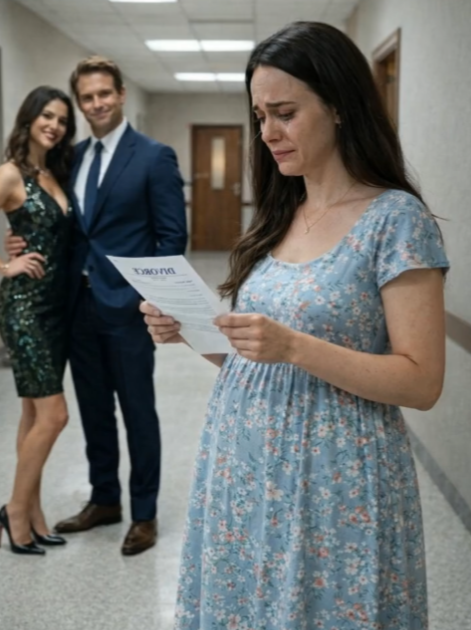
My husband, Grant Ellis, had already filed three days earlier. At the top of the first page was a short handwritten note in his familiar script: “I’m not coming back. Don’t make things complicated.”
I stood frozen in the entryway for a long time. The baby shifted heavily inside me, pressing against my ribs. Nine months pregnant—and my husband chose this exact moment to erase me from his life.
My phone buzzed before I finished reading. A message from Grant: “Meet me at Westbridge Courthouse at 2 PM. We’re finalizing this.” No reason. No explanation. Just instructions, as if I were a task on his schedule.
The courthouse smelled like old carpet and cleaning chemicals. Grant was already there when I arrived. He looked… polished. Perfect navy suit. Hair styled flawlessly. The quiet confidence of someone who thinks he’s already won.
Standing beside him was a woman in a cream dress and heels, her manicured hand resting on his arm like it belonged there.
Tessa Monroe.
I recognized her immediately. She worked with Grant—the same colleague he told me not to worry about. The same woman I once skipped a holiday party for because I was “too tired.”
Grant looked at my belly with disgust. No guilt. No hesitation.
“I can’t stay with a woman with a big belly like you,” he said coldly.
His words echoed louder than expected. People nearby turned to look.
“It’s depressing,” he added. “I need my life back.”
The baby kicked suddenly, as if reacting to the cruelty in his voice. Tessa let out a soft laugh. “Grant really tried,” she said lightly. “But men have needs.”
My throat tightened. “You’re divorcing me while I’m about to give birth,” I whispered.
Grant shrugged. “You’ll manage. My lawyer will handle child support. I’m not your caretaker.”
Then he slid another document across the bench.
An engagement receipt.
“You’re marrying her?” I asked.
He gave a satisfied smile. “Next week.”
The baby moved again, heavy and slow. “Do you realize how this looks?” I asked.
Tessa leaned closer, her voice dropping to a whisper only I could hear. “You were a mistake,” she said coldly. “You never brought anything.”
If she had shouted, maybe I could have responded. But the calm certainty in her voice hurt even more.
Because she meant it.
He thought I had nothing. He thought I was nothing.
What Grant didn’t know was that my quiet father—the man who hated attention and lived in a modest house near Dayton—owned an industrial company worth over forty million dollars.
He also didn’t know that when my parents passed away two years earlier, I inherited part of it.
I never told him. Not once.
And standing in that courthouse, watching him walk away with Tessa on his arm, I made a promise to myself.
I wouldn’t beg.
I wouldn’t chase him.
I would rebuild my life in silence.
And if one day Grant Ellis crossed my path again… he would finally realize exactly what he had lost.
I didn’t see Grant Ellis again for a long time.
Not after the courthouse. Not after the birth. Not even in the quiet, sleepless nights when my son cried and the world felt unbearably heavy.
Life didn’t pause for heartbreak. It moved forward—slowly at first, painfully—but it moved.
My son, Oliver, was born two weeks after the divorce was finalized.
Labor was long and exhausting, but when I finally held him in my arms, everything shifted. His tiny fingers curled around mine like he was anchoring me back to life.
In that moment, I realized something simple and powerful:
I hadn’t lost everything.
I still had him.
And that was enough to start again.
The first year was the hardest.
Not because of money—I never struggled financially—but because of everything else. Loneliness. Exhaustion. The quiet ache of betrayal that would surface at the most unexpected times.
I moved out of the house Grant and I once shared and into a smaller, peaceful home closer to my father’s old property near Dayton.
That house held memories, but they were different. Softer. Safer.
I hired help when I needed it, but I insisted on raising Oliver myself. I wanted to be present—for every milestone, every laugh, every tear.
At the same time, I slowly stepped into the role I had once avoided.
The company.
My father had built it from nothing.
A manufacturing and logistics business that quietly expanded over decades, earning contracts, trust, and respect without ever chasing attention.
After his passing, the board had managed operations, but they were waiting.
Waiting for me.
At first, they didn’t expect much.
I was “the daughter.” The quiet heir who had never shown interest. The woman who had been… underestimated.
But I learned.
Relentlessly.
I studied financial reports late at night while Oliver slept on my chest. I attended meetings with a calm focus that surprised even me. I asked questions—sharp ones—and listened carefully to every answer.
Within a year, things began to change.
Within two, I was leading.
Within three, no one questioned it anymore.
By the time Oliver turned five, the company had grown significantly.
We expanded into new markets, modernized operations, and secured partnerships that positioned us far ahead of competitors.
People in the industry started to recognize my name.
But I still lived quietly.
No flashy lifestyle. No headlines. No unnecessary attention.
Because I hadn’t forgotten what it felt like to be dismissed… to be seen as nothing.
And I never wanted to become someone who made others feel that way.
It was a Tuesday morning when everything came full circle.
I was reviewing candidate profiles for a senior operations role. It was an important position—someone who would oversee a new division we were launching.
My assistant had narrowed it down to a shortlist.
“Strong candidates,” she said. “One in particular has an interesting background.”
I nodded, flipping through the files casually.
Then I saw the name.
Grant Ellis.
For a moment, the world went completely still.
Not because I still loved him.
Not because I missed him.
But because of the irony.
After everything… after the way he walked away, convinced I was nothing… he had unknowingly walked right back into my world.
And this time, the roles were very different.
I read his application carefully.
His career had progressed—on paper, at least. Several job changes. Some mid-level leadership roles. Nothing extraordinary.
There were gaps too.
Subtle signs of instability.
And then I saw it: his cover letter.
Confident. Polished. Slightly arrogant.
Some things never change.
“Schedule him for an interview,” I said calmly.
My assistant blinked. “Are you sure?”
“Yes.”
The day of the interview arrived.
I chose a simple outfit. Elegant, but understated. I didn’t want theatrics.
I wanted clarity.
When Grant walked into the room, he didn’t recognize me at first.
Why would he?
Five years had changed me.
Not just outwardly—but in the way I carried myself. The way I looked at the world.
Confidence, when it’s real, is quiet.
And he didn’t see it coming.
He sat across from me, flipping through his notes, preparing to impress.
Then he looked up.
And froze.
I watched the exact moment recognition hit him.
The color drained from his face.
“...You?”
His voice cracked slightly.
“Yes,” I said, calm and composed. “It’s me.”
Silence filled the room.
He glanced around, as if trying to make sense of it.
“You… work here?” he asked, confused.
A small pause.
Then I answered.
“I own it.”
That was the moment everything shifted.
Not dramatically.
Not loudly.
But completely.
Grant tried to recover.
You could see it—the scramble behind his eyes. The attempt to regain control of a situation that had slipped far beyond his reach.
“I didn’t know,” he said quickly. “If I had known—”
I raised a hand gently.
“That’s exactly the point,” I said.
The interview continued, but not in the way he expected.
I asked questions.
Not to embarrass him.
Not to humiliate him.
But to understand who he had become.
And more importantly… whether he had changed.
At one point, I asked quietly:
“Tell me about a time you underestimated someone—and what you learned from it.”
He hesitated.
For too long.
The answer never really came.
Not an honest one.
When the interview ended, he looked at me with something I hadn’t seen before.
Not arrogance.
Not confidence.
Regret.
“I made a mistake,” he said softly.
I held his gaze.
“Yes,” I replied. “You did.”
There was a long pause.
Then he asked the question that had been building inside him the entire time.
“Do I… have a chance?”
I thought about it.
Not emotionally.
Not personally.
But professionally.
And honestly.
“You have experience,” I said. “But this role requires more than that.”
He nodded slowly.
“I understand.”
Then I added:
“And trust matters here.”
That was the final answer.
He understood it.
Grant left the building quietly.
No scene.
No argument.
Just a man walking out of a life he once believed was beneath him… now realizing it was something he could never return to.
That evening, I picked Oliver up from school.
He ran toward me, smiling, full of energy and life.
“Mom!” he shouted.
I knelt down and hugged him tightly.
“How was your day?” I asked.
“The best,” he said.
As we walked home, hand in hand, I realized something important.
Closure doesn’t always come with dramatic endings.
Sometimes, it comes quietly.
In a room.
Across a table.
In a moment where you finally see the past for what it was… and yourself for who you’ve become.
Grant Ellis thought I was nothing.
But he was wrong.
Not because of the money.
Not because of the company.
But because I never stopped being someone worth more than the way he saw me.