The black Mercedes looked like a lie parked in front of Margaret Doyle’s house.
It gleamed beneath the South San Antonio sun, polished so perfectly that the cracked sidewalk, the leaning porch posts, and the faded little houses around it appeared warped in its reflection. On that street, people did not ignore a car like that. Curtains shifted. A screen door opened halfway. A dog sleeping beneath a light pole lifted its head as if even it understood that something important had arrived.
Margaret Doyle’s house was small, old, and tired from years of weather and worry. The paint had peeled from the walls in long strips. Iron bars guarded the windows. The front steps were chipped red concrete, swept clean every morning by hands that had washed dishes, carried plates, scrubbed floors, and held back tears for most of a lifetime.
Then the driver’s door opened.
A young man stepped out.
He was about twenty-five, dressed in a dark tailored suit that looked too expensive for the street, his black shoes spotless against the broken pavement. His face was controlled, almost calm, but his fingers trembled around the brown leather folder in one hand and the thick sealed envelope in the other.
For a long moment, he did not move.
He simply stared at Margaret’s front door.
Seventeen years had passed.
But some memories do not fade with time. Some wait inside the bones.
He walked up the porch steps and knocked.
Inside, slow footsteps crossed the floor. A lock clicked. The door opened with a tired creak.
Margaret Doyle stood there in a faded beige diner uniform, her gray-streaked hair tied back with an old black band. Grease stains marked her shirt. Her face was kind but worn down by years of double shifts, unpaid bills, and small sacrifices no one had ever thanked her for. Her rough hands rested against the doorframe, ready to close it if trouble had come.
“Yes?” she asked carefully.
The young man swallowed. “Are you Margaret Doyle?”
“That’s me,” she said, eyes narrowing. “Can I help you?”
His voice dropped. “I came to settle a debt I owe you from seventeen years ago.”
He extended the envelope.
Margaret did not take it. Instead, she stepped back as if it might burn her.
“Son,” she said, glancing past him at the Mercedes, “I think you have the wrong woman. I don’t know anyone who comes to my door in a car like that.”
His eyes softened.
“I’m not mistaken,” he said. “You saved my life when I was eight years old.”
The words struck the air between them.
Margaret’s expression shifted. Not recognition. Not yet. But something old stirred behind her eyes, something buried beneath thousands of long nights and forgotten faces.
“I’ve worked in diners most of my life,” she said quietly. “I’ve met a lot of people.”
“This was Riverside Diner,” he said. “Near the downtown bus terminal.”
Margaret froze.
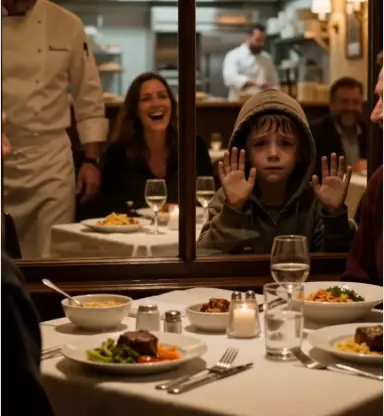
“It was February,” he continued. “Heavy rain. Two boys were standing outside the window. Soaked. Starving. One of them was shaking so badly he could barely stand.”
Her fingers tightened on the doorframe.
The young man looked down, fighting emotion. “I was the older one.”
The sound of the neighborhood seemed to disappear.
Margaret stared at his face, and suddenly the polished suit vanished from her mind. She saw a child instead. Thin. Wet. Terrified. Pressing his small hands against a diner window while another boy leaned against him, burning with fever.
Her lips parted.
“The older boy kept saying…” she whispered, almost to herself, “‘Don’t fall asleep. Please don’t fall asleep.’”
Tears filled his eyes.
“That was me.”
Margaret covered her mouth with one hand.
The young man glanced toward the neighboring windows, where shadows still watched. “May I come in?”
For a moment, she could not answer. Then she opened the door wider.
Her living room was small but spotless. A worn floral sofa sat against the wall. Family photographs hung slightly crooked. A table covered with a faded floral cloth stood near the window, and the smell of fresh coffee lingered in the warm afternoon light. An old wooden side table sat beside Margaret’s chair, its bottom drawer slightly warped from age.
“Sit,” Margaret said softly.
He sat on the edge of the sofa, the folder resting on his knees as if it weighed more than leather and paper.
“My name is Nathan,” he said. “Nathan Cole.”
Margaret blinked. “Cole?”
He gave a small, sad smile. “It wasn’t my name back then. Back then, I was Nathan Reyes.”
She lowered herself into the chair across from him.
He looked around the little room, then back at her. “My brother’s name was Daniel. He was six.”
At the name, Margaret’s face tightened.
Nathan’s voice grew unsteady. “We had run away from a man our mother trusted. He had promised to help us after she died, but he took the little money she left and kicked us out. We spent two nights near the bus terminal. Daniel got sick. I didn’t know what to do.”
Margaret shut her eyes.
“The owner of the diner wanted to chase us away,” Nathan continued. “He said we were scaring customers. But you came outside. You didn’t look at us like we were trash. You looked at us like children.”
Margaret remembered the rain.
It had come down so hard that night it looked silver beneath the diner lights. She remembered the boy’s blue lips. The little one’s burning forehead. She remembered buying soup with her own tip money because the owner refused to give away food. She remembered calling a taxi even though she knew she would have to skip groceries that week.
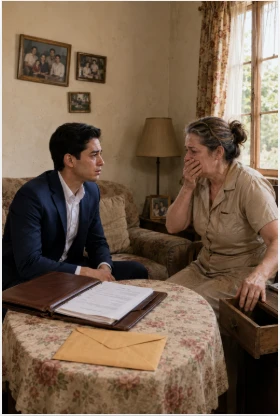
“You took us to the hospital,” Nathan said. “You signed as the responsible adult. You stayed all night.”
Margaret’s eyes filled.
“I couldn’t leave you there alone,” she whispered.
Nathan nodded, but pain twisted across his face.
“Daniel died two days later.”
The room fell silent except for the old clock ticking on the wall.
Margaret bowed her head. “I prayed for him for years.”
Nathan looked at her sharply. “You did?”
“Every February,” she said. “I never knew what happened to you.”
“I ended up in a shelter,” he said. “Then foster care. I studied hard. Scholarships got me through school. Later, I started a logistics company. Then another. I got lucky.”
Margaret shook her head. “That doesn’t sound like luck.”
“It started with you,” he said. “I promised myself that if I ever became someone, I would find you. Not because kindness can truly be repaid, but because you deserved to know it mattered.”
He opened the leather folder and placed documents on the floral tablecloth.
Margaret looked down.
“This house,” Nathan said, voice trembling, “is now fully paid.”
She did not move.
He placed the sealed envelope beside the papers.
“And this,” he continued, “is enough for you to never work another diner shift again.”
Margaret stared at the envelope. Her breath seemed to catch somewhere in her chest.
Nathan expected tears of relief.
Instead, he saw terror.
Her hand flew to her mouth. Her eyes flooded, not with joy, but with a grief so deep it looked ancient.
“Nathan,” she whispered.
He leaned forward. “What is it?”
Margaret’s shoulders began to shake.
“I thought I had buried this,” she said. “I thought God had punished me enough by making me remember it every single night.”
Nathan’s heart began to pound.
“Margaret?”
She looked at him, and the kindness in her face broke apart.
“My son,” she whispered, “there is something I never told anyone about that night.”
Then she reached toward the old drawer beside her chair.
The drawer stuck at first. She pulled harder. Wood groaned. Inside were old receipts, a rosary, yellowed envelopes, and a small metal cookie tin tied with a faded blue ribbon.
Nathan watched her hands tremble as she opened it.
Inside lay a hospital bracelet.
A folded newspaper clipping.
And a small silver locket.
Nathan stopped breathing.
He knew that locket.
Not because he remembered wearing it.
Because for seventeen years, he had seen its twin in every dream he ever had of Daniel.
Margaret lifted the locket with shaking fingers.
“Your brother did not die two days later,” she said.
Nathan’s face went pale.
The room tilted.
“What?”
Margaret began sobbing now, the words tearing out of her.
“The hospital told me both of you were wards of the state. No family. No money. No one coming. Daniel was very sick, but he survived the fever. Barely. A man came to the hospital the third day. Expensive coat. Smooth voice. He said he worked with a private children’s charity. He said he could place Daniel in a home where doctors would care for him.”
Nathan stood slowly.
“No,” he whispered.
“I was tired,” Margaret cried. “I was poor. I was scared. I had no legal right to either of you. He showed papers. The nurse believed him. Everyone believed him. He told me if I interfered, both boys would disappear into the system and I’d be blamed for kidnapping. So I signed as witness.”
Nathan’s hands curled into fists.
“What was his name?”
Margaret looked down at the newspaper clipping.
“He called himself Leonard Vale.”
Nathan staggered back as if struck.
The name split open a locked room in his memory.
Leonard Vale.
The foster-care sponsor. The wealthy man who had later funded Nathan’s education. The man who had appeared when Nathan was thirteen and said, “You have potential, boy.” The man whose foundation had introduced him to investors. The man who now sat on the board of Nathan’s own company.
His mentor. His benefactor. His second father.
Margaret pushed the newspaper clipping toward him.
It was old and yellowed. The headline was faded, but still readable.
LOCAL CHARITY DIRECTOR QUESTIONED IN ILLEGAL ADOPTION PROBE.
Beneath it was a younger Leonard Vale, smiling beside a group of children.
Nathan grabbed the clipping. His eyes raced across it.
Several children had vanished through forged medical transfers. Some were adopted illegally by wealthy families. Some were never found.
His voice came out hollow. “Why didn’t you tell anyone?”
“I tried,” Margaret said. “The police said the papers were legal. Then Leonard came to my house.” Her voice dropped. “He knew where I lived. He knew I had a daughter. He told me if I kept asking questions, my child would be next.”
Nathan stared at her, trembling.
Margaret reached back into the tin and removed a small photograph.
It showed two little boys outside Riverside Diner. Nathan, thin and watchful. Daniel, pale and leaning against him.
Between them, Margaret had written on the back: The boys from the storm.
Beside the photograph was one more item.
A business card.
Nathan took it.
His blood turned cold.
It was not Leonard Vale’s old card.
It was new.
The embossed logo belonged to Nathan’s company.
At the bottom was Leonard’s handwritten message.
Found her before you did. Keep her quiet.
Nathan lifted his eyes to Margaret.
“When did he give you this?”
Margaret’s face crumpled. “Yesterday.”
A sound like thunder rolled through Nathan’s chest.
He reached for his phone, but before he could dial, headlights swept across the living room wall.
A car had pulled up outside.
Margaret looked toward the window and went white.
Nathan turned.
Through the thin curtain, he saw a black sedan behind his Mercedes.
The driver’s door opened.
Leonard Vale stepped out.
He was older now, silver-haired and elegant, with a calm smile that made Nathan suddenly feel eight years old again.
Margaret whispered, “He said you would come. He said kindness always makes people predictable.”
Nathan’s phone buzzed in his hand.
A text appeared from an unknown number.
Look in the envelope before you do something stupid.
Nathan stared at the sealed envelope he had brought for Margaret. His own assistant had prepared it that morning. Or so he had believed.
Slowly, with numb fingers, he tore it open.
Inside was not money.
Inside was a DNA report.
Nathan read the first line.
Then the second.
Then everything inside him stopped.
The report compared Nathan Cole to Daniel Reyes.
Probability of biological sibling relationship: 99.98%.
But attached beneath it was a photograph of a man in an orange prison jumpsuit, taken only three days earlier.
The man had Nathan’s eyes.
Daniel was alive.
And printed across the bottom of the page were four words:
EXECUTION SCHEDULED: MIDNIGHT TONIGHT.
Nathan’s knees nearly buckled.
Leonard had not just stolen Daniel.
He had buried him inside a false identity, framed him for a crime, and kept Nathan close all these years to control the fortune that could save him.
Outside, Leonard walked toward the porch.
Margaret’s hand closed around Nathan’s wrist.
“Run,” she whispered.
But Nathan’s tears were gone.
He looked at the paid-off house papers, the locket, the photograph, the DNA report, and the woman who had carried a secret for seventeen years because fear had been wrapped around her throat.
Then he looked toward the door.
The debt he had come to repay was nothing.
The real debt was waiting on death row.
And the man who had stolen his brother was knocking.
Nathan stepped toward the door, opened it before Leonard could touch the handle, and looked straight into the eyes of the monster who had built his life.
Leonard smiled. “Son, we need to talk.”
Nathan raised his phone.
On the screen, a call was already connected.
A woman’s voice came through the speaker.
“Mr. Cole,” she said, “this is the United States Attorney’s Office. We heard everything.”
Leonard’s smile died.
Nathan looked past him as police sirens began screaming down the street.
Then he spoke the words he had waited seventeen years to say without ever knowing it.
“He is not your son.”
His voice broke.
“He is my brother.”
And behind him, Margaret Doyle fell to her knees, clutching Daniel’s silver locket as the past finally came crashing through the door.