PART 2: At 2 AM, my husband secretly packed his luggage and slipped out of our bedroom like a thief M1
Life stories 22/07/2026 17:52
My eyes remained fixed on the handwriting.
Grace’s handwriting.
I recognized the elegant curve of the first letter. The slight tilt of every word. Even the unusual way she crossed her t’s a little higher than most people.
There was no possibility of a mistake.
And yet my mind refused to accept what I was seeing.
Grace had been gone for ten years.
Owen’s fingers trembled as he reached for the envelope.
Four words were written across the front.
For Owen. Age 25.
His breathing changed.
“How…?” he whispered.
Clara lowered her eyes.
“I think you should read it first.”
I finally found my voice.
“Clara.”
She looked at me.
“Where did you get that?”
My question sounded sharper than I intended.
I wasn’t angry.
I was desperate for an explanation.
Because somehow, a letter written by my late wife had appeared in my son’s room a decade after her death.
Clara hesitated.
“Please. Let Owen read it.”
Owen looked from Clara to me.
Then he carefully opened the envelope.
Inside was a single sheet of cream-colored paper.
His eyes moved slowly across the page.
Within seconds, they filled with tears.
He continued reading.
The room became so quiet that I could hear the soft movement of the paper in his hands.
Then something unexpected happened.
Owen smiled.
Not the polite smile he gave doctors when they asked how he was feeling.
Not the exhausted expression he used when visitors tried too hard to cheer him up.
A real smile.
The kind I hadn’t seen since before his illness became serious.
When he finally lowered the letter, I leaned forward.
“What does it say?”
Owen stared through the window for several seconds.
Then he looked at me.
“Mom knew.”
“Knew what?”
“That one day I’d be angry.”
I frowned.
“Angry?”
He nodded.
“She wrote that growing up means realizing your parents aren’t heroes.”
His voice became quieter.
“She said every family has mistakes. Regrets. Things people avoid discussing because they’re afraid of what the truth might change.”
A strange pressure settled in my chest.
“What else?”
Owen looked at the page again.
“She said there might come a time when I felt completely lost.”
A tear moved down his cheek.
“And she told me not to spend my life waiting for perfect answers before deciding to live.”
No one spoke.
Then Owen turned toward Clara.
“Where did you get this?”
Clara inhaled slowly.
The sadness I had noticed in her from the beginning suddenly seemed deeper.
Personal.
“I made a promise,” she said.
“To whom?”
Her eyes moved toward me.
“Your mother.”
The words seemed to change the air in the room.
“What?”
“I knew Grace.”
My heart nearly stopped.
“That’s impossible.”
Clara shook her head.
“No. I met her shortly before she died.”
I stared at the young woman standing in front of me.
Grace had died ten years earlier.
Clara would have been a teenager.
Yet there was something in her expression that made disbelief difficult.
Owen spoke first.
“You knew my mom?”
“A little.”
“How?”
Clara looked toward the window.
“When I was fifteen, my mother became seriously ill.”
Her voice remained steady, but old sadness lived beneath every word.
“We lost our home. Then we lost almost everything else.”
She paused.
“One afternoon, I was sitting alone in a hospital waiting room. I was trying very hard not to cry.”
Neither Owen nor I interrupted.
“Your mother sat beside me.”
My chest tightened.
“She didn’t ask questions,” Clara continued. “She simply stayed there.”
A faint smile appeared on her face.
“Then she offered me half of her sandwich.”
I closed my eyes briefly.
That was Grace.
Painfully, unmistakably Grace.
“Eventually, I started talking,” Clara said. “I told her about my mother. About being afraid. About having no idea what would happen to me.”
“What happened?” Owen asked softly.
“My mother died three months later.”
The sadness in Clara’s voice deepened.
“After the funeral, I received a package.”
She reached into her pocket and removed an old photograph.
Owen took it first.
Then he handed it to me.
My throat tightened.
Grace stood beside a teenage girl.
Clara.
Both were smiling.
On the back, Grace had written:
Keep going. One day you’ll help someone else survive this too.
For a moment, I couldn’t speak.
It felt as though Grace had entered the room through her own words.
“She stayed in touch with you?” Owen asked.
“For a while.”
“Why didn’t Mom ever mention you?”
Clara hesitated.
“She probably believed it was better that way.”
“Why?”
“Because eventually our friendship became connected to something private.”
Uneasiness moved through me.
“What kind of private matter?”
Clara looked directly at me.
“Something Grace asked me to protect.”
Owen studied her carefully.
“Is that why you came here?”
“Partly.”
“What’s the other reason?”
Clara looked toward him.
“I saw your name in an article.”
Owen’s expression changed.
“The article about my condition?”
“Yes.”
He looked away.
Clara continued.
“I recognized your name immediately. And I remembered a promise.”
“What promise?”
“That if life ever brought me back to this family, I was supposed to deliver what Grace left behind.”
I slowly sat down.
“Grace gave you something?”
Clara nodded.
“When?”
“Three weeks before she died.”
“And you’ve kept it for ten years?”
“Yes.”
“Without contacting us?”
“Yes.”
My mind searched for logic.
Timelines.
Explanations.
Anything that would make the situation easier to understand.
But then I remembered Grace.
She bought birthday presents months early.
She wrote holiday cards before December.
She hid notes inside books and drawers.
Grace had always prepared for tomorrow as though she understood that tomorrow was never guaranteed.
Maybe this wasn’t impossible.
Maybe it was exactly the kind of thing she would have done.
That evening, Owen asked for dinner.
Only soup and half a sandwich.
But he asked.
The kitchen staff nearly celebrated.
Clara carried the tray upstairs.
From the doorway, I watched my son eat.
Slowly.
Carefully.
But willingly.
Between bites, he asked Clara about her life.
Her work.
The cities where she had lived.
They talked for almost an hour.
It was the longest conversation Owen had willingly had in months.
Later, after he fell asleep, I found Clara in the library.
She stood beside Grace’s favorite bookshelf, lightly touching the spines of the books.
“I need answers,” I said.
“I know.”
“Then tell me everything.”
Clara turned toward me.
“Your wife trusted me.”
“With what?”
“A box.”
My pulse quickened.
“What box?”
“She gave it to me three weeks before she died.”
“What was inside?”
“I don’t know.”
I stared at her.
“You never opened it?”
“No.”
“Where is it now?”
“I still have it.”
The library suddenly felt smaller.
“Why would Grace give a box to you instead of me?”
Clara’s expression softened.
“I don’t know.”
That answer somehow disturbed me more than an explanation would have.
“When can you bring it here?”
“Tomorrow.”
I barely slept that night.
At six the next morning, I passed Owen’s bedroom.
His door was partly open.
He was awake.
Reading Grace’s letter again.
Morning sunlight covered his bed.
And for the first time in months, my son did not look like a young man waiting for his life to end.
He looked like someone wondering what tomorrow might contain.
All my money had failed to give him that.
Doctors had failed.
Specialists had failed.
My desperate attempts to solve every problem had failed.
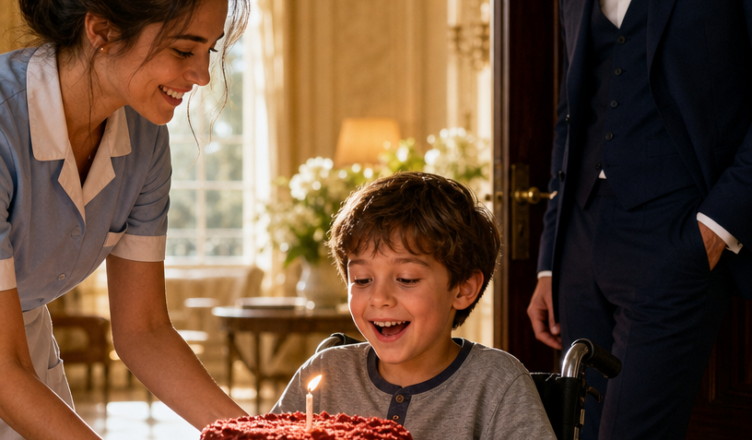
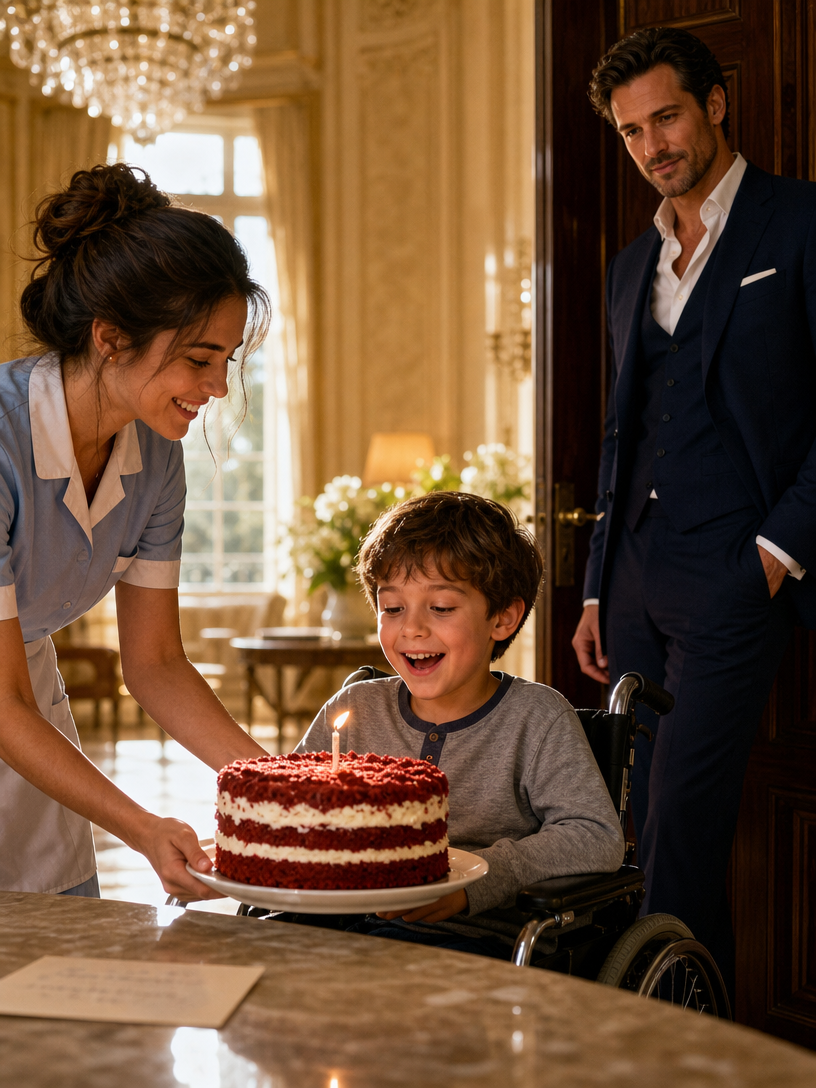
Yet a homemade cake and one letter from his mother had somehow reached him.
The next afternoon, Clara returned carrying a weathered wooden box.
Dark walnut.
Brass corners.
A small engraved lock.
I recognized it immediately.
Grace had bought the box in Vermont shortly after Owen was born.
I had forgotten it existed.
Apparently, she had not.
Owen sat beside the dining table.
Clara placed the box between us.
Then she reached into her coat pocket.
A small key rested in her palm.
“Your mother told me this day might come.”
The lock clicked.
Clara lifted the lid.
Inside were dozens of envelopes.
Each carefully organized.
Each written in Grace’s handwriting.
For Owen.
For Nathan.
For both of you.
For difficult days.
For celebrations.
For forgiveness.
For courage.
For when you think you’ve failed.
For when life surprises you.
Owen stared at them.
My eyes filled with tears.
For ten years, I had believed Grace was completely gone.
Now pieces of her were sitting on the table.
Waiting.
Patiently.
Like lights she had left burning for us.
Then Owen noticed a larger envelope beneath the others.
It had no date.
Only two words.
Open together.
We exchanged glances.
Owen carefully removed it.
Inside was a letter.
And an old photograph.
The moment I saw the picture, my breath caught.
Grace was standing beside a young woman.
I recognized the woman’s face.
Not from memory.
From photographs and old articles.
But before I could understand why Grace had known her, Clara looked at the picture.
All the color disappeared from her face.
“No,” she whispered.
“Clara?” Owen asked.
She continued staring.
Her hands began to tremble.
Then she pointed toward the woman standing beside Grace.
“My mother.”
Silence filled the room.
Owen looked at Clara.
I looked at the photograph.
No one knew what to say.
Then I noticed a folded note beneath the picture.
Grace’s handwriting covered the page.
I opened it.
My hands began to shake before I had finished reading the first sentence.
Because Grace had written:
If you are reading this, then Clara has finally come home.
And in that moment, I understood that the box wasn’t simply a collection of letters.
Grace had planned something.
Something connected to Clara.
Something connected to Owen.
And possibly something she had hidden from me for ten years.
The room became completely silent.
Not the ordinary silence of people searching for words.
This was different.
It felt as though time itself had stopped.
Grace’s letter trembled slightly in my hand.
Across the table, Clara remained frozen.
Owen stared from her to me, clearly trying to understand the sentence we had just read.
Finally, he spoke.
“What does that mean?”
Neither Clara nor I answered.
Because neither of us knew.
I lowered my eyes to the page again.
Grace’s familiar handwriting filled the paper.
For one impossible moment, I could almost imagine her sitting beside us.
I swallowed and began reading aloud.
My dearest Nathan, Owen, and Clara,
If you are reading this, then Clara has finally come home.
That sentence will probably confuse all three of you. That’s all right. It confused me once too.
Some truths take years to understand.
I paused.
Owen leaned forward.
“Keep reading.”
I continued.
Before you go any further, I need you to do something for me. Look at one another and remember that whatever questions come next, love matters more than answers.
The words sounded exactly like Grace.
Even after ten years, she was still trying to prepare us before revealing something difficult.
I read on.
Nathan, there are parts of this story I never told you. Not because I didn’t trust you. I was waiting for the right time.
And if this letter has been opened, that time has finally arrived.
A strange ache moved through my chest.
For a decade, I had believed there were no hidden rooms left in Grace’s life.
I had been wrong.
The letter continued.
Twenty-six years earlier, before Owen was born, Grace had volunteered at a community center on the south side of Chicago.
That was where she met a young woman named Elena Bennett.
Clara inhaled sharply.
“My mother.”
I nodded and kept reading.
Grace described Elena as brave, stubborn, and endlessly generous.
When Elena became pregnant, she had almost no support.
Very little money.
No close relatives nearby.
And more fear than she admitted.
But according to Grace, Elena loved her daughter from the moment she learned she was expecting her.
Clara lowered her eyes.
Tears gathered there.
Grace and Elena remained friends for years.
Sometimes life pulled them apart.
Eventually, they always found their way back to each other.
But one promise never changed.
If anything happened to Elena, Grace would quietly watch over Clara.
Clara stared at me.
“What?”
I continued reading.
Elena never wanted Clara to know about our agreement. She believed a child should be free to become herself without feeling indebted to anyone.
I respected that wish.
But promises matter.
Clara covered her mouth.
“I never knew.”
Owen looked at her.
“So my mother was protecting you?”
Clara slowly shook her head.
“All those years… I thought I was alone.”
The letter continued for several pages.
Grace wrote about Elena.
Their friendship.
The difficult years.
The promises they made when both of them were younger.
Then I reached the final section.
And one detail changed everything.
Clara, if life has brought you back to this house, I hope you have finally discovered what I saw in you years ago.
You have a gift for helping people remember why they should keep going.
One day, someone in this family will need that gift.
Owen slowly lowered his eyes.
No one needed to explain.
Grace had been writing about him.
The letter ended.
But the questions had only begun.
That evening, Owen asked Clara to sit with him in the sunroom.
The autumn sky glowed orange beyond the large windows.
For several minutes, neither of them spoke.
Then Owen asked a question.
“Do you believe in coincidence?”
Clara smiled faintly.
“Not as much as I used to.”
“Neither do I.”
Owen looked toward the garden.
“The doctors say I’m dying.”
Clara didn’t interrupt.
She simply listened.
“I know everyone avoids saying it,” Owen continued. “But that’s what they told me.”
His voice was calm.
Too calm.
“I spent months preparing myself for the end.”
Then he looked at her.
“And you appeared.”
Clara studied him.
“And now?”
Owen gave a tired laugh.
“Now I’m confused.”
“That’s understandable.”
“Part of me wants to hope.”
“That’s understandable too.”
He turned toward her.
“What if hope makes everything hurt more?”
Clara was quiet for several seconds.
“When my mother became sick, I stopped hoping.”
Owen listened.
“I thought giving up hope would protect me.”
“Did it?”
“No.”
Her answer came immediately.
“The pain arrived anyway.”
Owen looked down.
Clara continued.
“Hope doesn’t guarantee that everything will end the way you want.”
Then she smiled sadly.
“But giving up doesn’t guarantee safety either.”
Something changed in Owen after that conversation.
Not dramatically.
There was no sudden miracle.
Just small things.
He began eating breakfast again.
He spent more time downstairs.
One afternoon, he asked to visit the garden.
Mrs. Ellis nearly cried when she heard.
The house slowly began to feel alive again.
Every evening, Owen selected another envelope from Grace’s box.
Some letters made us cry.
Others made us laugh.
One contained predictions Grace had written about Owen when he was five.
One line said:
You will pretend not to like people, but secretly care about them very deeply.
Owen laughed for almost five minutes.
“She was annoyingly accurate.”
“Very,” I agreed.
For the first time in years, genuine laughter echoed through the house.
Then, one rainy Thursday afternoon, Clara found something hidden between two old photo albums.
A faded receipt.
She almost threw it away.
Then she noticed Grace’s handwriting on the back.
“Mr. Whitmore?”
I looked up.
“What is it?”
She handed me the paper.
Six words were written there.
Don’t forget Blackwood Lake. July 18.
I stared at the date.
Something about it felt familiar.
For several minutes, I searched my memory.
Then it returned.
“Owen.”
He looked at me.
“Your mother disappeared that day.”
His expression changed.
“Disappeared?”
“Only for several hours.”
I remembered it clearly now.
Two months before Grace died, she left early one morning.
She told me she had errands.
She returned late.
And I never asked where she had gone.
At the time, it seemed unimportant.
Now I regretted every question I had failed to ask.
“We need to find Blackwood Lake,” Owen said.
Three days later, we did.
The lake was less than ninety minutes from the city.
Quiet.
Surrounded by woods.
Almost forgotten.
Owen insisted on coming despite his weakness.
The moment Clara stepped from the car, she stopped.
“I’ve been here before.”
My pulse quickened.
“When?”
“I don’t know.”
She stared toward the far shore.
“I was little. Maybe six or seven.”
We followed a narrow path through the trees.
The deeper we walked, the stranger Clara’s behavior became.
She recognized turns before reaching them.
She knew where the path divided.
She knew about an old wooden bridge none of us had mentioned.
Eventually, we entered a small clearing.
At its center stood a weathered stone bench.
Clara stopped.
“I know this place.”
A bronze plaque was attached to the stone.
Most of the lettering had faded.
But two names remained visible.
Grace Whitmore.
Elena Bennett.
Owen touched the plaque.
“What is this?”
No one answered.
Then Clara found a symbol carved beneath the bench.
A compass.
Beside it was a number.
The same number appeared in one of Grace’s unopened letters.
That evening, after we returned home, Clara remembered something else.
“There was another person at the lake.”
“A man?”
“I think so.”
“Do you remember his face?”
“No.”
“What do you remember?”
She hesitated.
“His watch.”
I frowned.
“It had a compass on it.”
A chill moved through me.
Before I could answer, footsteps sounded near the library.
Owen appeared in the doorway.
His face was pale.
He held an envelope.
One we hadn’t noticed before.
There was no date.
No name.
Only one sentence written across the front.
Owen handed it to me.
I read the words.
Then felt the blood leave my face.
If Nathan is reading this, tell him the truth about July 18.
I sat down.
“What truth?” Owen asked.
My hands shook as I opened the envelope.
Inside were three things.
A letter.
A small brass key.
And a photograph.
The photograph showed Grace at Blackwood Lake.
Elena stood beside her.
Between them was a man in a dark coat.
His face was turned away.
But his wrist was visible.
A silver watch.
A compass engraved around its edge.
Clara covered her mouth.
“That’s him.”
I unfolded Grace’s letter.
Then I read.
Nathan,
If this letter has reached you, I am sorry for every year you believed I kept this from you because I didn’t trust you.
That was never true.
I trusted you with my life.
But I did not trust your fear.
I closed my eyes.
Even after death, Grace knew me too well.
On July 18, she had gone to Blackwood Lake to meet Elena.
Elena was sick again.
She had brought Clara.
And another man.
Dr. Malcolm Reeves.
The name struck me immediately.
Reeves had once controlled much of Chicago’s old medical research district.
My company had later purchased land connected to his organization.
But Grace’s next sentence changed everything.
Malcolm was the only person who knew the full truth about Owen’s condition.
Owen stepped closer.
“My condition?”
I continued reading.
Grace had noticed the warning signs when Owen was a child.
The exhaustion.
Fainting episodes.
Unexplained fevers.
His racing heartbeat.
Doctors had dismissed the symptoms.
And I had accepted their explanations because accepting them was easier than being afraid.
Grace hadn’t.
She asked Malcolm to perform private tests.
He discovered something rare.
Something potentially treatable.
But at the time, the treatment was experimental and available only through limited research programs.
Grace had begged Malcolm to continue searching.
He promised he would.
Then Elena became ill.
Grace’s own health declined.
And time disappeared.
On July 18, Malcolm gave Grace a file.
If Owen ever became critically ill, there might still be one path left.
Not a guaranteed cure.
A chance.
The file wasn’t in Grace’s box.
She had hidden it somewhere else.
The brass key opened a deposit box at First Lake Trust.
The account name was:
Compass Foundation.
Clara began crying.
“The compass.”
I stared at the small key in my hand.
Grace had left a trail.
Not for Nathan Whitmore, the wealthy businessman.
For me.
Her husband.
Owen’s father.
The man she hoped would finally stop trying to solve grief with money and simply sit beside his son.
Then I reached the final part of the letter.
Owen, my beautiful boy, listen carefully.
Do not confuse a diagnosis with a sentence.
Do not confuse fear with wisdom.
And do not confuse being tired with being finished.
Live first.
Answers can follow.
I love you past every ending.
Mom.
No one spoke.
The old clock continued ticking.
But for the first time, it didn’t sound like a countdown.
It sounded like time returning.
The next morning, we went to First Lake Trust.
Inside the deposit box was a sealed medical folder.
Grace’s name.
Elena’s name.
Malcolm Reeves’s name.
And Owen’s.
There were medical records.
Research notes.
Specialist referrals.
And a final letter from Dr. Reeves.
Before his death, he had transferred his research to a cardiac institute in Boston.
One sentence had been circled in Grace’s handwriting.
Call them when Owen is ready to fight.
I called.
Not as a businessman.
Not as a millionaire.
As a father.
Within twenty-four hours, Owen’s records were transferred.
Within forty-eight hours, a specialist contacted us.
By the end of the week, Owen was on a medical flight to Boston.
He was still seriously ill.
Still fragile.
But he was eating.
Talking.
Trying.
The treatment was difficult.
There were bad mornings.
Long nights.
Days when hope felt almost cruel.
But this time, I stayed.
I learned the rhythm of my son’s breathing.
I learned which nurses could make him laugh.
I learned how he wanted his blankets folded.
I discovered he hated hospital pudding but loved orange ice.
I finally understood that presence isn’t dramatic.
Sometimes it is simply a chair pulled close to a hospital bed.
A hand held in silence.
A person who refuses to leave when there is nothing useful left to say.
Clara stayed too.
She brought books.
Terrible coffee.
And once, a red velvet cupcake so badly decorated that Owen laughed before tasting it.
“Your frosting is getting worse,” he told her.
“It’s called emotional realism.”
Owen laughed until he had to catch his breath.
I went into the hallway afterward and cried.
Not because I was afraid.
Because I had heard my son laugh.
Three months later, Owen stood.
Only for twelve seconds.
Only with help.
But he stood.
Six months after doctors had once given him fourteen days, Owen came home.
Not cured.
Not unchanged.
But alive.
Alive enough to complain about the cold.
Alive enough to ask for real food.
Alive enough to sit beneath the Japanese maple and read his mother’s letters.
That autumn, I changed my will.
Then my company.
Then my life.
Whitmore Developments created the Grace and Elena Compass House, a place for families living through serious illness and uncertain diagnoses.
Private rooms.
Meals.
Transportation.
Counseling.
No bills.
No parent sitting alone in a hospital corridor wondering how to survive the next hour.
At the opening ceremony, Owen gave the first speech.
He stood behind the podium.
Thin.
Pale.
Smiling.
“My mother once wrote that love matters more than answers,” he said.
He looked at Clara.
Then at me.
“I used to think answers saved people.”
His voice trembled.
“Now I think sometimes people save people.”
Everyone stood.
Years later, people asked me what had saved my son.
The doctors?
Yes.
The treatment?
Yes.
Money?
Some of it.
But the complete answer was much smaller.
A maid who had never been only a maid.
A letter that should not have existed.
A cake made from a mother’s old recipe.
A promise kept for ten years.
And a young man who took one bite of cake beside a window and remembered that he still wanted more from life.
Owen lived.
Not forever.
No one does.
But he lived long enough to love mornings again.
Long enough to walk through the garden.
Long enough to forgive me.
And long enough for me to become the father I should have been before fear turned me into a stranger.
Every year, on Owen’s birthday, we opened another of Grace’s letters.
The final envelope was labeled:
For when you finally understand.
Inside were only two sentences.
I did not leave you.
I became the love that kept finding its way back.
Owen read the words beneath the Japanese maple.
Then he carefully folded the letter and smiled.
For once, none of us asked what would happen next.
We already knew.
We would live.
Together.