
🎬 PART 2: «The Hospital Built for People Like Him»
Life stories 09/06/2026 00:28
The knight caught the broken helmet with one hand before it could fall.
But he was too late.
The crowd had already seen enough.
A narrow line of his face had appeared beneath the cracked silver, just a glimpse through the broken metal, but it was enough to drain the color from the Royal Commander’s face. The commander stood frozen above the arena, one hand gripping the stone railing, his eyes locked on the knight as if the past had suddenly stepped into the sunlight.
For a moment, nobody moved.
The opponent across from the knight slowly lowered his sword. The cheering that had shaken the tournament grounds only seconds earlier had vanished so completely that the soft scrape of the broken helmet piece across the sand could be heard from the highest seats.
The knight stood in the center of the arena, silent as ever.
His silver armor was dented from the clash, his cloak stirred gently in the wind, and his gloved hand remained pressed against the side of the helmet, holding the broken plate in place. He did not look afraid. He did not look angry. He simply stood there, still and breathing quietly, like a man who had spent seventeen years preparing for a moment he had hoped would never come.
The king leaned forward on his throne.
At first, his expression showed only confusion. Then his eyes moved to the commander. He saw the commander’s face, the trembling in his jaw, the way the old soldier could not take his eyes off the knight. And slowly, something changed in the king’s expression. Not recognition. Not yet. Something colder than that.
Concern.
The Royal Commander descended the steps without waiting for permission.
Each step echoed through the arena.
The nobles whispered behind their hands. The soldiers along the wall straightened, unsure whether to stop him or stand aside. But no one touched him. No one spoke. The commander had led armies before most of them were born. If fear had found its way into his eyes, then whatever he had seen beneath that helmet was not a small thing.
He reached the sand and stopped several feet from the knight.
The knight did not turn away.
The commander’s voice came out low.
“Where did you get that mark?”
A murmur moved through the crowd.
The knight said nothing.
The commander took one step closer, his gaze fixed on the narrow space where the helmet had cracked open. Beneath the shadow of the silver metal, part of the knight’s cheek was visible. There, just below the eye, was a pale crescent-shaped mark. It was not large. It was not frightening. But to the commander, it seemed heavier than any crown in the kingdom.
His lips parted.
“I saw that mark once,” he whispered.
The king stood.
The movement was small, but the entire arena felt it. The golden chair behind him scraped against the marble platform. His guards looked toward him, waiting for an order. None came.
The knight’s hand tightened around the broken helmet.
The commander looked at the king, then back at the knight.
“No,” he said softly, almost to himself. “It cannot be.”
The knight finally moved.
Not quickly. Not dramatically. He lowered his sword first and placed it carefully on the sand, as if he refused to let the moment become a challenge. Then he raised both hands to the sides of the helmet.
The crowd held its breath.
The king’s voice cut through the silence.
“Do not.”
It was not loud, but it traveled across the arena with the weight of a command that had ended arguments for decades.
The knight paused.
His hands remained on the helmet.
The commander turned slowly toward the throne. For the first time that day, he did not bow.
“My king,” he said, his voice shaking, “if there is nothing to hide, then let him remove it.”
The words landed heavily.
The king’s face changed. Only for a second. A flicker near the eyes. A tightening of the mouth. But the people saw it. The nobles saw it. The soldiers saw it. And for the first time, the mystery of the helmet no longer belonged only to the knight.
It belonged to the throne.
The knight looked up.
Through the broken visor, his eyes met the king’s.
No one in the arena could see his full face yet, but they could see enough of his gaze to understand one thing. He was not asking for mercy. He was not asking for permission. He was only deciding whether the truth was worth the pain it would bring.
Then, slowly, he removed the helmet.
The silver lifted from his head.
The wind moved through the arena.
A woman in the front row covered her mouth. A young page dropped the banner he had been holding. Somewhere among the old servants near the palace gate, someone gave a small broken gasp.
The legendary knight was not an old warrior hidden by scars.
He was not a stranger.
He was a man in his early thirties, with calm eyes, dark hair touched by dust from the arena, and a face the kingdom had seen before only in paintings locked inside the east wing of the palace.
The resemblance was impossible to ignore.
He had the late queen’s eyes.
Not similar.
The same.
The same gentle shape. The same quiet sadness. The same look that seemed to forgive people before they had even spoken.
The commander staggered back half a step.
“No,” he breathed again, but this time the word was not denial. It was grief.
The king descended from his platform.
His guards followed, but he lifted one hand, stopping them. He walked alone into the arena, his royal cloak trailing behind him over the pale sand. The people watched him with wide eyes. This was no longer a tournament. It had become something no one had expected to witness.
The king stopped in front of the knight.
For several seconds, neither man spoke.
The knight held the broken helmet at his side. Without it, he seemed less like a legend and more like a person who had carried silence until it became armor. There was no pride in his face. No accusation. Only exhaustion, and beneath it, a tenderness that made the silence harder to bear.
The king stared at him.
Then his eyes moved to the crescent mark below the knight’s eye.
His breath caught.
The commander lowered his head.
“Sire,” he said carefully, “that mark was on the child.”
The crowd stirred.
The king did not look away.
“What child?” a noblewoman whispered.
An old nurse standing near the entrance to the royal platform began to tremble. She was a small woman, bent with age, dressed in plain gray robes, someone most people had passed without noticing for years. But now she stepped forward, one hand pressed to her chest.
The guards moved to stop her.
The king raised his hand again.
The old nurse entered the arena slowly. Her eyes were wet, but her voice was clear when she spoke.
“I wrapped him in blue cloth the night he was born.”
The arena fell into a deeper silence.
The knight closed his eyes.
Just once.
As if those words touched something inside him that no sword ever had.
The old nurse took another step. Her lips trembled as she looked at his face.
“The queen held him by the window,” she said. “She said the moon had marked him so the kingdom would always know him.”
The commander turned away, overcome by memory. The soldiers around the arena looked at one another, unsure what they were allowed to feel.
The king’s face had gone pale.
“Enough,” he said.
But this time, the command did not sound like power.
It sounded like fear.
The knight opened his eyes.
His voice, when it finally came, was calm. Low. Human.
“I did not come here to take anything from you.”
The words surprised everyone.
Even the king.
The knight looked around the arena, at the soldiers who had followed him, at the people who had cheered for him without knowing his face, at the old nurse who now looked as though seventeen years had been lifted and returned to her at once.
“I wore the helmet because someone asked me to survive quietly,” he said.
The king’s expression tightened.
The commander looked sharply at him.
The knight continued, his voice steady but heavy with years. “I fought for this kingdom because it was still my home. I protected your roads. Your walls. Your children. I stood beside men who never knew my name. And I kept my face hidden because the person who saved me said the truth would break more than one heart.”
No one breathed.
The old nurse silently covered her face.
The king looked at the broken helmet in the knight’s hand.
“Who saved you?” he asked.
The knight’s gaze moved to the far side of the arena.
There, beneath the archway where servants and messengers stood, an elderly stableman leaned on a wooden cane. He had been there all morning, unnoticed by almost everyone. His clothes were simple. His shoulders were thin. But when the knight looked at him, the old man straightened as much as his body allowed.
The crowd turned.
The stableman lowered his eyes.
The king stared at him.
“You?” the king asked.
The old man gave a small bow.
“I only did what her Majesty asked,” he said.
A ripple moved through the crowd like wind through dry leaves.
The late queen.
The king took one slow step backward.
For the first time, he looked less like a ruler and more like a man standing before a door he had spent seventeen years refusing to open.
The knight reached into the lining of his cloak and removed a small folded cloth. It was faded with age, carefully preserved, tied with a thin blue thread. He did not hand it to the king. He held it in his palm where everyone could see.
The old nurse gasped.
“That was his blanket,” she whispered.
The king stared at the cloth.
His eyes softened, then hardened again, as if two different memories were fighting inside him.
The knight looked down at the faded blue fabric.
“I was told not to return until the kingdom was ready to hear the truth,” he said.
The commander’s voice was barely audible.
“And are we ready?”
The knight looked at the crowd.
At the nobles, silent now.
At the soldiers, whose loyalty had suddenly become complicated.
At the king, whose crown had never looked heavier.
Then he looked back at the commander.
“No,” he said.
The answer stunned the arena.
The knight folded the cloth again with careful hands and placed it back inside his cloak. Then he bent down, picked up the broken helmet, and looked at it for a long moment. It had protected him for seventeen years. It had hidden him. It had made him a legend while keeping him from being a son, a prince, or simply a man with a name.
He turned the helmet over in his hands.
Then he placed it gently on the sand between himself and the king.
No challenge.
No anger.
Just a quiet ending to a long silence.
The king looked at the helmet.
“What do you want?” he asked.
The knight’s face changed then. Only slightly. A sadness passed through his eyes, deep and old, but it did not stay. He looked at the throne behind the king, then at the people watching from every corner of the arena.
“I want to know why my mother believed I had to disappear.”
The old nurse began to cry softly.
The commander closed his eyes.
The king did not answer.
Above them, the tournament banners moved in the wind. The sun slipped behind a pale cloud, and the bright arena dimmed just enough for everyone to notice.
The knight turned as if to leave.
But before he took a step, the old stableman lifted his cane and pointed toward the royal balcony.
“My lord,” he said quietly, “there is one person here who knows.”
Every face turned.
Not to the king.
Not to the commander.
But to a veiled woman seated in the shadow behind the throne, a woman who had not moved once since the tournament began.
For the first time all day, she stood.
And the king whispered her name like a secret he had tried to bury.
The knight looked up at her.
The woman reached beneath her veil with trembling fingers.
Then she said, “He has her eyes.”
And in the silence that followed, the broken helmet rolled gently in the sand, stopping at the king’s feet.


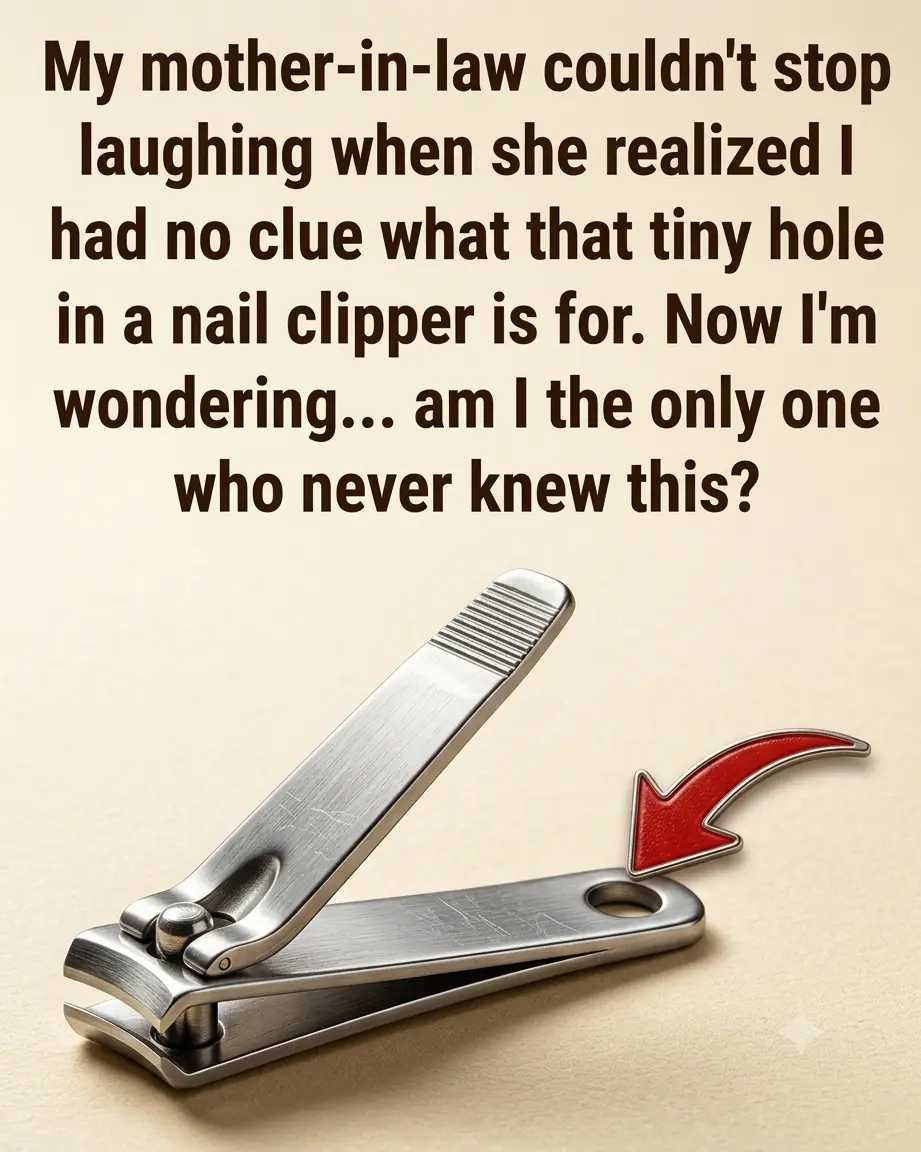
What's the Small Round Hole on Your Nail Clipper For?