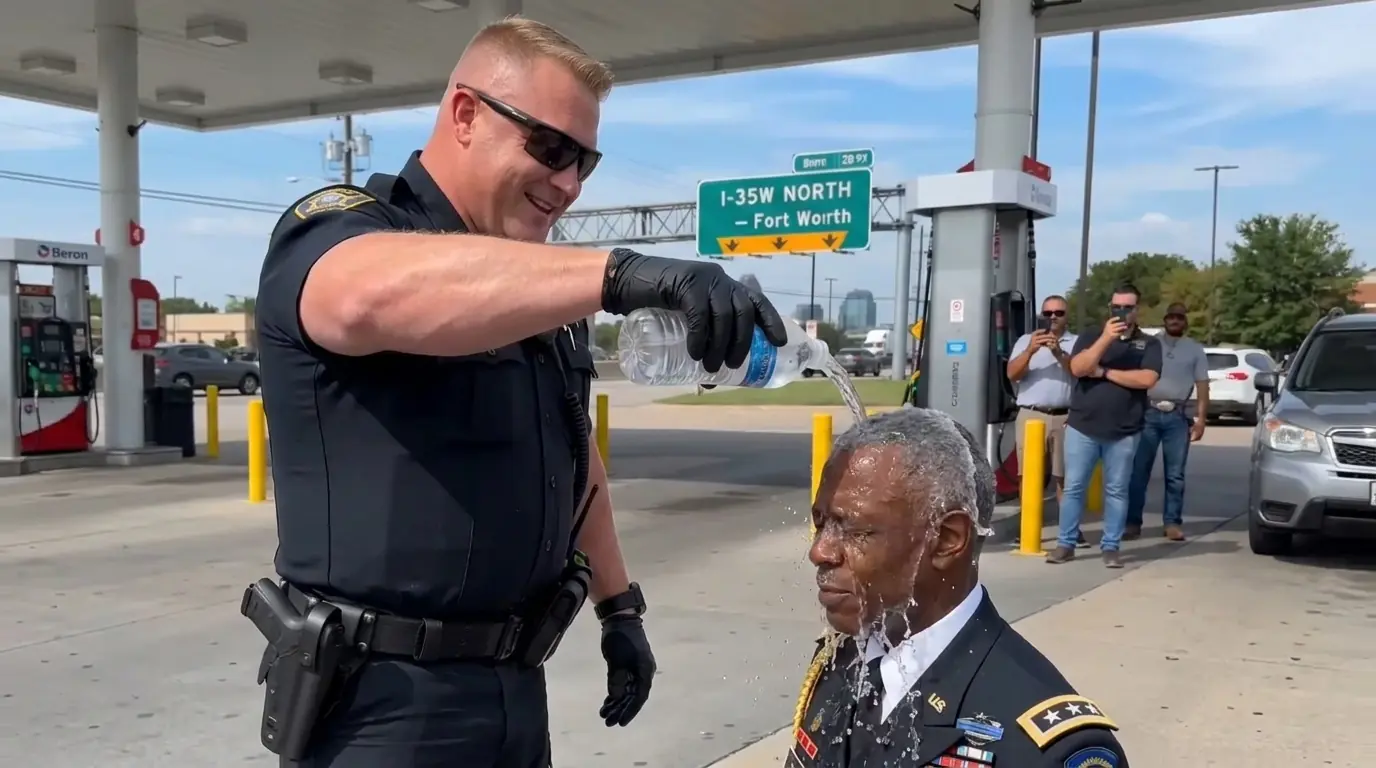
Deputy Travis Harlan was squeezing the last of a cold water bottle over Colonel Isaiah Bennett’s head when the first black SUV appeared beyond the gas pumps. Water ran through Isaiah’s close-cropped gray hair, across his temples, and down the collar of the dark-blue dress uniform he had worn to a military leadership ceremony that morning. His ribbons were soaked, his trousers were dusty at both knees, and thirty feet away a woman beside a minivan had stopped pumping gas because she could not believe what she was watching. Harlan crushed the empty bottle in one hand, dropped it beside Isaiah, and said, “Stay exactly where you are.”
Isaiah remained on both knees beside pump six with his palms open. He was fifty-seven years old, six-foot-three, and built like a man who had spent most of his adult life believing physical fitness was part of showing up prepared. Nothing about his posture suggested surrender, even though he was doing exactly what he had been ordered to do. When Harlan leaned over him and said the medals on his chest did not mean anything in Knox County, Isaiah looked toward the highway and answered, “You should have stopped before this became something you couldn’t explain.”
Harlan laughed because he still believed the afternoon belonged entirely to him. “Who’s going to make me stop?” he asked, glancing around at the customers who had already learned not to interfere. Isaiah did not answer immediately, because his attention had moved to the highway entrance behind the deputy. The black SUV slowed, signaled, and turned into Red Creek Travel Plaza.
A second identical vehicle followed ten seconds later. Then came a third, a fourth, and finally a fifth, each dark enough to reflect the afternoon sun like polished glass. Harlan looked toward them with irritation rather than fear at first, probably assuming some corporate convoy had chosen the wrong place to stop. Isaiah watched the first SUV move toward the truck lot and said quietly, “Start counting.”
Harlan frowned. “Counting what?”
“The vehicles.”
Doors opened almost simultaneously. Men and women in plain clothes stepped onto the pavement wearing visible federal credentials, dark jackets, and the unmistakable calm of people who had arrived with a purpose already decided. One woman carried a tablet, another man removed two black document cases from the rear cargo area, and a tall woman in a navy blazer started walking directly toward pump six. Harlan straightened and placed one hand near his belt.
“Stay back,” he called. “Active detention.”
The woman stopped several feet away. “What is the basis for the detention?”
“Failure to comply with lawful instructions.”
“Which instructions?”
Harlan’s eyes narrowed. “County matter.”
The woman opened a credential wallet. Whatever he read changed his face faster than anything Isaiah had said. She closed it and introduced herself as Special Agent Rebecca Sloan, then asked whether Harlan’s body-worn camera was functioning. Harlan touched the device clipped to his chest and answered that the battery had failed.
Rebecca looked upward.
Mounted beneath the metal gas canopy was a large security camera pointed almost directly toward pump six. Harlan followed her eyes and seemed to notice it properly for the first time. He turned toward the convenience store and shouted, “Shut that system down.”
The owner came through the glass entrance before anyone else could answer. His name was Martin Keller, a stocky sixty-year-old who had operated Red Creek Travel Plaza with his wife for twenty-three years. “No,” Martin said, stopping just outside the door. Harlan told him he was interfering with law enforcement, but Rebecca raised one hand and calmly instructed Martin not to alter, disable, erase, or touch any recording equipment.
Harlan stared at her. “You don’t run my scene.”
Rebecca looked toward Isaiah. “Colonel Bennett, are you injured?”
The deputy froze.
“Colonel?”
For the first time since pulling behind Isaiah’s pickup, Harlan actually studied the uniform rather than treating it as decoration. His gaze moved from the silver eagle rank insignia to the nameplate, then across the service ribbons he had spent several minutes mocking. Isaiah rose slowly when Rebecca told him he no longer needed to remain kneeling.
Water still dripped from his sleeves. Harlan took half a step backward and asked, “You really are a colonel?”
Isaiah wiped his forehead with the back of one hand. “That was true before you knew it.”
Harlan started to explain, but Isaiah shook his head. “My rank does not make your conduct wrong. If you had legal grounds to detain me, a colonel can be detained like anyone else, and if you did not have those grounds, a man stocking shelves at this station would deserve the same protection.”
Rebecca gave him a brief nod. Then she motioned toward one of the agents, who carried a black document case to the hood of the nearest SUV. Inside were thick folders, photographs, printed dispatch logs, spreadsheets, complaint summaries, and images of sheriff’s vehicles taken at different locations. The first photograph Rebecca laid on the hood showed Harlan’s cruiser, Unit 5217, parked at a roadside stop six weeks earlier.
A second photograph showed the same vehicle behind a plumber’s van. The next one placed it outside a truck stop in another county. One folder carried Harlan’s name in large block letters, while another was marked with a date from three months earlier. Harlan looked from the files to Rebecca and asked the question he had been avoiding since the SUVs arrived.
“You’ve been investigating me?”
Rebecca answered, “We were already scheduled to meet Mr. Keller before you ever pulled into this station.”
The sentence changed the story completely. The customers watching from the pumps had assumed somebody powerful had recognized Isaiah’s uniform and summoned federal help. Harlan had apparently assumed the same thing. In reality, the convoy had been less than fifteen minutes away before Martin Keller called anybody.
Three hours earlier, Isaiah Bennett had never heard the name Travis Harlan. He had spent the morning at an Army reserve leadership symposium at a conference center outside Wichita Falls, speaking to junior officers and senior noncommissioned leaders about command responsibility. He disliked inspirational speeches built around heroic stories, so he gave them twelve minutes on something less exciting and more useful. “Authority can make people follow you,” he told the room, “but authority cannot make a bad assumption become a good fact.”
Isaiah had been in uniform for thirty-five years. He began as an enlisted communications specialist, earned a commission after college, worked in operational planning and logistics, and eventually commanded organizations large enough that he rarely knew every person by name. He was proud of the rank, but he had seen enough poor leadership to understand that insignia could inflate a personality just as easily as it could represent responsibility. His favorite leaders were the ones willing to say, “I may have this wrong.”
The final slide of his presentation contained only three words. Correct yourself early. He told the younger officers that a small correction at the beginning of an incident was almost always cheaper than a proud explanation at the end. Less than three hours later, kneeling beside a fuel pump with cold water running off his uniform, Isaiah would remember exactly how quickly that lesson could become practical.
He left the symposium around two-thirty and headed east toward his sister Rochelle’s home near Denton. Rochelle had spent the week sending increasingly aggressive text messages about smoked ribs, and Isaiah had promised to arrive before six. He drove a dark-green Ford F-250 borrowed from his adult son Daniel because Isaiah’s own vehicle was in a repair shop awaiting a transmission sensor. Somewhere west of Decatur, the truck’s fuel warning light appeared.
Red Creek Travel Plaza sat beside a state highway about eight miles from the county line. It was the kind of station built for ranchers, contractors, long-haul drivers, and families trying to reach Dallas without hearing another child ask how much farther they had to go. Six regular pumps faced the store, two diesel islands sat farther back, and a faded red sign advertised barbecue sandwiches Martin’s wife had been making since 2008. Isaiah pulled beside pump six at 3:36 p.m.
He inserted his credit card and had barely begun fueling when a marked sheriff’s SUV rolled slowly behind the pickup. Isaiah noticed it but thought nothing of it until the driver’s door opened. Deputy Travis Harlan stepped out wearing mirrored sunglasses and the broad, confident walk of someone who expected people to move before he reached them. “You,” Harlan called. “Step away from that truck.”
Isaiah turned. “Me?”
“Now.”
Isaiah returned the fuel nozzle to the pump. “What seems to be the problem?”
“Identification.”
Isaiah looked toward Harlan’s hands, the body camera on his chest, and the patrol vehicle behind the pickup. “I’ll give you identification. Can you tell me why you’re contacting me?”
Harlan’s expression tightened. “Are you refusing?”
“No.”
“Then hand me your license.”
Isaiah’s wallet was inside his uniform jacket. He began moving one hand toward it and Harlan immediately shouted, “Hands where I can see them.” Isaiah stopped with both palms visible.
“You just asked for my license.”
“I told you to show me your hands.”
Isaiah waited a second. “Tell me how you want me to retrieve the license.”
Inside the store, Martin Keller looked up from a delivery invoice. He recognized Harlan before he could hear the conversation, because Unit 5217 had become familiar over the previous year. Martin walked closer to the front glass.
Harlan finally told Isaiah to use his left hand. Isaiah did exactly that, removed the license, and handed it over without making another movement. The deputy studied the Virginia address, then the name, then looked at the pickup.
“Vehicle yours?”
“My son’s.”
“Registration?”
“Glove compartment.”
Harlan smiled slightly. “Of course it is.”
Isaiah heard the direction of the conversation changing. “Deputy, what was the original reason for contacting me?”
“Suspicious activity.”
“What activity?”
“Watching vehicles.”
Isaiah glanced around. “I pulled in less than two minutes before you.”
Harlan removed his sunglasses. “Calling me a liar?”
“No.”
“I’m asking what you were told.”
Harlan stepped closer. “People like you always think using formal words changes the situation.”
Isaiah became very still. “People like me?”
The deputy smiled without humor. “You heard me.”
Martin Keller heard that line too.
It was not the first time he had heard Harlan say something that felt designed to provoke rather than clarify. Months earlier, Martin had watched the deputy question a Latino flooring contractor named Ernesto Ruiz for nearly an hour after finding nothing illegal in his van. The written incident report later described Ernesto as evasive and possibly preparing to flee.
Martin’s camera showed the van never moved.
At the time, he assumed the difference came from poor wording. Then came another case involving a twenty-six-year-old Black electrician named Darius Cole. Harlan wrote that Darius repeatedly concealed his license plate from view while parked beside the store, but Martin’s exterior camera showed the plate completely visible.
A third incident involved a retired teacher from Oklahoma. She told Martin that Harlan threatened to impound her vehicle unless she paid an old court-related fee immediately through a county payment portal. The issue was later traced to a database mistake.
Martin began saving footage.
He did not think of himself as an investigator. He owned a convenience store and had enough problems involving refrigeration compressors and wholesale coffee prices. But every time Unit 5217 appeared, he copied that camera segment into a separate archive before the standard retention system erased it.
Eventually somebody from a federal investigative task force contacted him.
That was why Special Agent Rebecca Sloan had been scheduled to arrive at four o’clock.
Isaiah knew none of this when Harlan pointed toward Daniel’s F-250 and said, “Open it.”
“No.”
Harlan blinked. “Excuse me?”
“You have not told me any legal basis to search the truck.”
“There it is.”
“What?”
“The attitude.”
Isaiah’s voice stayed controlled. “Declining a search is not an attitude.”
A construction worker beside pump four smiled to himself.
Harlan noticed.
That smile probably cost Isaiah whatever chance remained of the encounter ending quickly.
“Turn around.”
Isaiah did not immediately move. “Am I under arrest?”
“No.”
“Then why am I turning around?”
Harlan raised his voice. “TURN AROUND.”
Isaiah considered the legal question and the practical one separately. He had enough experience around weapons, authority, and pride to understand that winning a roadside argument did not matter if the method of winning made everything more dangerous. He turned slowly.
Harlan frisked him.
No weapon.
No contraband.
Phone.
Wallet.
Keys.
Then the deputy said, “Get on your knees.”
Isaiah looked over his shoulder. “I am not resisting you.”
“Knees.”
“For what purpose?”
“Because I told you.”
That answer told Isaiah more than any formal explanation could have.
He lowered himself carefully.
Right knee first.
Then left.
His hands remained open.
No sudden movements.
Martin Keller came out through the store entrance.
“Deputy Harlan.”
The deputy turned. “Go inside.”
“This is my business.”
“And I’m conducting law enforcement.”
Martin looked at Isaiah. “What did he do?”
Harlan pointed toward the door. “Go back inside before you become part of this.”
Martin stopped.
He was angry.
More importantly, he was afraid.
People later asked why he did not physically challenge Harlan at that moment. The answer was simple: only one person there had a gun and a badge, and escalating another man’s detention because you wanted to feel brave could make things worse for the person already on his knees.
Martin went inside.
Then he locked the security recording system into preservation mode.
Outside, Harlan continued questioning Isaiah.
“Where are you going?”
“Denton.”
“Why?”
“Family dinner.”
“Where did you come from?”
“Wichita Falls.”
“Why were you there?”
“Speaking at a military leadership event.”
Harlan looked at the ribbons. “Those real?”
Isaiah stared. “Yes.”
“People buy uniforms.”
“I’m aware.”
“People buy medals too.”
Isaiah’s jaw tightened.
Harlan smiled because he saw it.
“What rank are you pretending to be?”
“Colonel.”
“Colonel.”
“Yes.”
Harlan laughed once. “Must be important.”
“Responsibility is important.”
“That wasn’t my question.”
Isaiah looked at him. “Rank does not create a different law for me.”
The answer seemed to irritate Harlan more than boasting would have.
Isaiah noticed the body-camera light was dark. “Your camera isn’t running.”
Harlan looked down. “Battery problem.”
“When did it fail?”
“Not your concern.”
Isaiah looked toward the canopy camera.
Harlan followed his eyes.
“You think that camera scares me?”
“No.”
“What are you looking at it for?”
“Because it is recording.”
Harlan leaned closer. “Maybe you should worry less about cameras and more about following instructions.”
Isaiah answered, “I have followed every lawful instruction you’ve given me.”
There it was again.
Lawful.
Harlan seemed to hear that word as a challenge.
“Stop talking.”
Isaiah did.
For almost thirty seconds, neither man spoke.
Cars moved along the highway.
Fuel pumps clicked.
Somewhere behind the store, an air compressor started.
Martin looked through the front window and decided waiting silently was no longer enough.
He walked into his small back office.
Opened the contacts on his phone.
Found REBECCA SLOAN – FEDERAL TASK FORCE.
He called.
Rebecca answered on the second ring. “Sloan.”
“This is Martin Keller at Red Creek.”
Her tone changed immediately. “What happened?”
“Harlan is here.”
“With who?”
“Older Black man.”
“Formal military uniform.”
“He’s got him kneeling by pump six.”
“Camera?”
“Harlan’s looks off.”
“Your system?”
“Everything is recording.”
Rebecca was quiet for a second. “Do not interfere physically unless somebody is in immediate danger.”
“How far away are you?”
“About twelve minutes.”
Martin frowned. “You’re already nearby?”
“We were headed to you.”
He remembered their four o’clock appointment.
“Right.”
Rebecca continued. “Call me if force increases.”
Martin looked toward the front.
Harlan was entering the store.
“It may be increasing.”
The deputy ignored Martin and opened the refrigerator case. He took a bottle of water, placed cash on the counter, and walked back outside. Martin looked down at the register timestamp.
3:44:18.
He printed the receipt.
Then placed it beside his phone.
Outside, Isaiah watched Harlan approach carrying the unopened bottle. He assumed the deputy had decided to drink something.
Harlan twisted off the cap.
“You know what I hate about people like you?”
Isaiah said nothing.
“All those decorations.”
The bottle tilted.
Cold water struck Isaiah’s scalp.
For an instant, every muscle in his shoulders reacted.
He forced them still.
Harlan squeezed harder.
“Think those medals make you somebody.”
Water ran over Isaiah’s face.
Down the front of his jacket.
Across ribbons commemorating assignments, service, command, and years that had outlived friends who were no longer around to wear anything.
Isaiah did not move.
“Those don’t mean a damn thing here,” Harlan said.
Isaiah looked up.
“You’re right about one thing.”