Ukraine Urges Israel to Act Against Russian Ships, Faces Sharp Response
News 17/04/2026 17:25
Approximately $100 billion worth of Iranian assets are frozen overseas, and their release is a key condition for Iran in negotiations with the United States.
As mediators work to push through a second round of talks between the US and Iran to end the conflict, a central issue emerging as a contentious point is Tehran's frozen assets held abroad.
On April 10, before the first ceasefire talks in Pakistan, Iranian Parliament Speaker Mohammad Bagher Ghalibaf wrote on X that the country's frozen assets must be released before any negotiations can take place.
By April 11, at the ceasefire talks in Islamabad, Pakistan, some reports emerged suggesting that the US had agreed to release at least some of Iran's overseas assets. However, the US government quickly denied this, asserting that those assets remain frozen.
A $100 Billion Asset
The Iranian economy has weakened over the past several years due to a series of sanctions from the United States and other countries. These sanctions began in 1979, initially stemming from the hostage crisis at the US embassy in Tehran following the Islamic Revolution, and were later intensified because of Iran's nuclear and ballistic missile programs.
These sanctions have prevented Iran from accessing many of its own assets, such as oil sales revenue, which is frozen in foreign banks. According to aggregated information from Iran and experts, the total value of the country's assets currently held abroad is estimated at over $100 billion.

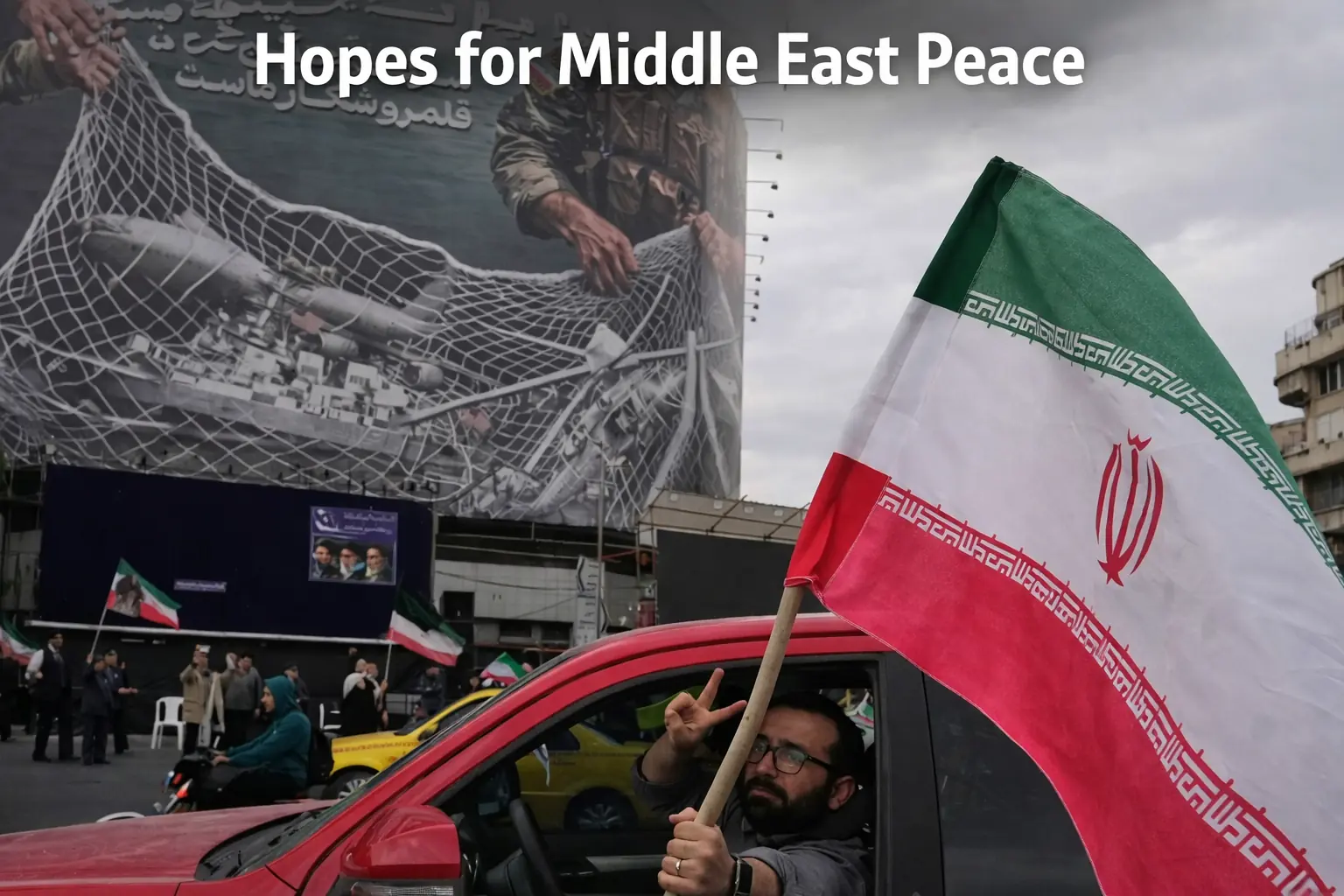
Vehicles move past a large billboard in Tehran, Iran, on April 15, that refers to the Strait of Hormuz with the Persian inscription "Forever in Iran's hands." (Photo: VCG)
Frederic Schneider, an expert at the Middle East Global Affairs Council, said the asset is approximately four times Iran's annual oil revenue.
"That's a huge amount of money, especially for a country that has been under US sanctions for decades," he said.
Frozen assets are money, wealth, or securities balances of individuals, businesses, or a country's central bank that are temporarily held by authorities in another country or international organization. The owner's ability to sell the assets is restricted due to sanctions, court rulings, or other legal reasons.
Schneider further noted that even if the release of these assets is agreed upon, it remains unclear whether the U.S. will impose conditions on how Iran uses them.
Jacob Lew, Treasury Secretary under U.S. President Barack Obama, stated in 2016 that Iran would not be able to access all of its frozen assets abroad even if all sanctions were lifted. At that time, Iran had just reached a historic agreement with the U.S. and other world powers, accepting restrictions on its nuclear program in exchange for the easing of sanctions.
Lew testified before the U.S. Congress that, in reality, Iran would only be able to access about half of the frozen assets at most, as the rest were tied to pre-existing investment commitments or to repay loans.
Currently, Tehran's key demand in ceasefire negotiations is for the U.S. to release at least $6 billion in frozen assets, viewing this as a confidence-building measure.
Why were Iran's assets frozen?

A dilapidated apartment building after an attack on the city of Tabriz, Iran, on March 24. Photo: AP
According to U.S. government records, the first asset freeze occurred in November 1979, when then-President Jimmy Carter declared that Iran "poses an unusual and extraordinary threat to the national security, foreign policy, and economy of the United States."
At that time, Iranian students were holding 66 American citizens hostage at the U.S. embassy in Tehran.
William Miller, then-U.S. Treasury Secretary, stated that Iran's liquid assets were worth less than $6 billion, with the largest being $1.3 billion in Treasury bonds held by the Federal Reserve Bank of New York. In 1981, the Algiers Agreement, brokered by Algeria between the US and Iran, resulted in the US releasing a significant portion of these assets in exchange for Iran's release of 52 American hostages still held in Tehran.
However, in the years that followed, relations between the US and Iran continued to deteriorate due to Washington's concerns about Tehran's nuclear program.
Iran has consistently maintained that its uranium enrichment program is solely for civilian energy purposes, although it has enriched uranium far beyond the threshold necessary for that goal.
Israel and the US have repeatedly accused Iran of enriching uranium to develop nuclear weapons. The US and its allies, particularly Europe, have imposed numerous rounds of sanctions on the country.
In 2015, under President Obama, the US led negotiations to bring Iran to an agreement with world powers known as the Joint Comprehensive Plan of Action (JCPOA). Under the agreement, Tehran agreed to scale back its nuclear program and thereby regain access to much of its overseas assets.
However, in 2018, during his first term, President Donald Trump unilaterally withdrew the U.S. from the JCPOA, calling it a "one-sided" agreement and reimposing sanctions on Iran, once again freezing Tehran's overseas assets.
In 2023, the U.S. and Iran agreed on a prisoner exchange deal, under which Iran released five Iranian-American citizens in exchange for the U.S. releasing several Iranians and allowing Tehran access to billions of dollars in frozen funds. This included $6 billion in oil revenue frozen in South Korea.
Under this plan, the funds were transferred to Qatar for monitoring. However, a year later, US President Joe Biden imposed new sanctions in response to Iran's missile and drone attacks on Israel, once again depriving them of access to the funds frozen in Doha.
Besides the US, the European Union (EU) also froze a portion of Iran's central bank assets, citing alleged human rights violations and non-compliance with nuclear regulations.
Iran's frozen assets are currently held by several countries. The exact amount held by each country is unclear, but Iranian media previously reported that Japan, a major oil customer, holds approximately $1.5 billion, Iraq holds around $6 billion, and India holds $7 billion.
The US also holds approximately $2 billion of Iran's frozen assets, while EU countries such as Luxembourg hold around $1.6 billion. Qatar currently holds approximately $6 billion, money that was transferred from South Korea to pay Iran, but was subsequently blocked by the US.
Hope for the Iranian economy

People shop at the Tajrish market in Tehran on April 6. Photo: AP
Iran's economy is in crisis as decades-long sanctions have restricted oil exports, paralyzing its ability to attract investment and modernize its industry and technology.
High inflation and a depreciating currency led to large-scale protests earlier this year. The conflict with the US and Israel, which erupted on February 28, has severely damaged Iran's infrastructure.
Fatemeh Mohajerani, the Iranian government spokesperson, said on April 14 that the country suffered approximately $270 billion in damage during the six weeks of fighting, demanding compensation from the US, Israel, and Gulf states.
In this context, the release of frozen assets would be a readily available source of funds for Iran. $100 billion is equivalent to nearly a quarter of Iran's GDP.
Roxane Farmanfarmaian, a lecturer in international politics specializing in Iran at the University of Cambridge, UK, argues that the unfreezing of assets is particularly important for Iran.
"This means Iran can bring the hard currency earnings from oil sales back into the domestic economy. It also helps them control exchange rate fluctuations, thereby limiting the damage caused by the volatility of the domestic currency," Farmanfarmaian explained.
She noted that key industrial facilities, including oil fields, water systems, and the deteriorating power grid, would be upgraded if they had access to their frozen assets. With that money, Iran could pay foreign companies and fund domestic industries to begin improving its economic situation.
"Clearly, Iran will also need to rebuild after the conflict, and the release of assets will immediately help that process happen more quickly and efficiently," Farmanfarmaian added. "In addition, access to frozen funds will boost economic growth and improve relations between the government and the people."
The U.S. decision on whether or not to release Iranian assets will also be an important diplomatic message, commented Chris Featherstone, a political scientist at York University.
"Internationally, releasing the assets could signal that the U.S. is easing pressure on the Iranian economy," Featherstone said, noting that with the unpredictable approach of the Trump administration, few can predict what he will do next.