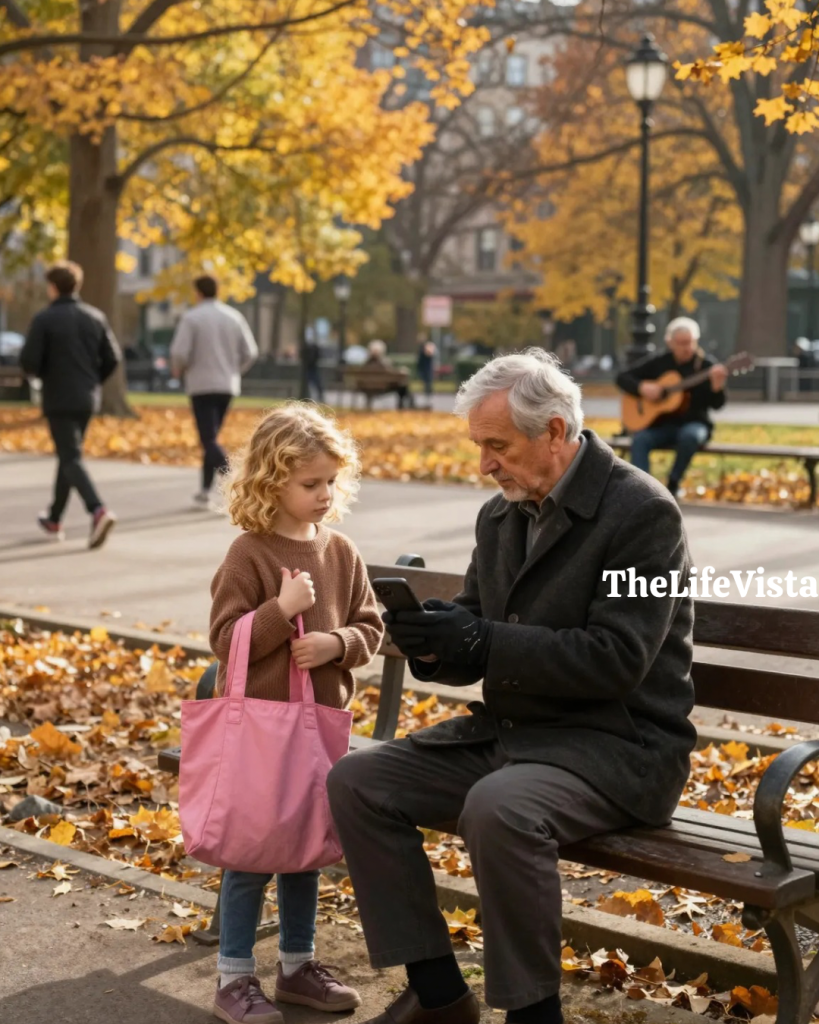
At sixty-three, Graham Langford had mastered the art of looking satisfied while feeling nothing at all, which was a discipline he had refined through decades of boardrooms, acquisitions, and carefully curated silences, and on that mild October afternoon in Central Park, while the city hummed around him with joggers, musicians, and families who still knew how to laugh without glancing at their phones, he sat alone on a cold iron bench scrolling through emails that could have waited but offered him the comforting illusion of importance. His tailored navy coat sat perfectly on his shoulders, his leather gloves were clean and untouched by dirt, and his face, still sharp despite the years, carried the distant expression of a man who had spent too long winning arguments and too little time listening to consequences, and nothing about that moment suggested it would fracture the careful architecture of his life until a small shadow fell across his shoes.
“Sir?”
The voice was quiet but steady, not timid in the way lost children usually were, and when Graham looked up he saw a little girl standing impossibly straight, clutching a faded pink tote bag to her chest like it contained something fragile enough to shatter her entire world. She couldn’t have been older than five or six, with hair the color of pale honey curling wildly around her face, and eyes so unsettlingly familiar that a strange, unearned discomfort crawled up Graham’s spine before he even understood why he felt it.
“Yes?” he replied, already scanning the path behind her for an anxious parent or nanny who might appear at any second and rescue him from this interaction before it began.
The girl swallowed, squared her shoulders as if she were bracing for impact, and said the sentence that dismantled him piece by piece. “Could you please pretend to be my dad,” she asked, and her voice didn’t wobble even though her fingers tightened on the tote, “just for this afternoon?”
The park didn’t go silent, but Graham’s mind did, as though someone had pressed pause on the entire city while his heart fumbled for a response that didn’t exist, and when he finally found his voice it came out lower and sharper than he intended. He leaned forward slightly, keeping his tone controlled the way he did in meetings when he needed authority without volume, and he said, “That isn’t something you ask strangers,” and then he added, because responsibility was a reflex even when compassion wasn’t, “where is your mother?”
The girl’s lips trembled, though she didn’t cry, and the restraint in her face unsettled him more than tears would have. “My real dad died,” she said softly, and she blinked once as if that was the only moment she allowed herself to feel it. “My mom doesn’t smile anymore when she sees other families,” she continued, still upright, still trying to sound brave. “Today there’s a school festival,” she said, and the words came faster like she needed to get them out before courage ran out. “Everyone else will have a father there, and she said it’s okay if I imagine one, but imagining isn’t the same as someone holding your hand.”
Graham opened his mouth to decline, to do the responsible thing, to extricate himself politely and return to the comfortable numbness of his routine, but before he could speak the girl reached into her tote and pulled out an old photograph, the edges cracked and softened by time and too much handling, and she placed it into his gloved hand with the seriousness of someone delivering evidence. Graham didn’t recognize the woman in the picture at first, though she was smiling brightly while holding a newborn, but the man beside her stole the air from his lungs because the resemblance was not vague or flattering, it was exacting and cruel.
Same jawline, the same brow, the same eyes that looked like they were evaluating something even in a still image, and for a heartbeat Graham genuinely believed someone had altered a photograph of him from decades earlier and planted it in a stranger’s hands, because the face in that image fit his memory the way a lock fits a key. His fingers tightened around the paper as his pulse thudded in his ears, and the girl watched his face like she had been trained to read outcomes from the smallest shift in expression, and she whispered, “My dad’s name was Nathan Rook,” and then she added, almost apologetically, “Mom says you look like him so much it hurts to look sometimes.”
Graham’s stomach dropped because Nathan Rook was not simply a stranger’s name, and the delayed force of something he had buried deliberately and deeply struck him hard enough that his vision sharpened in an ugly way, the way it did when he realized a negotiation had turned into a fight. “What’s your name?” he asked, and he heard the tremor he couldn’t hide despite years of practice, and he hated that his voice sounded like a man who had just been caught lying to himself.
“I’m Ivy,” she said, and then she lifted her chin again as if she needed to be taller to say what came next, and she spoke the last name like she was placing a stone on a grave she didn’t fully understand. “Ivy Rook,” she finished, and the surname landed like a weight Graham had been pretending didn’t exist, because it carried decades of absence inside it and made the air around him feel suddenly thinner.
Ivy led him across the park with the quiet confidence of a child who believed the universe had finally aligned in her favor, and Graham followed in a haze, memories pressing against his skull as fragments of a past he had disowned clawed their way back to the surface. Thirty-seven years earlier, there had been a woman named Caroline Rook, brilliant and stubborn and unwilling to shrink herself to fit inside Graham’s ambition, and when she had told him she was pregnant he had reacted not with joy but with fear, the kind that disguised itself as logic when a man convinced himself that success required sacrifice and that someone else could carry the cost. They fought until the air between them felt permanently bruised, and one night Caroline packed her bags and left, and Graham, convinced she would return or at least call, allowed pride to stand guard where love should have been, and eventually the silence became convenient enough to accept, because convenience is the shape regret takes when it wants to sleep.
He never knew she had a child, and he never knew that child would grow up into a man whose life would intersect with his in a way that would scorch everything clean, and as he walked he felt the old arrogance in him try to build a wall, but it kept crumbling under the simple fact of a small hand leading him like she had already decided he belonged in her story.
They stopped near a playground where a woman stood watching the swings with a tension that suggested she had already lost too much to afford losing anything else, and when Ivy called out, “Mom,” the woman turned, and the color drained from her face the instant she saw Graham. She stepped forward immediately, placing herself in front of Ivy with a protective instinct so sharp it looked like muscle memory, and her breath came out in a single word that held accusation and disbelief at the same time, as if she had been waiting years for this exact moment and still hadn’t decided whether she wanted it.
“You.”
Her name was Leah Merritt, though Graham wouldn’t learn it for several long seconds because the recognition in her eyes made language feel useless, and Leah’s hands trembled even as she held them steady, and Graham saw an echo of Caroline in the set of her shoulders and the stubborn line of her mouth, and he understood with a cold clarity that Nathan had inherited more than his face. Leah didn’t ask Ivy to step back because she didn’t want her to be afraid, but she angled her body so that if Graham moved wrong, if he raised his voice, if he tried to take control, she could shield her child without thinking about it.
“Who are you?” Leah asked, though her eyes said she already knew enough to be afraid, and the question sounded less like curiosity and more like a challenge, because only a fool would accept a stranger’s presence near her daughter without demanding proof of purpose.
“My name is Graham Langford,” he replied, and the words sounded too small for the moment, and he hated that he could still hear the old polished authority in his tone even now. He held up the cracked photograph with hands he couldn’t stop from shaking and said, “I think I may be your daughter’s grandfather,” and the sentence felt impossible in his mouth, like a language he had never planned to speak.
The words fell between them thick with years of absence and irreversible loss, and Leah’s expression tightened as if she were gripping something inside herself to keep it from breaking in public. “Nathan died five years ago,” she said, and each word sounded controlled, measured, practiced through grief, and she didn’t flinch when she said it, which told Graham she had said it in hospitals and offices and to well-meaning strangers who wanted a neat answer, and she had stopped allowing the world to see her fall apart. “And if you’re here to buy your way into a story you abandoned,” she added, voice turning sharper, “you’re too late,” and the last word hit like a door slammed in the face of a man who had never believed doors could be closed to him.
They sat in a small café on the edge of the park because Leah refused to talk on a sidewalk where strangers could hover, and Ivy was given cocoa and crayons at a corner table where she could see them but not hear every word, and Graham and Leah faced each other across a narrow table that felt wider than a courtroom. Leah told the truth in pieces, not because she wanted drama but because the truth was too heavy to lift all at once, and it became clear quickly that Nathan had known about Graham, had known who his father was, and had chosen silence not out of fear but out of principle, because sometimes silence is not weakness, it is a boundary drawn by someone who refuses to beg.
“He didn’t want Ivy growing up thinking love was conditional,” Leah said, fingers wrapped tightly around her mug as if warmth could anchor her, and her knuckles stayed pale because she never loosened her grip. “When he died, I promised I would protect her from that lesson for as long as I could,” she continued, and her voice thinned on the last words because she was admitting she had reached the edge of what she could carry alone, and the admission made her angry because she had survived by not needing anyone.
Graham asked what had happened, though his chest already ached with premonition, and Leah hesitated before sliding a thick envelope across the table, the kind stuffed with documents that didn’t belong in a café, because paper like that always carried a stink of trouble. “He was investigating a real estate trust tied to your company,” Leah said quietly, and her eyes did not leave Graham’s, because she needed to see whether he would lie or deny or pretend ignorance. “One that was displacing families illegally,” she added, and her mouth pulled tight like she hated the taste of every word. “Two weeks before he died in what they called an accident, he told me if anything happened to him it wouldn’t be random,” and the sentence landed like a stone dropped into still water, sending ripples through everything Graham thought he knew about his legacy.
The room narrowed around Graham as if sound had been turned down and pressure turned up. The trust was managed by Damien Croft, his protégé, his presumed successor, the man Graham had mentored and praised and placed too close to power, the man who had learned ruthlessness at Graham’s knee and then refined it beyond even his mentor’s tolerance. Graham’s mind caught on the details Leah provided, on the dates, on the signatures, on the quiet pattern that now looked less like business and more like predation, and when Leah said Damien’s name, Graham felt the sick lurch of realizing how easily he had believed the lie of control, because he had always told himself that if he wasn’t in the room, nothing truly terrible would happen, as if absence were a form of innocence.
Outside the café window, a black sedan idled too long, and Graham noticed it not because he was paranoid but because he had spent his whole life noticing threats only when they had already arrived, and the car’s stillness felt deliberate, the way a held breath feels deliberate.
The confrontation came swiftly and without ceremony, because men like Damien Croft didn’t bother with subtlety when they believed themselves untouchable, and as Graham stepped into the narrow alley behind the café with Leah and Ivy close, he understood with a sudden ferocity that this was the moment when a lifetime of avoidance demanded resolution. Damien emerged from the shadows flanked by two men whose eyes were empty of conscience, and his smile was smooth and rehearsed, the kind of smile that tried to make danger look like inevitability, and the sight of him sent a flash of old anger through Graham, not because Damien had changed, but because Graham recognized the arrogance in him as something he had once rewarded.
“You should have stayed retired,” Damien said, voice easy, as if he were discussing scheduling, and his tone carried the quiet contempt of a man who believed he was speaking to someone already fading. “You should have left ghosts buried,” he added, and the words landed like a warning dressed as advice, because he was not just threatening Graham, he was threatening the idea that the past could ever be corrected.
Graham moved without thinking, stepping forward and placing himself between Damien and Ivy, and Ivy’s small hand clutched his coat with desperate trust as if she had decided that if he was going to pretend, he had better be convincing. In that instant decades of regret crystallized into a certainty so sharp it steadied him, and Graham heard himself say quietly and without the old detachment he used like armor, “I already buried my son,” and his voice tightened on the lie because Nathan had never been his son in the ways that mattered, but the truth underneath it still burned, because a child does not stop being yours simply because you were absent. “I won’t bury his truth,” Graham finished, and he did not look away, and he felt something in him lock into place that had never locked before, the simple willingness to stand still when standing still had a cost.
He had already made the call, and he had already transmitted files, and he had already forwarded documents and statements and internal records to people who would not be bribed easily, and he did it not as a strategic move but as the first honest act of accountability he had ever made without calculating how it would look afterward.
Within minutes sirens carved through the city noise, and Damien’s composure cracked, not because he feared prison as much as he feared exposure, because men like him lived on the belief that they could control the story. Accounts were frozen, phones seized, evidence cataloged, and Damien’s empire collapsed under the weight of what Nathan had died trying to preserve, and when officers led Damien away, Leah watched Graham with a mixture of grief and something dangerously close to hope, as if she hated herself for wanting to believe a man could change after it mattered most, and as if she feared hope more than disappointment.
Months later Graham no longer lived in a penthouse that looked down on other people’s lives, but in a modest brownstone near a school where Ivy laughed freely, and he learned the ordinary routines he had once dismissed as inconvenient, packing lunches, waiting in pickup lines, showing up early because showing up late felt like an insult when time was the thing you had stolen. He could never be Nathan’s father, and he could never rewrite the years he had spent choosing ambition over responsibility, but he became something else entirely, a guardian of memory and a keeper of promises, a man finally brave enough to be present even when presence didn’t come with applause, and he found that the quiet work of showing up was harder than any boardroom battle had ever been.
On a quiet afternoon Ivy tugged his sleeve and smiled up at him, cocoa mustache and all, eyes bright and uncomplicated in a way that still startled him. “You don’t have to pretend anymore,” she said, and the sentence carried more mercy than he deserved, because she said it like she was giving him permission to stop being afraid.
Graham swallowed hard and felt tears blur his vision in a way that didn’t embarrass him because some truths were too big for pride. “I know,” he replied, and his voice broke anyway. “I’m not pretending,” he said, and for the first time in his life the words sounded like a vow he actually intended to keep, not for an audience, not for a legacy, but for the small hand that reached for his and expected him not to let go.