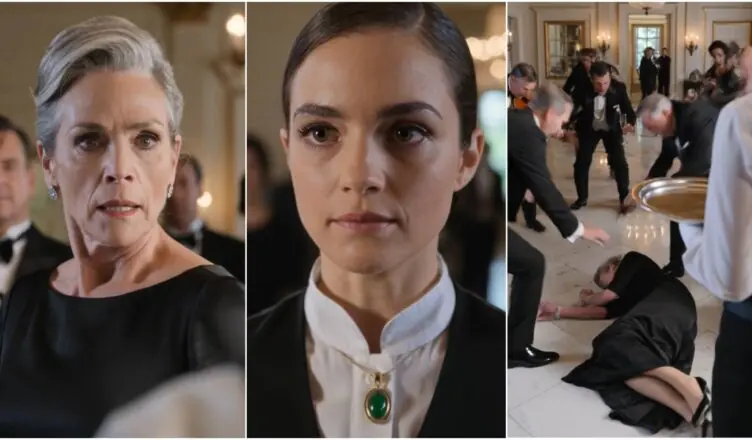
The Pendant Stopped Her Cold—Then One Name Made Her Faint
Life stories 17/05/2026 10:19

Rain started just before they lowered the casket.
By the time the funeral director nodded to his men, St. Aubin Cemetery had dissolved into black umbrellas, wet lilies, and mud that clung to every expensive shoe in sight. The white canopy over the grave snapped in the wind. Roses bent beneath the storm. Even the polished mahogany casket looked staged—lacquered dark enough to reflect the gray sky, brass handles gleaming, Eleanor Delaney’s initials stamped in gold as if death itself had been tailored, approved, and sent out for display.
Maya Lane stood near the back in a coat too thin for October and shoes already ruined by the mud. No one had asked why the housekeeper was there. In the Delaney world, staff were part of the setting. They poured the wine, opened the doors, kept the silver polished, and knew better than to grieve where anyone important might have to see it.
At the front, Eleanor’s husband, Victor Delaney, stood beside the priest in a black coat that held its shape even in the rain. His face was solemn, controlled, camera-ready. One hand rested on the shoulder of Eleanor’s younger sister, Tessa, seventeen and so pale she looked lit from within. On an easel beside the grave, Eleanor smiled out from a carefully chosen photograph—soft light, flawless hair, the kind of portrait used for charity galas and magazine profiles, not for a woman supposedly killed three days earlier on a county road. The family had insisted on a closed casket. They said the crash had made it necessary.
The casket dipped an inch.
And Maya heard Eleanor’s voice again, clear as a whisper at her ear.
If I disappear, don’t believe what they tell you.
The casket dropped another inch.
Maya moved before fear could catch up with her.
“Stop!” she shouted. “Don’t lower it. Open it.”
Her voice cracked across the cemetery.
The funeral workers froze. The priest turned so fast his stole twisted at the neck. Guests stared over their umbrellas, shocked less by the words than by the fact that they had come from her. Several phones rose at once, discreetly at first, then not at all discreetly.
Victor looked straight at Maya.
Not startled. Not grieving.
Annoyed.
A security guard started toward her with the bland, careful expression of a man used to removing problems before they became scenes. “Ma’am,” he said, “step back.”
Maya took a step toward the grave instead. Rain ran down the side of her face and into her collar. “Open it,” she said again, louder now. “Ask why it’s closed. Ask why they buried her so fast.”
A murmur traveled through the crowd like a draft.
Three nights earlier, Maya had been alone in the Delaney kitchen, rolling silverware into linen napkins after a dinner party nobody had enjoyed enough to admit it. It was close to midnight. The house was quiet except for the low hum of the industrial refrigerator and the ticking hallway clock beyond the pantry door.
Eleanor came in through the side entrance without turning on the light.
At first Maya barely recognized her. Eleanor Delaney usually moved through the house as if some invisible camera was always following her—beautiful, composed, effortless even in silence. But that night her hair was loose, her lipstick gone, one sleeve half shoved to the elbow as if she had forgotten what she was doing midway through it. She crossed to the marble island and gripped the edge so hard her knuckles drained white.
“Maya,” she said. Her voice was thin and wrong. “Listen to me.”
Maya set down the napkins. “Mrs. Delaney—”
“No.” Eleanor came around the island and caught her wrist. Her hand was cold enough to hurt. “You know the service corridor in the basement? Behind the laundry room?”
Maya stared at her. “Yes.”
“You still have the old laundry key?”
Maya nodded slowly.
Eleanor glanced toward the dark doorway, then leaned closer. Her perfume was faint beneath the smell of rain. “If something happens to me, they’ll say accident. They’ll say I was tired or upset or on pills or driving too fast. They already know what story they’re going to tell.”
Maya’s throat went dry. “Who?”
Eleanor’s eyes flicked toward the doorway again. “Don’t ask that out loud.”
“You need the police.”
A terrible little smile touched Eleanor’s mouth. “Especially not the police.”
Then she let go, straightened her spine, and in two heartbeats turned back into the woman from the magazines. Her face smoothed. Her voice did too.
“Forget I said anything,” she said.
The next morning, Victor’s office released a statement before sunrise: wet pavement, sharp curve, tragic loss of control, no foul play suspected. By noon people around the house were quoting the preliminary report as if it were settled fact. By evening the Delaney house had gone silent in the disciplined, expensive way powerful families grieved when they intended to control the story before it ever left the driveway.
Maya had gone down to the basement that same afternoon with a stack of guest towels on her hip.
The corridor behind the laundry room had always smelled of detergent, mildew, and old stone. Now it smelled faintly of bleach. The concrete had been scrubbed hard enough to change color. At the far end, the storage room door that usually sagged off one hinge had been repaired and fitted with a new silver padlock bright enough to catch the light.
Her old key opened the corridor door.
It did not fit the new lock.
When she tried the storage room knob anyway, she felt someone behind her before she heard him.
One of Victor’s security men stood by the service stairs, hands folded, expression empty.
“Mr. Delaney wants the lower level kept closed,” he said.
Maya left. Later she called the private mortuary Victor’s office said had handled Eleanor’s remains and was told, with polished sympathy, that no information could be released. She drove to the Westbridge police station and sat under fluorescent lights for nearly two hours before understanding that the waiting itself was the answer. No one was going to help her before the funeral.
So she came to the one place Victor Delaney could not fully control.
An audience.
Now, in the rain, Maya pointed at the casket. “Ask who actually saw her body,” she said. “Ask why it was closed. Ask why they rushed this.”
Victor’s hand tightened on Tessa’s shoulder.
“Remove her,” he said.
He said it softly. That was what made it frightening.
Two men in dark coats moved at once—not cemetery staff, not police, just Delaney security with polished shoes sinking for the first time into real mud.
Tessa looked from Maya to Victor and back again. Something in her face shifted. Not understanding. Not yet. But the beginning of it.
“Maya?” she said, weak and disbelieving.
The nearest guard caught Maya by the elbow. She tore herself free. “Open it!” she shouted. “You can’t bury a lie!”
He grabbed for her again.
Maya looked toward the lowering rig. Half under a folded tarp lay a wooden brace plank, thick and rain-darkened. She lunged for it before anyone understood what she meant to do.
The first blow against the casket lid cracked through the cemetery like a gunshot.
People gasped. Someone cried out. The priest flinched backward. One security man slipped in the mud trying to catch her, his hand skidding off the polished wood.
“Maya, stop!” the priest shouted, but his voice shook so badly it sounded more like prayer than command.
She struck the lid again, harder, near the seam. Varnish splintered. Brass rang. Phones were fully raised now. Whatever dignity Victor had bought for the afternoon was gone.
“Open it!” Maya screamed. “Ask him where she is!”
The third strike sounded wrong.
Hollow.
The funeral director went white.
Maya jammed the end of the plank into the cracked seam and threw her full weight against it. For a second nothing moved. Then the lid gave with a splintering groan and lifted two inches, then four.
Cold air breathed out.
Maya stared inside.
No body.
For one impossible second she could not speak. Then the truth hit her hard enough to turn back into sound.
“It’s empty!”
The cemetery went dead still.
Then everything shattered.
Guests surged forward. Umbrellas collided. Someone dropped a bouquet into the mud and never noticed. Tessa made a broken sound and stumbled backward into a folding chair. The priest crossed himself before seeming to realize what he was doing.
The funeral director rushed in with trembling hands and pulled the lid higher.
Inside the casket lay folded lining, strapped sandbags, and a shaped pillow where Eleanor’s head should have been—a fake weight, a fake outline, a fake farewell.
A prop.
A performance.
The shouting started all at once.
“What the hell is this?”
“Where is she?”
“Call the police.”
“They buried an empty box.”
Victor did not raise his voice. He took out his phone and typed with sharp, efficient focus. Rain ran down his knuckles. The lit screen flashed toward Maya for half a second before he angled it away.
Plan B. Now.
Something cold moved through her.
If Eleanor was not in the casket, then this funeral had never been about saying goodbye. It had been about closing the search. And whatever Victor meant to do next had just become urgent.
A guard slammed Maya against the side of a black sedan parked beyond the canopy. The metal was slick and freezing against her cheek.
“You should’ve left it alone,” he muttered.
“You staged a funeral,” Maya shot back, breathless.
His grip tightened. “You didn’t save anybody. You just changed the schedule.”
Another guard seized her arms. Beyond them, the cemetery wall and narrow service lane sat half-hidden by yew trees and rain. A dark van waited there with its side door already open.
They were going to take her.
Maya shoved a numb hand into her coat pocket and found her phone. She had started recording before she stepped out from the back row. It would not explain everything. But it was enough to show the empty casket. Enough to prove she had not imagined any of it. Enough to keep the lie from sealing back up if she disappeared next.
“Tessa!” she shouted.
Across the churned mud and chaos, the girl looked up.
She was soaked through, trembling, mascara gone, but she was looking at Maya now—not at Victor. Not at the adults trying to restore order. At Maya.
Maya mouthed the words carefully, one at a time.
Basement. Laundry. Key.
Then she threw the phone.
It skidded through the wet grass and stopped against Tessa’s shoe.
Victor’s head snapped toward it.
For the first time all day, he looked at Maya without disguise. No polished grief. No social composure. Just naked calculation.
“She never should have spoken to you,” he said.
The guards shoved Maya behind the cemetery wall.
The van door slammed.
Darkness cut off the rain, the shouting, the priest, the umbrellas, all of it. But just before the door closed, Maya saw Tessa bend and pick up the phone.
Good, Maya thought, her heart beating so hard it made her sick.
Good. Run.
Because the casket was empty.
Which meant the funeral had never been about burying Eleanor Delaney.
It had been about erasing her.
And now, at last, someone besides Maya knew it.