The plane doors were already closing when the exhausted nurse realized she had boarded the wrong aircraft. She had been awake for nearly 20 hours, her uniform wrinkled, her hands trembling from exhaustion, and her mind too overwhelmed to notice the polished interior around her. She dropped into the nearest leather seat, closed her eyes for only a second, and whispered a desperate prayer for the strength to make it home. Then a calm male voice stopped her cold. The owner of the private jet was standing a few feet away, staring at her with an expression she would never forget.
She expected security to remove her. Instead, the billionaire CEO looked at her exhausted face, noticed the hospital badge hanging from her pocket, and said one word that would change both their lives, "Stay. " Her name was Marin Whitlock, and for the past 11 years, she had worked as an emergency room nurse at St. Vincent Medical Center in Boston. At 36, Marin had become the kind of nurse other people depended on when everything was falling apart. She remembered patients' names, held frightened hands before surgery, stayed beside elderly patients who had no relatives nearby, and knew how to calm a child who was terrified by the sound of medical equipment.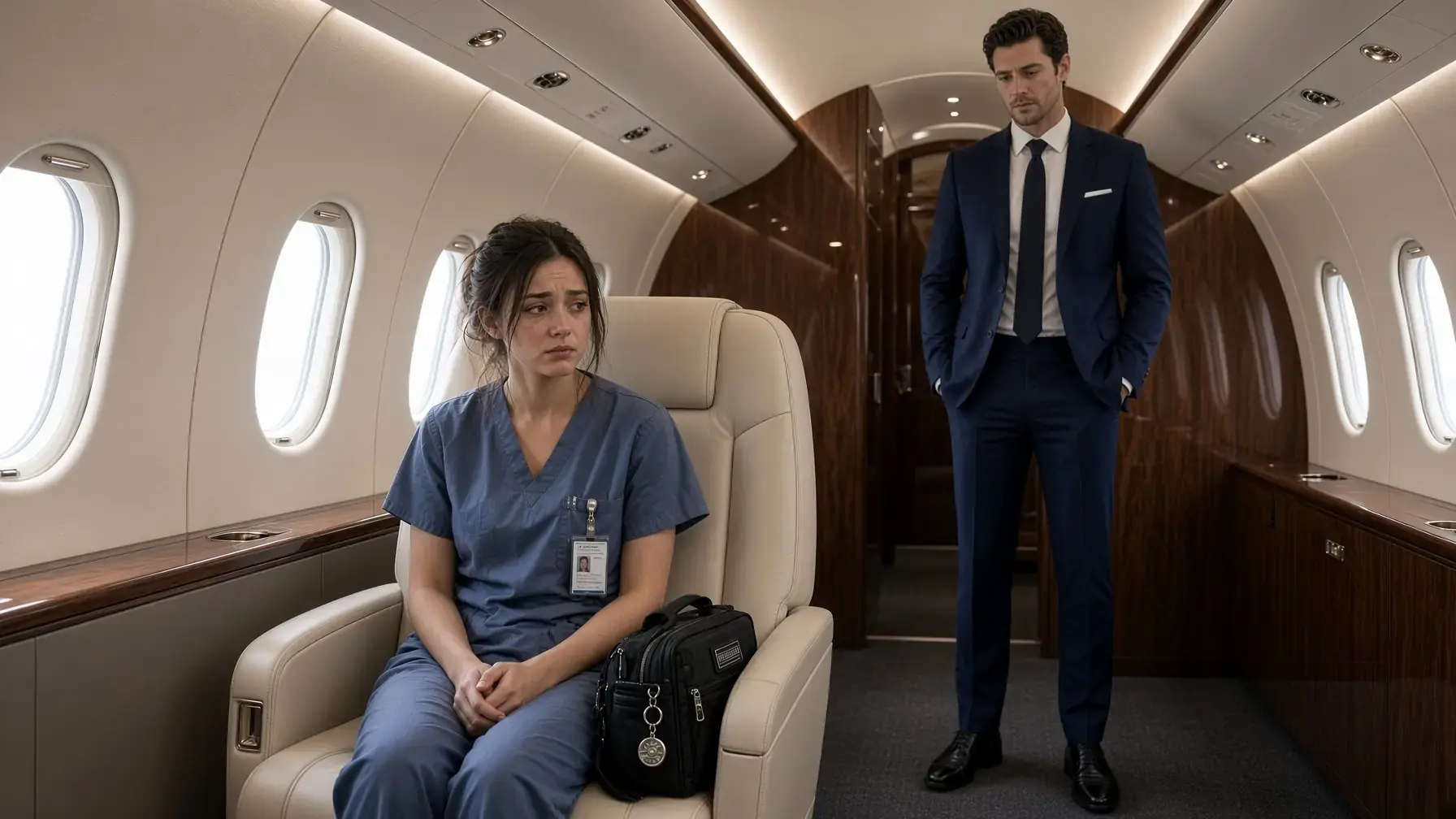
But behind that calm professionalism was a woman who had been carrying far more than anyone knew. Her younger sister had died years earlier, leaving Marin as the guardian of her 9-year-old nephew, Theo. Since then, Marin had built her life around one promise, the boy would never feel abandoned. She worked extra shifts, covered holidays, accepted exhausting overnight rotations, and rarely complained. Her apartment was small, her savings were modest, and her schedule was chaotic, but every morning Theo still had breakfast waiting for him, his school clothes folded neatly, and a note from his aunt reminding him that he was loved.
That afternoon, Marin had just finished a brutal stretch at the hospital when her phone vibrated with a message from Theo's school. His class had been selected for a special science program in Seattle, and his teacher had recommended him for a scholarship interview. Marin had promised him she would be there. The interview was scheduled the following morning, and because of a last-minute cancellation at the airport, she had managed to find a seat on a flight leaving within the hour. She was so tired that the terminal seemed to blur around her.
She followed the boarding signs, handed over her ticket without properly checking the gate, and walked onto an aircraft that looked surprisingly luxurious. She assumed the airline had upgraded her because of some clerical error. She was too exhausted to care. The cabin was quiet, spacious, and filled with cream-colored leather seats. Marin placed her bag beside her, lowered herself into a seat, and closed her eyes.
She didn't notice that there were no other passengers. She didn't notice the polished wood paneling, the private conference table, or the enormous windows. She didn't notice that the aircraft wasn't connected to a commercial gate. What she did notice was the sudden silence when someone entered the cabin. Marin opened her eyes and found a man in a navy suit standing several feet away.
He was tall, sharply dressed, and carried the unmistakable presence of someone accustomed to being obeyed. His name was Callum Voss, founder and CEO of Vas Meridian Technologies, one of the most successful medical technology companies in North America. His company had developed equipment used in hospitals across the country, and financial magazines often described him as brilliant, ruthless, and nearly impossible to impress. But the first thing he noticed about Maren wasn't her mistake. It was her face.
There were deep shadows beneath her eyes. Her hair was loosely tied back. A small adhesive bandage covered one finger, and her hospital ID was still clipped to her uniform. Her hands were trembling slightly as she tried to understand where she was. Callum glanced toward his assistant, then back at her.
The assistant quietly explained that the jet's ground crew had accidentally allowed Maren through the wrong boarding checkpoint during a confusing gate change. Security could have handled the situation quickly, but Callum noticed the way Maren looked toward her phone before anything else. She wasn't worried about embarrassment. She was worried about missing someone. When she explained that she had been trying to get home for her nephew's scholarship interview, Callum expected her to become defensive or frightened.
Instead, she simply apologized again and asked to be put off the plane as quickly as possible. Callum looked at the clock and realized that if they removed her immediately, she would miss her commercial flight and probably the interview the next morning. His jet was heading in the same general direction, and although he was scheduled for an important business meeting, the aircraft had room. His decision seemed irrational even to his assistant. But Callum had spent years surrounded by people who measured everything in profit, efficiency, and leverage.
He had forgotten what it felt like to help someone without asking what it would return. So he told Maren to stay. She refused at first, embarrassed by the generosity and convinced that she had already caused enough trouble. But, Callum insisted that she could use the spare cabin, rest, and be dropped at a private airfield close enough to reach Seattle on time. For the first time in years, someone had offered Maren help without making her feel like a burden.
As the jet lifted into the bright afternoon sky, Maren finally allowed herself to breathe. She sat by the window, watching the clouds drift below them, but she couldn't relax. She kept thinking about Theo. She had promised him she would be there, and promises mattered to her because she knew what it felt like when people broke them. Callum noticed that she was still holding her phone tightly.
He asked about the boy, and Maren showed him a picture. Theo was standing beside a homemade cardboard model of the human heart, smiling proudly beside his aunt. Callum stared at the photograph longer than expected. He had never been good around children, but something about the boy's smile reminded him of a part of his own life he had tried to bury. Years earlier, Callum's younger brother, Everett, had suffered a severe heart condition as a teenager.
Their father had been wealthy but emotionally distant, and when doctors recommended an expensive experimental treatment, Callum's father had refused, convinced that the treatment wasn't worth the risk. Callum had argued desperately, but he had been only 22 and powerless against his father's decision. Everett died before his 23rd birthday. Callum never forgave his father. Eventually, he built Voss Meridian around a simple mission: medical treatment should never depend entirely on how wealthy a family was.
But, success changed him. He became obsessed with expansion, competition, and proving himself. Somewhere along way, the original reason behind his company became buried beneath billions of dollars and endless boardroom battles. Maren knew nothing about this when she noticed a folder beside Callum's seat. It contained documents related to a medical device project that her hospital had recently rejected.
The device was designed to detect early signs of cardiac distress, but the hospital's administrators considered it too expensive. Maren recognized the device from an internal presentation. She carefully explained that the problem wasn't only the price. The machine required specialized training, and many nurses would struggle to use it during an emergency. She pointed out a practical flaw in the design that engineers had overlooked because they had never worked 12-hour emergency shifts.
Callum listened carefully. For the first time, someone wasn't impressed by his title or intimidated by his wealth. She was simply telling him what was wrong. By the time the jet reached Seattle, Callum had asked Maren several questions about emergency medicine. She answered honestly, explaining how exhausted nurses made decisions under pressure, how equipment needed to be simple enough to operate during chaos, and how patients often needed reassurance as much as medication.
Callum realized that the tired woman who had accidentally boarded his jet had just given him more useful feedback than an entire team of consultants had given him in 6 months. But the biggest surprise came after they landed. Callum arranged a car to take Maren directly to Theo's school. She arrived just minutes before the scholarship interview. Theo ran toward her, throwing his arms around her waist.
Maren held him tightly, closing her eyes as tears filled them. Callum watched from a distance and saw something he hadn't felt in years, peace. He had billions, private jets, companies, and people waiting for his decisions, but that simple embrace seemed more valuable than anything he owned. The next morning, however, Maren's world nearly collapsed again. Her hospital administrator informed her that her employment was being reviewed because she had left the city without properly completing her shift documentation.
Maren tried to explain what had happened, but the hospital saw only a scheduling violation. She was terrified. Losing her job meant losing the apartment, the health insurance, and the stability Theo depended upon. She had no wealthy family to call and no savings large enough to survive for long. For the first time in years, Maren wondered whether being strong for everyone else had left her with nothing when she finally needed strength for herself.
Callum learned what happened through his assistant. His first instinct was to intervene using his influence. But he remembered something Maren had said during the flight. People didn't need rescuing every time. Sometimes they needed someone to give them the chance to stand on their own.
So, instead of calling the hospital administrator, Callum contacted his company's medical research department. He asked them to invite Maren to participate in a nurse advisory panel for the cardiac monitoring device. The position was paid, flexible, and designed around her hospital schedule. He didn't make the decision for her. He simply opened a door.
Maren accepted, but only after making it clear that she would never compromise her nursing work. Over the following months, something remarkable happened. Maren became one of the strongest voices in the company's development program. She tested prototypes, identified safety problems, trained engineers to understand emergency room realities, and insisted that the final device be affordable for smaller hospitals. Callum began attending those meetings himself.
The ruthless CEO gradually became a listener. He learned to ask questions before giving orders. He began visiting hospitals without cameras or press releases. He sat with nurses during lunch and heard stories about patients who couldn't afford treatment. Slowly, the company changed.
But Maren's biggest challenge wasn't her career. It was learning that she didn't always have to carry everything alone. Theo noticed that she no longer came home completely exhausted. She started taking weekends off. She began eating proper meals.
She even allowed herself to laugh again. Callum, meanwhile, began repairing his relationship with his estranged father, who was elderly and living alone. Their reconciliation wasn't easy. There were years of anger between them, years that couldn't be erased with one apology. But Callum finally understood that forgiveness didn't mean pretending the past hadn't happened.
It meant refusing to let the past control the rest of his life. Nearly a year after Maren had accidentally boarded Callum's jet, Voss Meridian unveiled its redesigned cardiac monitoring system. The device was smaller, easier to operate, and significantly cheaper. Hospitals that had once rejected the original version began ordering it. At the launch event, Callum stood before investors and reporters, but instead of taking credit, he publicly recognized the nurses and clinicians who had transformed the project.
He specifically thanked Maren, not because she had been a passenger on his private jet, but because she had reminded him why he had entered medicine in the first place. Maren stood in the audience with Theo beside her. She looked around the enormous room and remembered the exhausted woman who had mistakenly walked onto a private jet believing she had ruined everything. She realized that the greatest turning point in her life hadn't been the flight itself. It had been the moment someone saw how tired she was and chose compassion instead of judgment.
After the ceremony, Callum approached Marin and handed her a small wooden box. Inside was a simple silver airplane charm. It wasn't expensive and that was exactly why he had chosen it. He explained that he wanted her to remember the day she boarded the wrong plane because sometimes the wrong turn is what takes us exactly where we need to go. Marin smiled through tears and told him that the flight had taught her something, too.
She had spent years believing that strength meant never needing anyone. Now she understood that accepting kindness wasn't weakness. Sometimes it was courage. Theo, standing between them, looked up at Callum and asked whether the private jet really had a bedroom. For the first time in a long time, Callum laughed without holding anything back.
Marin laughed, too, and the three of them walked toward the bright afternoon sunlight together. There was no dramatic fortune waiting at the end of the road, no magical transformation, and no perfect life. There were still difficult days, complicated decisions, and wounds that needed time to heal. But there was something more meaningful. People who had once been strangers had become part of one another's lives.
Marin continued nursing while serving as a clinical advisor for Voss Meridian. Callum transformed the company into one of the leading advocates for affordable emergency technology. Theo eventually earned his scholarship and grew into a young man who never forgot the nurse who raised him. And every time Marin saw an crossing the sky, she remembered that exhausted afternoon when she had made the biggest mistake of her life and somehow found the beginning of a better one. Because sometimes life doesn't give us the destination we planned for.
Sometimes it places us on the wrong plane, sends us through the wrong door, or introduces us to someone we never expected to meet. And sometimes, when we're exhausted, frightened, and convinced that we've made a terrible mistake, kindness appears in the form of a stranger who simply chooses not to judge us. Maren thought she had boarded the wrong plane that day. In truth, she had boarded the flight that carried her toward healing, purpose, friendship, and a second chance.
Because the most beautiful part of Maren's story was never the private jet, the billionaire CEO, or the success that followed. It was the simple truth that changed two lives forever. Sometimes a person doesn't need someone to save them. Sometimes they only need someone to see them, believe in them, and say, "Stay. "
Exhausted Nurse Boarded the Wrong Plane — It Was the CEO's Jet, and He Said "Stay!"
Theme:
Font Size:
24px