
Debate: Asking Babies for Consent Before Changing Their Diapers
Debate: Asking Babies for Consent Before Changing Their Diapers
News 12/06/2026 14:55
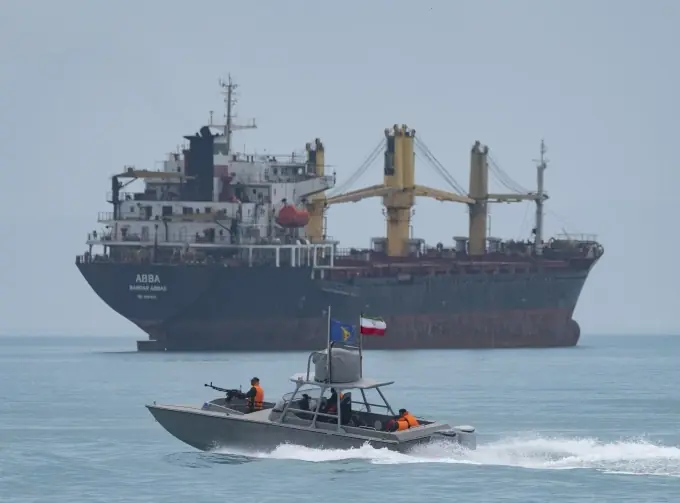
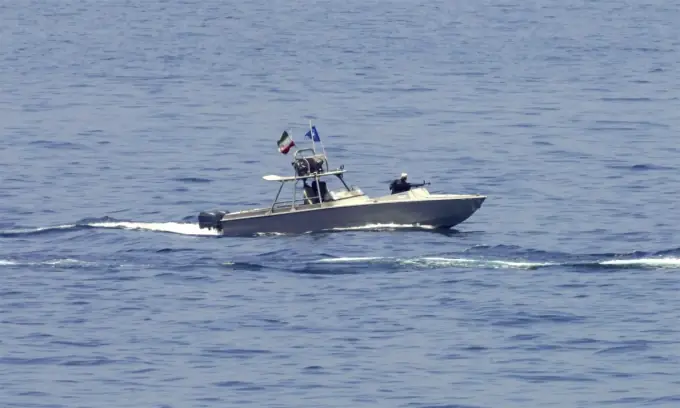
Iranian high-speed armed boats, nicknamed the "mosquito fleet" due to their small size and high maneuverability, pose a constant threat to the US Navy and cargo ships in the Strait of Hormuz.
On April 13, US President Donald Trump declared that he had "wiped out" the Iranian navy, sinking 158 warships, but acknowledged that Tehran still possesses "fast attack boats," although he did not consider them a major threat.
Fast attack boats are small, high-speed vessels equipped with machine guns and some types of anti-ship missiles. They are considered the primary weapon used by the Iranian Islamic Revolutionary Guard Corps (IRGC) naval forces for patrolling or laying mines in the Strait of Hormuz, according to Chris Long, a former British naval officer who served in the Persian Gulf.
Before the conflict, the IRGC was believed to possess 3,000-5,000 fast attack boats. The Wall Street Journal, citing sources, reported that more than 60% of the IRGC's fast attack boats remain intact after nearly two months of fighting with the US and Israel. These boats are often hidden in underground caverns along the Iranian coast and utilize their high speed and maneuverability to evade surveillance satellites.
Saeid Golkar, an IRGC expert and professor of political science at the University of Tennessee, calls them Iran's "mosquito fleet," due to their small size, speed, and maneuverability, enabling them to conduct harassing attacks using machine guns, missiles, and drones. They form the core of the IRGC's navy, a force independent of the regular navy.
"The IRGC navy operates like a guerrilla force at sea," Golkar stated. "They focus on asymmetrical warfare, prioritizing lightning-fast attacks and quick retreats, especially in the Persian Gulf and the Strait of Hormuz."

Iranian naval soldiers on a speedboat during a military exercise in the Gulf of Oman in 2025. Photo: AFP
The IRGC's naval forces were established around 1986. According to expert Farzin Nadimi from the Washington Institute, during the Iran-Iraq war, the Iranian regular navy hesitated to attack oil tankers from Kuwait and Saudi Arabia, countries that were then funding Iraq.
Therefore, the IRGC intervened and intensified its attacks, forcing the US to deploy warships to escort oil convoys through the area. During this period, the USS Samuel B. Roberts nearly sank after hitting a mine laid by Iran. The US Navy retaliated by destroying two frigates and numerous other Iranian military vessels in a subsequent confrontation.
Three years later, witnessing the US forces overwhelming the Iraqi army in the First Gulf War, Iran believed it would be difficult to win if it confronted the US military directly. Therefore, according to Nadimi, the country has developed an elite force specializing in guerrilla warfare in the Gulf.
The IRGC Navy has approximately 50,000 members, divided into five operational zones along the Gulf. This force also maintains a presence on many of the 38 islands controlled by Iran in the region.
The IRGC has built at least 10 heavily fortified and well-camouflaged bases to conceal its fast attack boat fleet. One of these is Farur, the operational center of the Iranian naval special forces.
Initially, Iran used modified boats equipped with machine guns or grenade launchers. The IRGC later manufactured a series of specialized small boats, along with mini-submarines and unmanned boats. The force claims some of its boat models can reach speeds exceeding 185 km/h.
The IRGC Navy has recently developed larger and more modern vessels, many of which have become targets of US-Israeli attacks, according to Alex Pape, a leading maritime expert at the open-source defense analytics platform Janes. Among the ships damaged in the US attack was the UAV carrier Shahid Bagheri, a converted container ship capable of launching anti-ship missiles.

Satellite image of Iran's UAV carrier Shahid Bagheri docked near Bandar Abbas port in 2024. Photo: Maxar Technologies
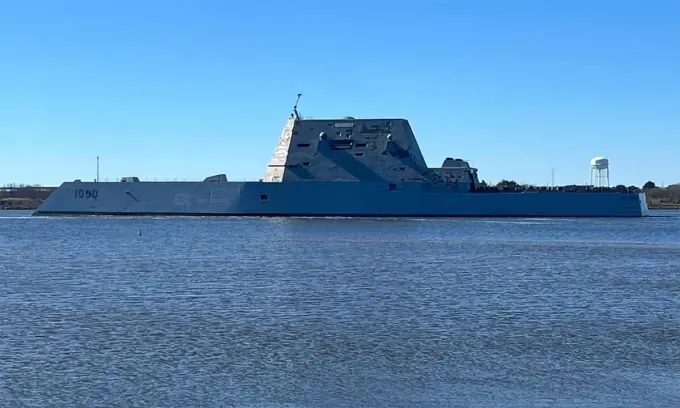
To counter the "swarm" tactics of Iran's small boat fleets, US warships have been equipped with heavy artillery and other modern equipment. However, commercial ships are completely defenseless against this type of attack.
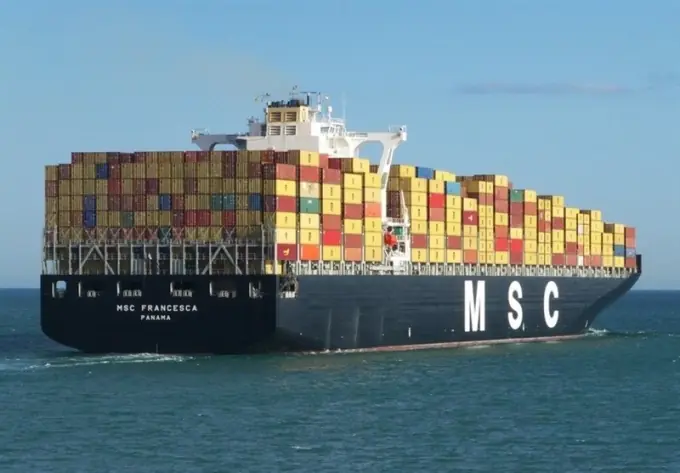
On April 18, IRGC speedboats approached two commercial ships operating near the Strait of Hormuz, firing to stop an oil tanker and apparently launching a UAV that damaged a container ship. Neither incident reported any casualties.
Nicholas Carl, an Iran expert at the American Enterprise Institute (AEI) in Washington, argues that such incidents demonstrate the constant threat that Iran's "mosquito fleet" can pose to commercial ships transiting the Strait of Hormuz, even with a large US Navy presence nearby enforcing the blockade.
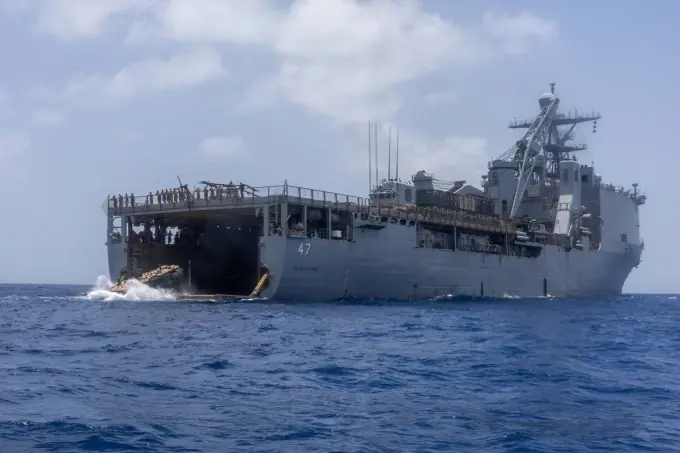
Large US warships have so far avoided patrolling the Strait of Hormuz, because the narrow strait is not wide enough for warships to maneuver and there is almost no time to react if attacked at close range by Iranian speedboats using UAVs or missiles.

Location of the Strait of Hormuz. Graphic: Guardian
The US warships enforcing the blockade could be stationed primarily outside the strait, in the Gulf of Oman or further out in the Arabian Sea. From these locations, they can still control shipping lanes, but the IRGC would be much harder to attack.
Expert Carl points out that these are only isolated attacks; the risk to the US Navy and commercial ships would be much higher if Iran were to actually experiment with swarm tactics, using dozens of speedboats to approach from multiple directions and launch surprise attacks in real combat situations.
The IRGC Navy has long employed a "cat and mouse" tactic against the US military in the Persian Gulf. Admiral Gary Roughead, former US Navy commander, recalls that in the 1990s and 2000s, small Iranian attack boats would often speed directly towards US warships and then suddenly change course when only about a kilometer away.
"They are a very annoying disruptive force," Admiral Roughead said. "You never know what they're planning or what their real intentions are."
UAV warfare has taken the danger level of the "mosquito fleet" to a new level, Roughead said. These devices are inexpensive and sometimes very difficult to detect and intercept, but they have the potential to inflict significant damage on a warship worth billions of dollars, the admiral said.
Debate: Asking Babies for Consent Before Changing Their Diapers



















Narcissistic Personality Disorder Signs
Debate: Asking Babies for Consent Before Changing Their Diapers

Study identifies possible connection to autism development

Check your personality based on the word that comes to your mind first