
Oil rises as markets assess supply risk after Iran denies US talks
News 24/03/2026 15:58

For the first two months of 2026, the financial world had only one word on its lips: Gold. The precious metal embarked on a parabolic run, fueled by a perfect storm of systemic bank failures, escalating conflicts in the Middle East between Iran and Israel, and a global trend of de-dollarization. Gold didn’t just rise; it soared, shattering the psychological $5,000 per ounce barrier in early February.
However, as of late March 2026, the narrative has shifted abruptly. A sharp 15-18% correction has dragged prices back down to the $4,300 - $4,400 range. To the untrained eye, the "Gold Rush" is over. To the seasoned institutional investor, this looks like the "Ultimate Buy the Dip" opportunity of the decade.
In this comprehensive analysis, we explore the mechanics behind this sudden pullback, the surging dominance of the US Dollar (USD), and why the current volatility might be the "last exit" for investors to enter the gold market before the next leg up.
It seems counterintuitive. With warships in the Strait of Hormuz and global supply chains under threat, Gold—the ultimate "Safe Haven"—should be climbing. Why is it retreating?
One of the most misunderstood aspects of gold trading is its role as a "liquidity provider." During periods of extreme market stress, institutional investors (hedge funds and pension funds) often face massive losses in their equity and crypto portfolios. To cover "margin calls" (the need to deposit more cash to keep their positions open), they sell their most liquid and profitable assets.
In March 2026, Gold was the most profitable asset on most balance sheets. The selling we see today isn't necessarily a lack of faith in gold; it is a desperate grab for cash to keep other investments afloat.
The US Dollar Index (DXY) has staged a miraculous recovery. While many predicted the dollar’s demise due to high debt levels, the "Dollar Smile Theory" has kicked in. In times of global panic, everyone—from central banks to retail savers—flees to the deepest, most liquid pool of capital: the US Dollar.
As the USD strengthens, gold (which is priced in USD) naturally becomes more expensive for holders of Euros, Yen, or Yuan. This "mechanical" downward pressure is a primary driver of the current price correction.
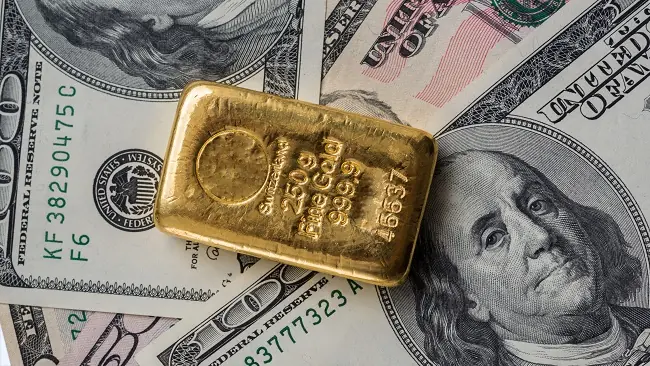
As we move through the first quarter of 2026, the US Federal Reserve has remained surprisingly "hawkish." Inflation, driven by rising energy costs due to the Middle East crisis, has not cooled as fast as expected.
Gold is a non-yielding asset. It doesn't pay a dividend, and it doesn't pay interest. When the Fed keeps interest rates between 3.5% and 3.75%, the "opportunity cost" of holding gold increases.
If an American investor can put their money into a 6-month Treasury Bill and earn a guaranteed 3.7%, they are less likely to hold a volatile bar of gold that might drop another 5% tomorrow. This shift in capital flow toward "Risk-Free" USD returns is currently starving the gold market of momentum.
Critics argue that in 2026, Gold has lost its crown to the "Digital Gold"—Bitcoin—or to the safety of the US Dollar. Is this true?
While Bitcoin has seen significant adoption as a store of value, its 2026 performance has been marred by extreme volatility and regulatory crackdowns in the EU and Asia. Gold remains the only asset with zero "counterparty risk." You don't need a power grid or an internet connection to trade a gold coin. In a true "black swan" event involving cyber warfare—a major concern this year—physical gold remains the ultimate insurance.
The conflict between Iran and Israel has entered a stalemate phase. Markets hate uncertainty, but they quickly "price in" known conflicts. The initial shock that drove gold to $5,000 has worn off. Unless there is a significant escalation (such as the closure of the Suez Canal or direct involvement of more superpowers), gold may lack the immediate "fear catalyst" to push back toward its highs in the short term.
If the short-term outlook is bearish, why are we calling this the "Ultimate Buy the Dip" moment? The answer lies in the structural shift of the global economy.
While retail investors in the US are selling their gold ETFs to buy dollars, Central Banks (especially in the BRICS+ nations) are doing the exact opposite. In 2025 and early 2026, central bank gold buying hit an all-time high.
These institutions are not looking at 3-month charts; they are looking at 30-year cycles. They are diversifying away from the USD to protect themselves from potential sanctions and debt debasement. When the "big money" is buying the dip, retail investors should take note.
The US national debt is now at levels that many economists consider unsustainable. To service this debt, the Fed will eventually be forced to lower interest rates and "inflate the debt away." When the pivot eventually happens—likely in late 2026—gold will not just recover; it will likely enter a "super-cycle" that could see prices reach $6,000 or $7,000.
For the American investor, the current environment requires a surgical approach.
Short-Term (1-3 months): Maintain a healthy cash position in USD. High-yield savings accounts (HYSA) and Money Market Funds are your best friends right now.
Goal: Liquidity and modest interest gains while waiting for the gold bottom to solidify.
The "Dip-Buying" Zone: Technical analysts identify the $4,150 - $4,250 range as a massive support zone. Buying in this range provides an excellent risk-to-reward ratio.
Dollar-Cost Averaging (DCA): Do not try to "time" the absolute bottom. Instead, allocate 5-10% of your portfolio to gold and buy in small increments every week that the price stays below $4,500.
Looking at the XAU/USD charts for March 2026, we see a "Bull Flag" pattern on the monthly timeframe. The run from $2,500 to $5,000 was the "pole," and this current correction is the "flag."
History tells us that once a bull flag completes its consolidation, the next move is usually equal to the height of the pole. This puts a technical price target of $6,500 - $7,000 for Gold by mid-2027. The current drop to $4,300 is merely a healthy "breather" in a long-term bull market.
Is the Gold Rush over? Absolutely not.
The current market dynamic is a classic "shake-out." It is designed to scare away the weak hands and reward those with a long-term vision. The US Dollar is currently enjoying its moment in the sun due to high interest rates and geopolitical panic, but the underlying cracks in the global financial system remain.
Our Verdict: Use the strength of the USD to buy the weakness in Gold. The "Buy the Dip" moment of 2026 is officially here. Position yourselves accordingly.















![🔥[KALEB STORY]🔥THE PAINFUL CHILDHOOD BEHIND THAT SMILE YOU SEE ON TV 💔](https://onplusnewscom.8cache.com/onplusnewscom/images/2026/03/21/1774099813GY09LCXgWc.webp)