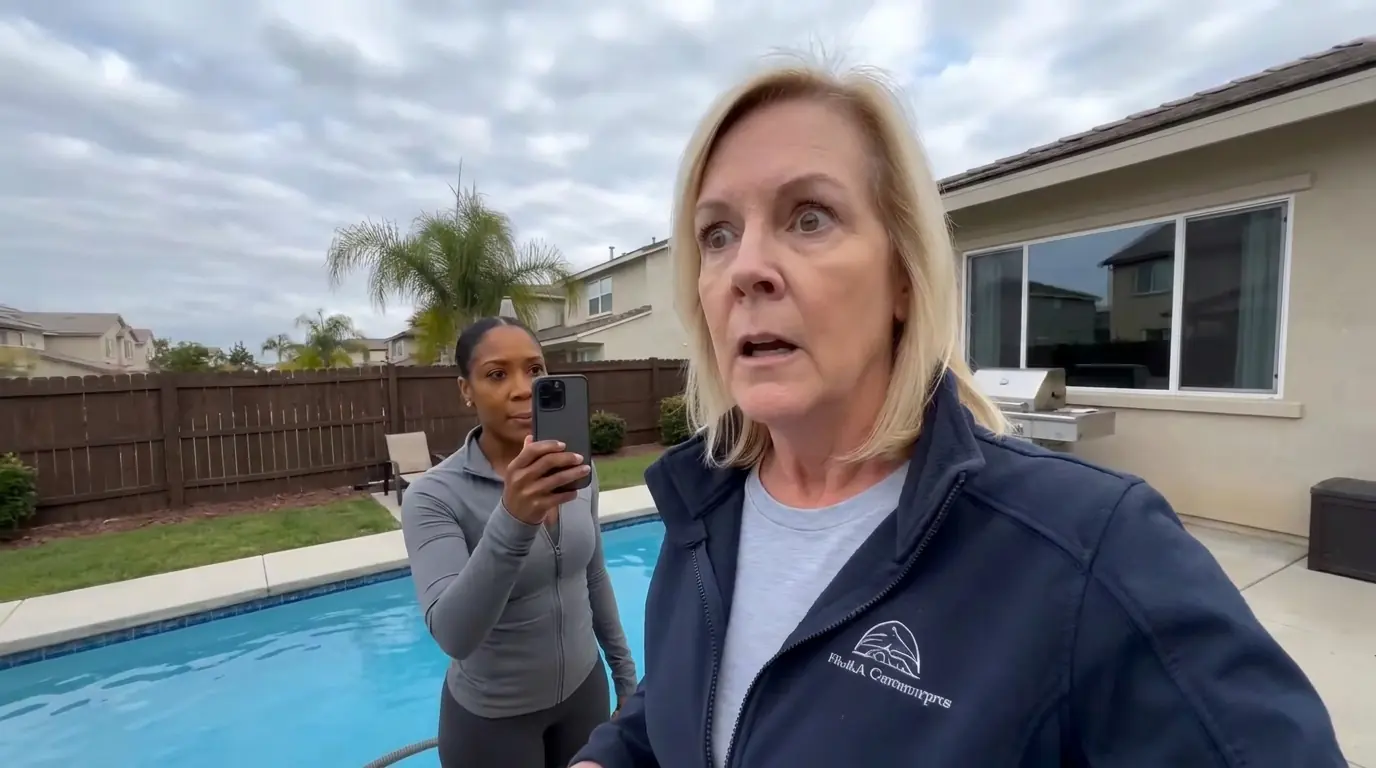
The first thing I noticed about Brookhaven Oaks was how carefully everyone seemed to keep their life inside the lines. The grass was trimmed to almost identical heights, the mailboxes were painted the same shade of charcoal, and even the trash cans disappeared behind fences by the end of collection day. My wife, Rachel, called the whole place suspiciously tidy, but after sixteen years of apartment buildings, busy streets, and neighbors whose arguments traveled through walls, tidy sounded wonderful to me. I wanted a place where our kids could spend summer outside and where I could sit in my own backyard without hearing somebody rev a motorcycle under the bedroom window.
The house at 117 Juniper Hollow gave us exactly that. It was a two-story brick colonial outside Raleigh, North Carolina, with four bedrooms, an aging cedar deck, and a backyard swimming pool shaped like a long kidney bean. The pool was what sold Rachel before the realtor finished showing us the kitchen, because our eleven-year-old son, Noah, practically jumped into it wearing sneakers during the inspection. Our fifteen-year-old daughter, Claire, pretended she was too mature to care, then immediately asked whether her friends could come over every weekend.
The previous owner was a retired dentist named Harold Mercer. Before handing over the keys, Harold showed me the pump controls, the filter schedule, the heater, and a binder containing ten years of service records. Tucked into the front pocket was a handwritten note that said, Take care of the water and people will always want to gather around it. I remember laughing when I read it, because it sounded like something printed on a decorative sign at a gift shop.
Six months later, that sentence would mean more to me than anything printed in Brookhaven’s HOA handbook.
My name is Andrew Keller, and I was forty-six when we moved in. I worked as an operations director for a regional hospital network, which meant my days were mostly budgets, staffing problems, vendor contracts, and people calling me when some invisible system stopped doing what everyone assumed it did automatically. Rachel taught fourth grade at a public elementary school, so between us we had developed a healthy appreciation for rules that actually solved problems and a deep suspicion of rules created mainly because someone enjoyed enforcing them.
For the first few weeks, Brookhaven felt almost too easy. Neighbors brought cookies, Noah found three boys his age within walking distance, and Claire discovered that a girl from her chemistry class lived two streets over. We spent evenings grilling near the pool while cicadas screamed from the oak trees and the kids argued about who had splashed whom first. I remember telling Rachel that maybe for once we had chosen a house without accidentally purchasing a second full-time job.
Then I met Patricia Harwood.
Patricia lived three houses down in a large beige home with black shutters and a front yard that looked professionally photographed every morning. She was fifty-five, divorced, worked part-time as a real-estate broker, and carried a white clipboard everywhere she went as though Brookhaven Oaks might suddenly require emergency documentation. The first time she approached me, I was standing beside our pool testing chlorine levels, and she did not bother introducing herself before saying, “You’re the new owner.”
I looked toward her through the fence. “That’s me.”
Patricia glanced from the deck to the pool equipment and then back at me. “I hope the closing attorney gave you the current community standards.”
“He gave us everything.”
“Good.”
She smiled, but it was the kind of smile that came with a warning label. “People sometimes move in and think paying for the property means they can ignore the neighborhood.”
I thought that was a strange way to greet someone. Still, I told her we had no intention of ignoring anything, and she said, “Excellent,” before continuing her walk. Rachel had been watering flowers near the porch and heard the entire exchange.
When Patricia disappeared around the corner, Rachel looked at me and asked, “Did we just get inspected?”
“Possibly.”
“Should I stand straighter?”
“Probably.”
We laughed.
That was my first mistake with Patricia.
Not the laughing.
The assumption that she was harmless.
The actual HOA president at the time was a man named Douglas Price, a seventy-year-old retired accountant who had served two terms and was desperate to stop. Douglas was quiet, procedural, and so determined to avoid conflict that some meetings felt more like negotiations with a hostage taker than neighborhood governance. Patricia chaired the architectural committee, which technically gave her authority to review exterior changes but did not make her responsible for everything from pool chemistry to the spiritual condition of garbage bins.
She did not appear to understand the distinction.
Within a month, I began receiving little “courtesy reminders.” One said our garden hose had remained visible beside the garage for more than twenty-four hours. Another mentioned that Claire’s bicycle leaned against the side fence where it could supposedly be seen from the street, although you would need binoculars and a willingness to trespass into somebody else’s bushes to confirm that.
None carried an actual fine.
I ignored them.
Patricia responded to being ignored by appearing more often.
She walked by while I cleaned the pool and suggested I remove a floating basketball hoop because “bright plastic equipment changes the visual character of the rear elevation.” I asked whether the HOA regulated equipment inside fenced backyards, and she said not everything needed a written rule if homeowners respected community expectations. I told her I preferred written rules, and she gave me a look that made it clear she had just added my name to some invisible list.
Two weeks later, she challenged Rachel over a birthday party.
Claire turned sixteen in August, and we let her invite twelve friends over for pizza and swimming on a Saturday afternoon. They played music from a Bluetooth speaker, laughed too loudly in the way teenagers do, and finished by eight-thirty. The next morning, Patricia appeared at our door carrying her clipboard.
Rachel answered.
Patricia said the party had created “excessive recreational noise.”
Rachel asked whether anyone had complained.
Patricia said she had.
Rachel asked which HOA rule prohibited teenagers from using a pool at four in the afternoon.
Patricia replied, “The rules assume basic consideration.”
Rachel smiled. “Then I assume we’re done.”
Patricia did not like Rachel after that.
The notices became more specific.
A warning about pool furniture allegedly extending above the fence line. A complaint about grass clippings left near the curb, even though the yard crew removed them less than twenty minutes later. A claim that our pool filter operated during restricted nighttime hours, which would have been impressive considering I had programmed the timer myself and it shut off every evening at seven.
I started keeping everything.
Emails.
Notices.
Camera clips.
Photographs.
As someone who managed hospital operations, documentation was almost a reflex. When an expensive medical pump failed, nobody cared who “felt like” it had been maintained correctly; they wanted dates, service records, serial numbers, and logs.
Patricia seemed to operate in the opposite direction.
She believed conviction could substitute for paperwork.
In September, I attended my first HOA meeting. Douglas Price sat at the center table looking like a man counting the minutes until parole, while Patricia occupied the chair beside him even though her committee had no special role in most agenda items. She interrupted three homeowners, corrected the secretary twice, and spent nearly ten minutes discussing a resident who had painted his shed a shade she described as “aggressively blue.”
At the end of the meeting, Douglas announced he would not seek another term.
Patricia looked almost pleased.
Several homeowners did not.
That was when I met Elaine Porter.
Elaine was sixty-three, recently retired from practicing municipal law, and lived on Sycamore Lane with her husband, Peter. She had served one year as an ordinary board member but rarely spoke unless something mattered. After the meeting, she introduced herself to Rachel and me and asked how our first months in Brookhaven were going.
Rachel said, “Ask Patricia.”
Elaine laughed.
“So she found you.”
“Apparently.”
Elaine glanced toward Patricia across the room.
“She finds everybody eventually.”
Then she told me something I did not know.
Three families had already formally challenged architectural violations issued by Patricia that year. Two prevailed. The third simply sold their house before the appeal finished.
“Why does the board let her keep doing it?” I asked.
Elaine looked toward Douglas.
“Because correcting Patricia requires an argument, and Douglas has spent four years avoiding arguments.”
That explanation stayed with me.
A difficult person can create a lot of power from everyone else’s exhaustion.
The election took place in October.
Patricia ran for president.
So did Elaine.
Patricia campaigned as though Brookhaven were choosing a governor. She printed flyers promising “stronger standards,” “protection of property values,” and “consistent enforcement without favoritism.” Elaine sent one email saying she wanted transparent rules, accurate records, and fewer arguments over things the HOA did not actually regulate.
Elaine won.
Forty-eight votes to twenty-nine.
Patricia remained architectural committee chair because her term in that position had another six months.
The morning after the election, Patricia walked past while I was skimming leaves from the pool.
“You voted for Elaine.”
It was not a question.
I looked over.
“Ballots were secret.”
“That means yes.”
I smiled.
“Have a good morning, Patricia.”
She stared at the water.
“You should clean that more often.”
I looked at the pool.
The water was clear enough to count individual screws in the drain cover.
“What exactly needs cleaning?”
She pointed vaguely.
“You can see buildup near the tile.”
I walked to the edge and looked.
Nothing.
Patricia folded her arms. “People notice these things.”
“Which people?”
“The neighborhood.”
“I’m part of the neighborhood.”
She smiled coldly.
“You’re still new.”
Then she walked away.
Rachel found me staring after her and asked what happened.
“She thinks the pool is dirty.”
Rachel looked at the water.
“Our children drink more dirt every time they eat outside.”
“I know.”
“Don’t engage.”
I agreed.
Unfortunately, Patricia considered non-engagement a form of defeat she needed to correct.
Two weeks later, the pool service technician found a handful of leaves and grass clippings inside the skimmer baskets. That would normally mean nothing during autumn. What made it unusual was that the grass had been freshly cut even though our landscaping crew had not visited for five days.
I checked the cameras.
One rear camera covered the patio but not the narrow strip behind the equipment shed. At 6:11 the previous evening, Patricia walked along the sidewalk outside our side fence, disappeared briefly from view, and reappeared forty seconds later. The footage did not show her entering our yard.
Rachel wanted another camera.
I installed one.
That decision probably saved us later.
The next incident came on a Wednesday.
Noah found an empty fertilizer bag floating in the shallow end after school. I initially assumed wind had carried it over the fence. Then I noticed the bag was weighted with two landscaping stones, meaning someone had intentionally placed enough weight inside to make it sink slowly.
I checked the new camera.
Nothing.
The angle still missed a small section beside the back gate.
I moved it again.
Patricia continued walking past our home almost every day.
Sometimes she stopped.
Sometimes she stared through the fence.
Once, our doorbell camera recorded her taking a photograph of a delivery box on the porch.
By Thanksgiving, the entire thing had become irritating enough that I finally filed a written complaint with the HOA.
Elaine called the next evening.
“I received it.”
“I’m sorry to make your first month exciting.”
“You are not the exciting part.”
She asked for camera footage, dates, and copies of Patricia’s notices. I sent everything.
Elaine then told me the architectural committee had issued six “courtesy reminders” that month without board authorization.
“All Patricia?”
“Her account.”
“Can you remove her?”
“Not unilaterally.”
“But?”
“The board can restrict the committee’s authority while we review.”
I heard hesitation.
“What aren’t you saying?”
Elaine sighed.
“There are more complaints.”
That changed things.
A couple on Birch Lane claimed Patricia repeatedly photographed their backyard through a fence. Another homeowner said she entered his side yard while he was away to measure a storage shed. A retired nurse named Denise Harper accused Patricia of moving decorative planters and then issuing a notice claiming they had been placed incorrectly.
No one had proof strong enough to make the issue simple.
Patricia denied everything.