The Great Escape
Life stories 01/07/2026 22:59


The first thing Kendra changed was not my furniture.
It was the air.
Until she arrived, my house still felt like mine. Quiet, yes. Painful, certainly. Every step with the walker felt as if someone had driven nails directly into my hip, but at least the rooms still belonged to me.
Frank’s chair still sat beside the window.
My wedding photograph still rested on the mantle.
The kitchen still smelled faintly of coffee and cinnamon.
The silence hurt, but it was my silence.
Kendra arrived on a Tuesday afternoon carrying three cardboard boxes.
She didn’t knock.
She opened the front door using the code Scott had given her and walked inside like a woman entering a vacation rental she had already paid for.
“Oh good, you’re awake.”
She smiled brightly.
The smile never reached her eyes.
I sat in my recliner with my ice pack balanced against my hip.
“What are those?” I asked.
“Just some things to help.”
She set the boxes down in my living room.
Inside them were throw pillows.
Candles.
Artificial plants.
Picture frames.
A rolled-up rug.
The kind of decorations people buy when they’re trying to make a house look appealing to strangers.
Kendra had worked as a home stager before she married Scott.
She mentioned this often.
Too often.
As though arranging furniture qualified someone to rearrange lives.
She turned slowly in the center of my living room.
Her eyes moved over my walls.
My shelves.
My curtains.
My photographs.
She wasn’t looking.
She was evaluating.
“This room is really dark.”
I glanced toward the windows.
Sunlight filled half the room.
“It isn’t dark.”
“The colors are.”
She touched the arm of Frank’s recliner.
“This chair takes up a lot of space.”
My voice became very quiet.
“That was my husband’s chair.”
“Oh.”
She smiled again.
“Of course.”
Five minutes later, she moved it anyway.
I watched from my recliner as she slid Frank’s chair against another wall.
Then she moved my reading lamp.
Then my end tables.
Then the small table beside the sofa where Frank used to leave his glasses every evening.
Nothing dramatic.
Just three feet here.
Two feet there.
A few inches.
Tiny changes.
The kind people believe you won’t notice.
The kind I had spent thirty-one years noticing.
At Ridgemont Regional Medical Center, I once uncovered a billing fraud because a department head changed three numbers in a monthly report.
Three numbers.
Most people never saw it.
I saw it.
Small changes tell larger truths.
Kendra finally picked up my wedding photograph.
Frank and I.
June 1981.
Standing outside St. Michael’s Church.
He was twenty-eight.
I was twenty-four.
He had forgotten his cufflinks.
I had lost one shoe before the ceremony.
We laughed through the entire reception.
Forty-five years later, I still looked at that picture every morning.
Kendra examined it.
Tilted her head.
Then set it face-down against the closet wall.
In its place, she leaned a large abstract print against the mantle.
Blue.
Gray.
Orange circles.
The kind of art sold in stores that smell like candles.
I stared at it.
“Kendra.”
She turned.
“Yes?”
“Why did you move my wedding picture?”
“Oh.”
She laughed lightly.
“I thought we’d freshen things up.”
We.
Not you.
We.
As if she already lived there.
As if the decision had already been made.
As if I simply hadn’t received the memo.
That evening she posted photographs online.
I know because Lorraine showed me.
My living room.
My furniture.
My house.
The caption read:
Freshening up Mom’s place while she recovers.
Forty-seven people clicked “like.”
Several wrote:
You’re such a good daughter-in-law.
She’s lucky to have you.
Family is everything.
I stared at the screen.
Then I looked across my living room.
Frank’s photograph still leaned against the wall.
Facing inward.
Like someone in time-out.
I said nothing.
Because at the hospital, when something felt wrong, we never reacted to the first incident.
One incident was an accident.
Two incidents were coincidence.
Three incidents became a pattern.
Patterns mattered.
Patterns held up in court.
Patterns survived audits.
Patterns told the truth.
The second incident happened three days later.
Kendra arrived again.
No Scott.
No phone call.
No warning.
She carried paint samples.
At least twenty of them.
She spread them across my coffee table.
Soft green.
Cream.
Gray.
Beige.
Names like Ocean Mist and Winter Sage.
She held one against my wall.
“What do you think?”
“I think that’s my wall.”
She laughed.
“Oh, Myra.”
As though I had made a joke.
As though ownership itself had become funny.
She taped four samples beside my bookshelf.
Then she stood beside me.
“You know, once the space is brighter, you’ll feel better.”
The sentence bothered me.
Not because of the words.
Because of the assumption.
Once.
Not if.
Once.
As if decisions had already been made.
As if my approval was merely a formality.
That evening I called Scott.
He answered on the fourth ring.
“Hey, Mom.”
“Kendra was here.”
“Yeah.”
“She moved things.”
Silence.
Then:
“She’s just trying to help.”
“She put my wedding photograph in a closet.”
“Mom, don’t make a big deal out of everything.”
Everything.
I had spent six weeks waiting for my son.
Eleven minutes on my doorbell camera.
Two missed prescription pickups.
Three missed therapy appointments.
And now I was making a big deal because someone removed my husband from his own living room.
I said, “Scott, when are you coming back?”
“Things are crazy right now.”
“When?”
“I’ll figure it out.”
He ended the call six minutes later.
I checked the doorbell footage that evening.
Old habits.
Scott’s car appeared the previous day.
2:14 p.m.
He entered the house.
2:25 p.m.
He left.
Eleven minutes.
Again.
The man who promised to move in had now spent less than half an hour inside my home in nearly three weeks.
Meanwhile, Kendra had spent nine hours rearranging it.
The third incident arrived Monday morning.
7:15 a.m.
The doorbell rang.
It took me nearly four minutes to reach the front door.
Walker.
Hallway.
Pause.
Breathe.
Pain.
Continue.
When I opened the door, three children stood on my porch.
Logan.
Eleven.
Haley.
Eight.
Cody.
Five.
All wearing backpacks.
All holding lunchboxes.
Behind them sat Scott’s SUV.
Engine running.
Window down.
“Morning, Mom!”
I stared.
The children stared.
“Scott?”
“Kendra got called into work.”
He smiled.
“I’ve got an interview.”
“What?”
“Just today.”
He waved.
“I’ll pick them up after work.”
The SUV pulled away.
My grandson Cody asked:
“Grandma, where do we put our stuff?”
I looked at my walker.
I looked at the three children.
I looked at the empty street.
And I realized my son had just used his disabled mother as free childcare.
The first day became three days.
Three days became one week.
One week became two.
Every morning.
7:15.
Three children.
Backpacks.
Lunches.
Noise.
Television.
Arguments.
Questions.
Hunger.
Energy.
I love my grandchildren.
That is important.
None of this was their fault.
Logan helped me carry groceries.
Haley made tea.
Cody hugged me every afternoon.
They were children.
Children simply go where adults place them.
The adults were the problem.
The adults had decided a woman recovering from hip surgery could supervise three children because daycare cost money.
I later learned exactly how much.
Two thousand four hundred dollars per month.
Scott had been unemployed for eight months.
Kendra worked irregular staging jobs.
Money was tight.
My house was free.
I was free.
And apparently my labor was free as well.
One afternoon Cody ran toward the backyard.
Instinct made me follow.
Walker.
Grass.
Pain.
He reached the garden.
I stopped halfway.
My hip screamed.
I sat heavily on the patio chair.
For twenty minutes I could not move.
Cody poked sticks into the flower beds.
I watched him.
I also watched my hands trembling.
Not from pain.
From anger.
When Scott arrived that evening, I called him.
“You cannot keep leaving the children here.”
“We’re family.”
“You haven’t taken me to physical therapy in two weeks.”
“We’re doing our best.”
“Your best?”
“Mom, stop keeping score.”
Keeping score.
The phrase fascinated me.
Because keeping score was exactly what I had done for thirty-one years.
Hospitals survive because somebody keeps score.
Medication errors.
Patient outcomes.
Budgets.
Attendance.
Compliance.
The people who say stop keeping score are almost always the people who are losing.
Ruth arrived Friday morning.
She stepped inside.
Stopped.
Looked around.
Three children.
Toys.
Juice boxes.
Television.
Me wearing yesterday’s clothes because dressing myself had taken all my energy.
She set down her bag.
“Mrs. Swanson.”
I looked at her.
“This isn’t safe.”
“No.”
“For you or the children.”
I nodded.
The truth felt almost relieving.
Someone else had finally said it.
Ruth prepared soup.
She cleaned the kitchen.
She organized my medications.
Before leaving, she sat beside me.
“Can I ask you something?”
“Of course.”
“Why are you allowing this?”
I thought about the answer.
Because he is my son.
Because I missed soccer games.
Because I missed school plays.
Because Frank always defended me.
Because guilt is a debt mothers continue paying long after their children stop sending invoices.
Finally I said:
“I keep thinking he’ll remember who he is.”
Ruth looked at me.
Sometimes people do.
Sometimes they don’t.
That evening I sat alone at Frank’s desk.
The same desk he built in 1987.
Oak.
Solid.
Straight edges.
No wasted wood.
I opened the bottom drawer.
Inside sat the blue folder.
SWANSON FAMILY TRUST.
Frank’s handwriting.
I hadn’t opened it since his funeral.
I read every page.
Slowly.
Carefully.
Then I reached the clause Pat had insisted upon years earlier.
No-contest provision.
Any beneficiary attempting to exert undue influence, interfere with trust administration, or improperly obtain assets would immediately forfeit their inheritance.
At the time, Frank laughed.
“Who would ever do that?”
Pat had answered:
“You write these because people change.”
I closed the folder.
Outside, the house had gone quiet.
The children were gone.
Kendra was gone.
Scott had not come.
Only me.
Only Frank’s desk.
Only the sound of the clock.
For six weeks I had believed I was healing from a broken hip.
That night I realized I was actually recovering from something else.
The illusion that my son had come to save me.
He hadn’t moved into my house.
He had moved his needs into it.
And somewhere between the paint samples, the missing photograph, and three children standing on my porch at dawn, I finally understood something.
They weren’t preparing to take care of me.
They were preparing to take over my life.
And for the first time since I fell, I stopped waiting for Scott to arrive.
Instead, I reached for my phone.
And I called my lawyer.
By the fourth week after my surgery, I had learned something important.
People lie differently when they think you’re weak.
They become careless.
They stop performing.
They stop pretending.
And if you’ve spent thirty-one years running a hospital, you learn that carelessness is where the truth lives.
Scott stopped calling.
Kendra stopped asking permission.
Bryce stopped listening.
And I stopped believing them.
The first piece of evidence arrived on a Tuesday morning.
My bank called.
Not an automated message.
Not an email.
An actual phone call.
The branch manager, Celia, spoke carefully.
“Mrs. Swanson, someone attempted to add an authorized user to your checking account yesterday.”
I sat very still.
“Who?”
There was a pause.
“Your son.”
For a moment I couldn’t speak.
Outside, rain tapped against the kitchen windows.
My coffee sat untouched beside me.
“He said you needed help paying bills.”
“He said that?”
“Yes.”
“And he had my information?”
“He had your Social Security number.”
My fingers tightened around the phone.
Frank’s study.
The filing cabinet.
The same drawer that contained the trust documents.
The same drawer Scott had walked past thousands of times growing up.
He had finally opened it.
Not to look for family photographs.
Not to look for his father’s letters.
He had looked for account numbers.
Celia continued.
“You placed a security flag on your accounts several years ago. Nothing can be changed without your personal authorization.”
Pat.
Years earlier.
“Put protections in place while you don’t need them,” she had said.
I thanked the bank.
Hung up.
And sat in silence.
A son who promises to take care of you does not try to access your money behind your back.
A son who does that is making plans.
And suddenly every small thing made sense.
The children.
The paint samples.
The furniture.
The discussions about my health.
The comments about my memory.
None of it had been random.
They were building a case.
And they assumed I wasn’t building one of my own.
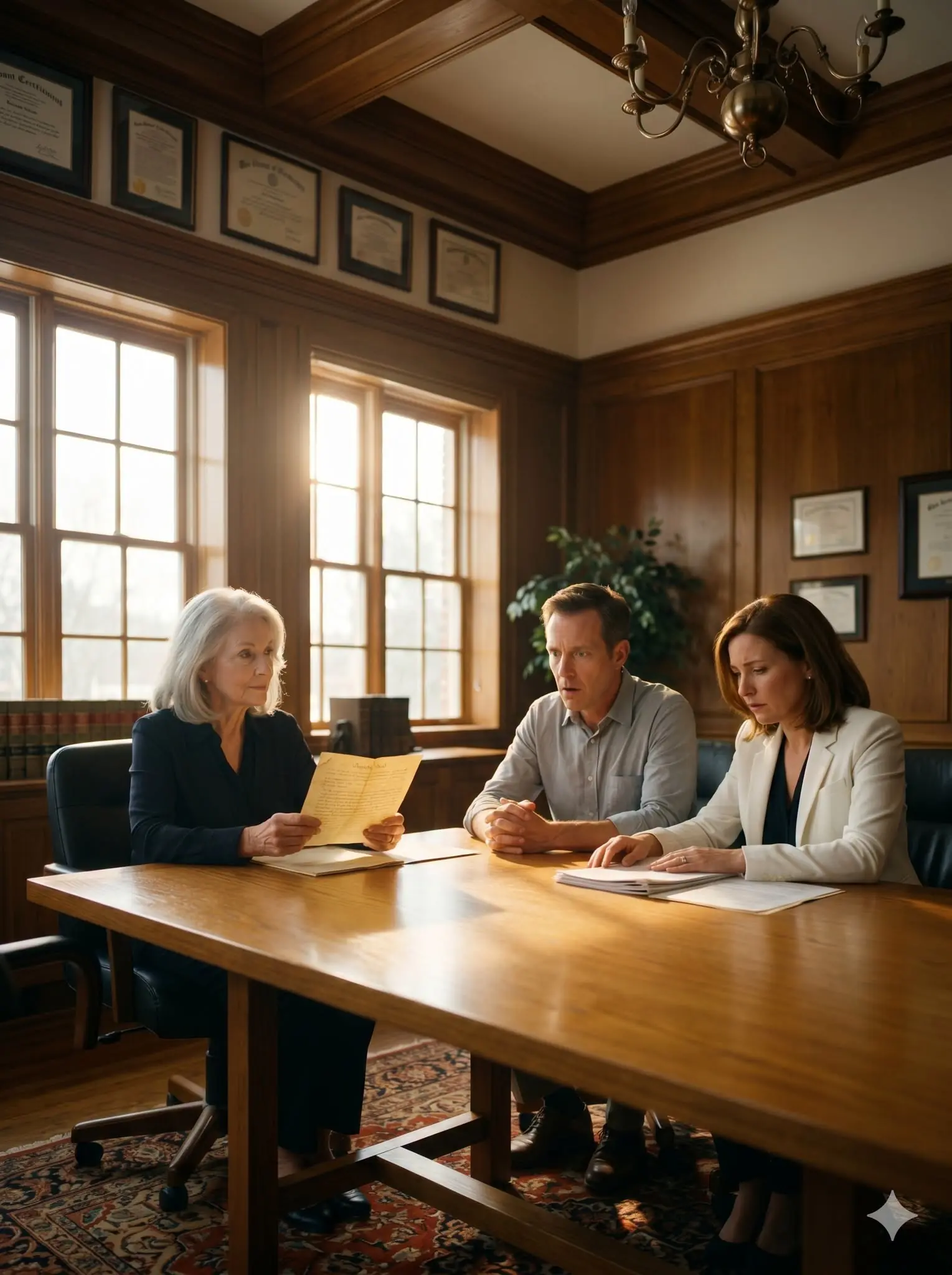
That afternoon I called Pat Yun.
She listened for twenty minutes without interrupting.
When I finished, she asked only one question.
“Do you want to protect yourself?”
“Yes.”
“Then stop thinking like a mother.”
The words hurt.
Because they were true.
“For the next few weeks,” she said, “I want you to think like an administrator.”
That, I understood.
So we built a system.
Every text message.
Every missed visit.
Every doorbell recording.
Every bank alert.
Every conversation.
Dates.
Times.
Documentation.
At Ridgemont Regional we had a saying.
If it isn’t documented, it didn’t happen.
By the end of that week, I had folders.
Doorbell footage.
Medication records.
Physical therapy appointments.
Ruth’s care notes.
Photographs.
Screenshots.
Timelines.
Scott thought I was sitting alone in my recliner.
What I was actually doing was building a case.
Then Kendra painted my wall.
I came home from physical therapy and smelled it immediately.
Fresh paint.
Chemical.
Sharp.
Wrong.
The south wall of my living room had been painted pale green.
Coastal Sage.
Kendra stood in the middle of the room smiling.
“Surprise.”
I stared at the wall.
Frank had painted that room himself in 1994.
I remembered the ladder.
The spilled paint.
The arguments over the second coat.
I remembered laughing.
I remembered him kissing paint from my cheek.
Thirty years.
Gone in one afternoon.
My wedding photograph sat on the floor.
Still facing inward.
I looked at Kendra.
“Did you ask me before painting my house?”
She crossed her arms.
“I was helping.”
“This is my home.”
She exhaled sharply.
“God, you’re exactly like Scott said.”
I looked at her.
“What did Scott say?”
She realized her mistake immediately.
But mistakes cannot be unsaid.
She looked away.
“Nothing.”
I wrote it down later.
Date.
Time.
Exact words.
Exactly like Scott said.
Because now I knew.
They talked about me.
When I wasn’t there.
When I was at therapy.
When I was asleep.
When they thought I couldn’t hear.
A few days later, Donna called.
Frank’s younger sister.
Seventy-two years old.
Professional worrier.
Amateur gossip.
“Myra, honey, how are you feeling?”
“I’m healing.”
“Scott says you’ve been confused.”
There it was.
Confused.
Not lonely.
Not abandoned.
Not recovering.
Confused.
“He says you’ve forgotten things.”
“I haven’t.”
Long silence.
“Well, you know, the house is a lot for one person.”
The house.
Always the house.
Frank would have wanted the boys to have it.
The house.
You’re getting older.
The house.
Maybe it’s time to think about the future.
The house.
Nobody asked how my hip felt.
Nobody asked if I had groceries.
Nobody asked if I was sleeping.
Only the house.
Always the house.
Two days later Bryce called from Denver.
My youngest son.
The reasonable one.
The quiet one.
The son who had visited exactly once in four years.
“Mom, maybe somebody should help manage things.”
Manage.
I knew that word.
Manage meant power.
Manage meant signatures.
Manage meant control.
“We’re worried about your judgment.”
“My judgment?”
“You’re upset about paint.”
“I’m upset because someone painted my house.”
He sighed.
“Mom, you’re being difficult.”
The same word.
Scott had used it.
Bryce used it.
Donna used it.
A script.
People repeating lines.
I ended the call.
And then something happened.
Haley had forgotten her iPad.
The screen lit up.
A message appeared.
SWANSON FAM 
I wish I could say I ignored it.
I didn’t.
I opened it.
Scott:
“Mom’s getting worse.”
Kendra:
“We need to move quickly.”
Donna:
“Frank always wanted the boys to have the house.”
Bryce:
“Would guardianship be easier than POA?”
Guardianship.
I stared at the screen.
My own children discussing whether I should lose control of my life.
My own family.
A heart emoji beside the conversation title.
I took screenshots.
Every single message.
And I sent them to Pat.
Subject line:
Exhibit F.
That evening I sat alone in the living room.
The green walls.
The missing photograph.
The silence.
Frank’s chair.
I thought about my husband.
He had trusted people.
I didn’t.
He believed promises.
I believed records.
He saw goodness.
I saw patterns.
Perhaps that was why we worked.
Perhaps that was why losing him had been so dangerous.
Because after Frank died, nobody remained who automatically stood beside me.
I had to do it myself.
So I called Pat.
“I’m ready.”
“For what?”
“Everything.”
Silence.
Then:
“I’ll prepare the paperwork.”
I looked around my living room.
The room Kendra thought she had redesigned.
The room Scott thought he would inherit.
The room Donna believed belonged to the boys.
No.
It belonged to me.
And for the first time in six weeks, I wasn’t afraid.
Because fear disappears the moment you stop hoping someone will save you.
Scott called on a Friday.
His voice sounded cheerful.
Too cheerful.
“Mom, we should all get together.”
“Why?”
“Just family.”
“When?”
“March twenty-ninth.”
Who’s coming?
“Bryce is flying in. Aunt Donna. Kendra.”
A meeting.
Not a dinner.
A meeting.
I already knew.
The group chat had told me.
Guardianship.
Power of attorney.
The house.
The intervention.
They believed I was old.
Weak.
Confused.
They believed they would sit me down and explain why someone else should take control.
They believed I would cry.
Or agree.
Or surrender.
I said:
“That sounds lovely.”
After hanging up, I called Pat.
“It’s happening.”
“I’ll be there.”
“I want you in the kitchen.”
She laughed.
“Hidden?”
“Waiting.”
“Very dramatic.”
“I worked in administration. We call it timing.”
The locksmith arrived the day before.
New locks.
New keys.
New code.
Three hundred and forty dollars.
Best money I ever spent.
Scott texted.
“Why did you change the code?”
“Security update.”
“You could have told me.”
I stared at the message.
For six weeks he hadn’t told me he wasn’t coming.
And now he wanted explanations.
No.
Not anymore.
March twenty-ninth.
Coffee at six.
Chairs arranged in a circle.
My cane beside my chair.
Pat waiting in the kitchen.
At ten o’clock they arrived.
Kendra.
Donna.
Bryce.
Scott.
They sat exactly as people sit when they have rehearsed.
Scott began.
“Mom, we’re worried.”
Kendra nodded.
Bryce looked serious.
Donna held tissues.
Since your surgery you’ve been different.
You’ve been confused.
Emotional.
Forgetful.
Kendra tried helping and you became angry.
The children were left unsupervised.
We’re worried about your finances.
Your house.
Your health.
Your future.
Scott slid papers across the table.
Power of attorney.
I looked at them.
Then at him.
He smiled gently.
“Just temporary.”
Temporary.
Like daycare.
Like moving furniture.
Like painting walls.
Like taking over bank accounts.
I stood.
Slowly.
My cane touched the floor.
I looked toward the kitchen.
“Pat?”
My attorney walked into the room.
Scott blinked.
Kendra went pale.
Donna stopped breathing.
Pat sat beside me.
Opened her folder.
And I began.
“Scott promised to move in.”
Doorbell logs.
Four hours.
Twenty-two minutes.
Six weeks.
Text messages.
No questions about my health.
Only the children.
The house.
Schedules.
Bank records.
Unauthorized account access.
Ruth’s statements.
APS investigation.
Screenshots.
The group chat.
Silence.
Absolute silence.
Bryce looked sick.
Donna stared at the floor.
Kendra stared at Scott.
Scott stared at me.
Pat finally spoke.
“The trust contains a no-contest clause.”
Scott frowned.
“What trust?”
“The family trust.”
My son looked genuinely confused.
Because he had never asked.
He had assumed.
“The house,” Pat said, “is owned by the trust.”
Scott sat perfectly still.
“Any beneficiary attempting undue influence forfeits his interest.”
“No.”
His voice cracked.
“No.”
Pat continued.
“Attempting unauthorized financial access and coercive intervention may trigger the clause.”
“No.”
The room had become very small.
The air felt heavy.
I looked directly at my son.
“The house was never yours.”
He stared.
“You promised to take care of me.”
“Mom—”
“You left me alone.”
“I—”
“You used my grandchildren as babysitting.”
“That’s not—”
“You tried to access my account.”
“I was helping.”
“You weren’t helping.”
My voice never rose.
That was the worst part.
Quiet truth is far more frightening than anger.
Because anger passes.
Truth remains.
Kendra stood.
“You told me she didn’t have cameras.”
Scott turned.
“Don’t do this.”
“You said she was confused.”
“You painted her house!”
“You wanted the house!”
Donna walked toward the door.
Bryce lowered his head.
The alliance collapsed.
Exactly as Pat predicted.
Because lies only work while everyone keeps telling the same one.
Once the truth enters the room, people begin saving themselves.
Scott finally looked at me.
Real fear.
Real pain.
“You’re doing this to your own son?”
I walked toward him.
I was standing without my walker.
Without help.
Without fear.
“I spent six weeks alone.”
He said nothing.
“I broke my hip.”
Nothing.
“I waited for you.”
Nothing.
I opened the front door.
“You may visit when I invite you.”
He stared.
“Mom—”
“No.”
I pointed toward the porch.
“This is my house.”
He walked outside.
The new lock clicked behind him.
And for the first time in six weeks—
I felt safe.
Not because my hip had healed.
Not because my family had changed.
But because I finally understood something.
A locked door is not punishment.
It is protection.
And sometimes the strongest thing a mother can do is stop opening it.
Disclaimer : This content may be created by AI for entertainment purposes. Any resemblance to real persons, events, or places is coincidental.