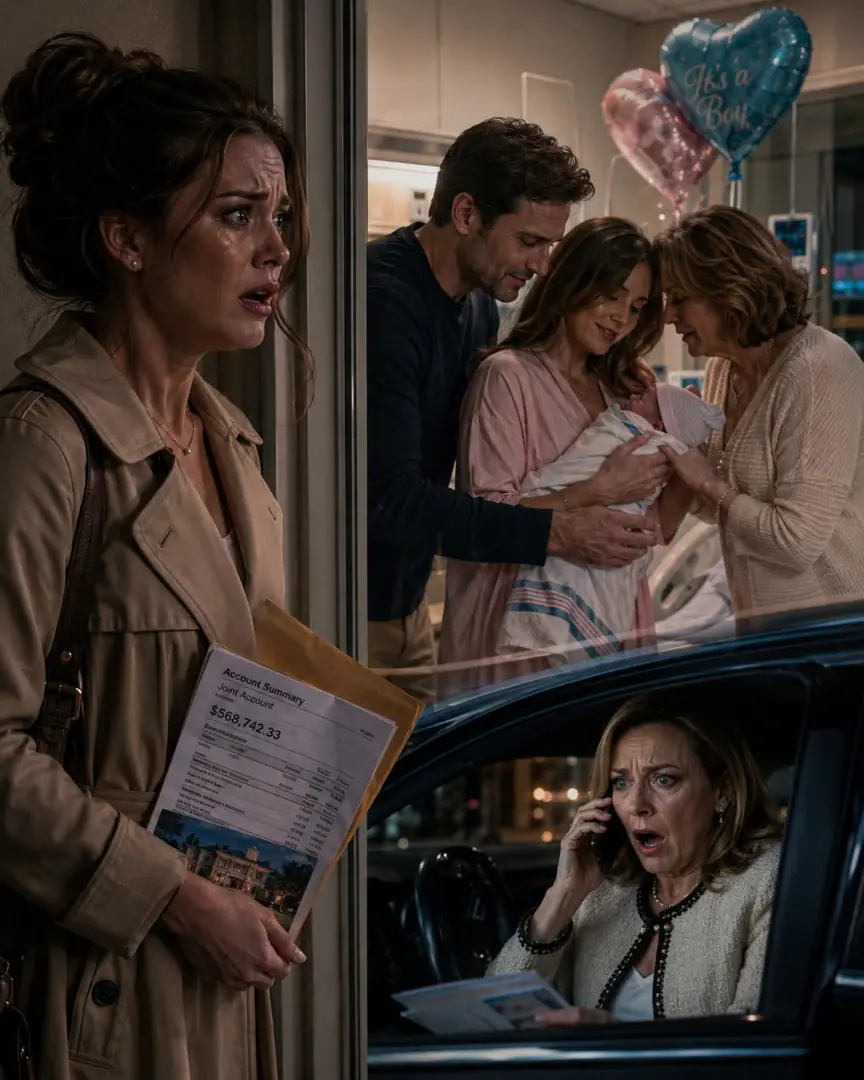
The Great Escape
Life stories 01/07/2026 22:59
Sometimes, she pictured an older woman with kind hands. Sometimes, a college student who had signed up for a registry after a campus drive. Sometimes, a father, a teacher, a nurse, someone ordinary in the most extraordinary way.
But never once had she imagined him sitting alone in a hospital cafeteria, counting bills beside cold fries while his daughter cried into his shoulder.
arrow_forward_ios Read more Play 00:00 00:56 01:31 Mute PlayNever once had she imagined that the man who gave her a second chance would be denied one for his own child.
Grant Ellison reached for the paper in her hand.
“I’ll take that.”
Sloane moved it out of reach.
Grant’s eyes narrowed.
“You don’t understand what you’re holding.”
“I understand more than you think.”
He gave a thin laugh. “This is a hospital financial matter.”
“No,” Sloane said. “This is a foundation matter.”
Grant froze.
For the first time, he looked at her face instead of her coat.
Recognition hit him slowly, then all at once.
“Ms. Merrick.”
The two administrators behind him went pale.
Sloane held up the denial letter.
“Why was Penny Bellamy denied by my foundation?”
Grant adjusted his tie.
“The case did not meet this quarter’s strategic standards.”
“She is seven.”
“That is not the point.”
“It is the only point.”
Grant lowered his voice. “Sloane, this is not the place.”
She hated the way he used her first name. Grant was not just a foundation executive. He was the man her board loved because he made cruelty sound clean. He was polished, careful, and useful in rooms where people confused wealth with wisdom.
For two years, he had been her mother’s favorite choice for her future.
For two years, Sloane had ignored the coldness in him because she thought cold people could still do good work.
Now she realized cold people could build entire systems where suffering had to prove it was profitable.
“I want Penny Bellamy’s file on my desk in one hour,” Sloane said.
Grant smiled, but his jaw was tight.
“Of course.”
“And I want every email attached to the denial.”
His smile disappeared.
“Sloane—”
“One hour.”
She walked away before he could answer.
But instead of going to her office, she went upstairs.
Room 412 was at the end of the pediatric hallway. The door was half open. Inside, Penny sat in bed while Wyatt tried to untangle a pair of earbud cords.
“Dad, you’re making it worse.”
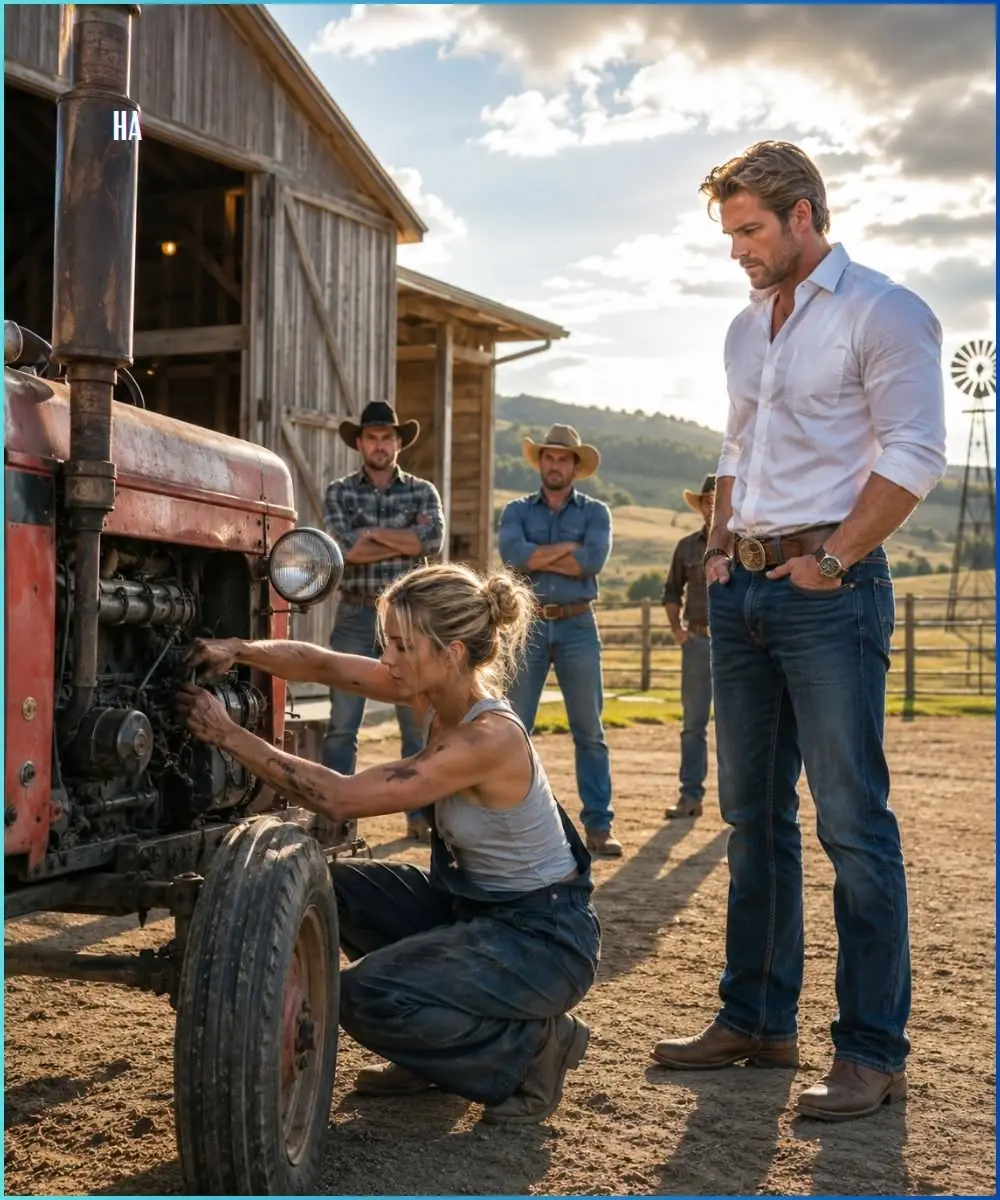
“I’m a mechanic,” Wyatt said. “I fix engines, not spaghetti wires.”
Penny giggled.
Sloane stood outside the door, one hand raised, unable to knock.
She had commanded boardrooms with fifty men waiting for her to fail.
She had spoken to senators, investors, surgeons, and reporters.
But she did not know how to walk into a room and say, Hello, I’m the woman alive because your father once gave a stranger hope, and now I just watched my own foundation break yours.
Penny saw her first.
“Lonely chair lady!”
Wyatt turned.
His expression changed instantly. Guarded. Tired. Protective.
“Hi,” Sloane said. “May I come in?”
Wyatt stood. “If this is about the cafeteria, I’m sorry. Penny’s been through a lot today.”
“It isn’t about that.”
Penny pointed at the chair beside the bed. “You can sit there. It squeaks.”
Sloane smiled softly and sat.
The chair squeaked.
Penny looked delighted.
Wyatt did not.
“You work for the hospital?” he asked.
“No.”
“The foundation?”
Sloane hesitated.
“Yes.”
Wyatt’s eyes hardened.
“Then you can save your speech. I already got the dragon letter.”
Penny frowned. “Dad.”
“It’s okay, moonbeam.”
Sloane looked at the little girl. “Can I talk to your dad in the hallway for a moment?”
Penny studied her like a judge.
“Are you going to make him sadder?”
The question hit Sloane in the chest.
“No,” she said. “I’m going to try not to.”
Penny nodded. “Then okay.”
In the hallway, Wyatt folded his arms.
“Look, I know you probably mean well, but we’ve been meaning-welled all month. People keep saying they’re sorry. Sorry doesn’t keep a surgery date.”
“You’re right.”
That stopped him for half a second.
Sloane held out the old donor card.
“You dropped this.”
Wyatt looked at it, then took it quickly.
His face softened with memory.
“Didn’t realize I still had that.”
“You donated six years ago?”
He shrugged, uncomfortable.
“Something like that.”
“Why?”
Wyatt looked through the window at Penny.
“My wife had just left. Penny was a baby. I was angry at the world. Saw a sign at a community center asking people to register. Figured if I couldn’t fix my own life, maybe I could help someone else keep theirs.”
Sloane’s throat tightened.
“Did you ever find out who received it?”
“No. Anonymous. They said the person survived, though.” He glanced at her. “That was enough.”
Sloane tried to speak, but the words would not come.
Wyatt noticed.
“What?”
She held up her wrist.
Under her sleeve was a small silver bracelet engraved with the same code.
WB-417-M.
Wyatt stared at it.
The hallway seemed to fade around them.
“That’s not possible,” he whispered.
“You saved my life.”
He took one step back.
“No.”
“Yes.”
“No,” he said again, sharper. “I donated to a stranger. Not to a billionaire.”
“I was a stranger.”
“You own the foundation that denied my daughter.”
The words landed exactly where they were meant to.
Sloane did not defend herself.
“Yes.”
Wyatt laughed once, bitter and quiet.
“That’s something, isn’t it?”
“I didn’t know.”
“But you should have.” His voice stayed low, but every word shook. “If your name is on the wall downstairs, if your picture is in the brochure, if your speeches say no family fights alone, then you should know what your people are doing.”
Sloane looked down.
He was right.
That was the worst part.
Grant had hidden the denial. The board had buried the review. The administrators had followed procedure.
But Sloane had built the house.
She could not act shocked that someone had locked the wrong people outside.
“I’m going to fix this,” she said.
Wyatt’s face closed.
“Don’t.”
“Your daughter needs help.”
“My daughter needs care, not a billionaire’s guilt.”
“This isn’t guilt.”
“Then what is it?”
Sloane looked at him honestly.
“A debt I can never repay.”
Wyatt shook his head.
“That’s exactly what I don’t want. I didn’t donate so one day someone would owe me.”
“You donated because you believed a life mattered before you knew whose it was.”
“And now I’m asking you to believe the same about Penny.”
Sloane had no answer.
Because again, he was right.
Wyatt looked through the glass at his daughter, who was now making her stuffed rabbit wave at a nurse.
“She doesn’t know how bad it is,” he said. “She thinks I can fix everything because I fix old trucks and broken lamps and the kitchen sink. Every night she asks me if the dragons are gone. And every night I lie.”
His voice cracked on the last word.
Sloane felt tears sting her eyes.
Wyatt wiped his face quickly, angry at himself for letting her see.
“I’m sorry,” he said. “You didn’t come here for that.”
“Yes,” Sloane said. “I did.”
He looked at her.
She took a breath.
“I came here because I forgot what my life was for. You reminded me.”
Before he could respond, Grant Ellison appeared at the end of the hallway.
His expression was calm, but his eyes were furious.
“Ms. Merrick. The board is waiting.”
Sloane did not move.
Grant looked at Wyatt.
“Mr. Bellamy, I hope you haven’t misunderstood this conversation. Ms. Merrick is very compassionate, but foundation decisions are not reversed because of hallway emotions.”
Wyatt stepped forward.
“I didn’t ask her for anything.”
“No,” Grant said. “Men like you never ask directly. You just bleed in public and let decent people feel responsible.”
Sloane turned cold.
“Grant.”
Wyatt’s hands curled into fists, but he stayed still.
Penny’s door opened.
She stood there holding her rabbit.
“Dad?”
Wyatt immediately softened.
“It’s okay, moonbeam.”
Grant glanced at the child, then at Sloane.
“This is exactly why the board has rules.”
Sloane walked toward him.
“No. This is exactly why rules become cruelty when cowards hide inside them.”
Grant’s face flushed.
“You are emotional.”
“I am awake.”
She turned to the nearest administrator.
“Penny Bellamy’s surgery stays on schedule. The foundation will cover it.”
The administrator swallowed.
“Ms. Merrick, under current authorization—”
“I am the authorization.”
Grant smiled thinly.
“Actually, you’re not. Not alone.”
Sloane went still.
Grant removed a folded document from inside his jacket.
“The emergency finance committee voted this morning to pause discretionary family grants pending review. Your signature authority is limited until tomorrow’s board session.”
Sloane stared at him.
“You did this after denying her.”
“I did this to protect the foundation from impulse decisions.”
Wyatt laughed softly.
Every head turned toward him.
“That’s rich,” he said.
Grant looked irritated. “Excuse me?”
“You people build castles with your names on them, then call a child an impulse.”
Penny tugged on Wyatt’s sleeve.
“I don’t like him.”
Wyatt picked her up.
“Me neither.”
Sloane looked at Grant.
“Tomorrow, then.”
Grant’s mouth curved.
“Tomorrow.”
But his smile told her he already had a plan.
That night, Sloane sat in her penthouse office surrounded by everything success had bought her.
Glass walls overlooking the city. Awards on shelves. A piano she never played. A framed magazine cover calling her “The Woman Who Beat the Impossible.”
She thought about that phrase now and hated it.
Because she had not beaten the impossible alone.
Wyatt Bellamy had been sitting somewhere in a cheap apartment, recovering from his donation while feeding a baby daughter, never knowing his pain had become her future.
Her assistant, Lena, entered with a tablet.
“I pulled everything you asked for.”
Sloane turned.
Lena’s expression was grim.
“It’s bad.”
The emails began three months earlier.
Grant had flagged Penny’s case as “emotionally compelling but financially inefficient.”
An administrator had written: Father has no media value, no donor network, no public influence.
Another note read: Recommend denial unless family story can be packaged for campaign.
Sloane felt sick.
Then came the worst one.
Grant’s reply: Do not route to Sloane. She overidentifies with patient stories.
Sloane closed her eyes.
Lena spoke softly.
“There’s more. Wyatt Bellamy applied twice. He sold his repair shop last month. He’s been sleeping in his truck when he can’t afford parking near the hospital.”
Sloane opened her eyes.
“Where is his truck?”
“Hospital garage. Level C.”
Thirty minutes later, Sloane stood in the cold concrete garage beside an old blue pickup with a cracked windshield.
A folded blanket sat behind the seat.
A pair of child’s sneakers rested on the floor.
On the dashboard was another drawing from Penny.
Dad versus dragon.
In the picture, Wyatt held a wrench like a sword.
Sloane pressed a hand to her mouth.
She had never felt poorer than she did standing beside that truck.
The next morning, the story broke before sunrise.
LOCAL SINGLE FATHER ACCUSED OF PRESSURING BILLIONAIRE FOUNDATION FOR SPECIAL TREATMENT.
Sloane saw the headline at 5:14 a.m.
Her phone exploded with messages.
The article quoted an unnamed hospital source claiming Wyatt had “emotionally manipulated” foundation leadership after a chance meeting. It mentioned his debts, his “unstable behavior,” and even suggested hospital security had concerns.
Sloane knew immediately.
Grant.
She called Wyatt.
No answer.
She called the hospital.
No answer.
Then Lena called.
“Security is trying to remove him.”
Sloane ran.
When she reached the hospital’s fourth floor, Wyatt was standing outside Penny’s room with two guards in front of him. His face was pale with exhaustion and rage.
Penny was crying inside the room.
“You can’t keep me from my daughter,” Wyatt said.
One guard looked uncomfortable.
“Sir, we’re following instructions.”
Grant stood nearby, speaking quietly to an administrator.
Sloane stepped out of the elevator.
“Whose instructions?”
Everyone turned.
Grant’s face tightened.
“Sloane, this is a safety issue.”
“No,” she said. “This is retaliation.”
Wyatt looked at her, and for one painful second she saw distrust.
Not because she had written the article.
Because the world she represented had.
Sloane walked past the guards and opened Penny’s door.
The little girl looked at her through tears.
“Are they taking my dad away?”
Sloane knelt.
“No.”
“Promise?”
Sloane glanced back at Wyatt.
Then she said, “Promise.”
She stepped into the hall and faced the guards.
“If anyone touches Mr. Bellamy, you will explain to the hospital board why you removed a father from his sick child based on a lie.”
Grant scoffed.
“A dramatic statement doesn’t change liability.”
“No,” Sloane said. “Evidence does.”
She held up her phone.
On the screen were Grant’s emails.
His face changed.
Sloane looked at Wyatt.
“I’m sorry.”
Wyatt said nothing.
She deserved that.
By noon, Sloane had called an emergency board meeting.
By one, Grant had called his own.
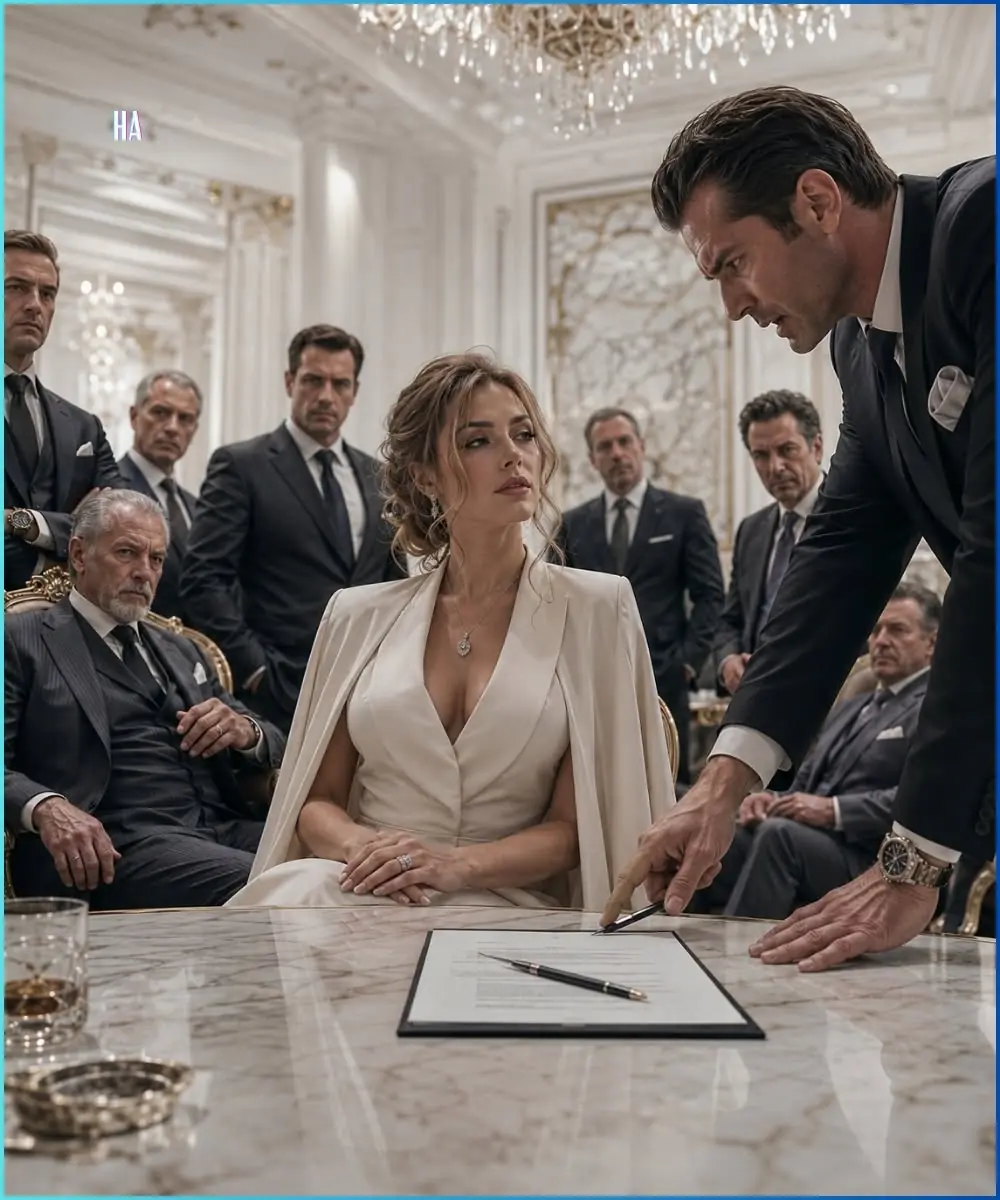
By two, the fight had moved to the top floor of Merrick Tower, where fifteen board members sat around a table long enough to feed an army and cold enough to freeze one.
Grant stood at the front with a presentation already loaded.
Sloane entered with Lena beside her.
The chairman, Howard Vale, cleared his throat.
“Sloane, before this becomes emotional, we need to discuss governance.”
She laughed.
Nobody expected it.
“Of course. Let’s discuss governance.”
Grant clicked to the first slide.
It showed headlines about Wyatt.
“This is what happens,” Grant said, “when foundation leadership becomes personally entangled with recipients. Ms. Merrick’s judgment has been compromised by private medical history and guilt.”
Whispers moved around the table.
Sloane stayed still.
Grant continued.
“We recommend immediate temporary removal of Ms. Merrick from individual grant approval, a public statement distancing the foundation from Mr. Bellamy, and a formal review of all patient assistance programs.”
Howard nodded.
“Reasonable.”
Sloane placed a folder on the table.
“Before we vote, I’d like to introduce someone.”
The door opened.
Wyatt Bellamy walked in.
He wore the same denim jacket. Same tired eyes. Same guarded posture.
But this time, he was not carrying bills.
He was carrying Penny’s drawing.
Grant’s face turned red.
“This is inappropriate.”
Wyatt stopped near the door.
“I agree.”
The room went silent.
Wyatt looked at Sloane.
“I almost didn’t come. I’m not here to beg. I’m not here to be your sad story. I’m here because my daughter asked me something this morning.”
He unfolded the drawing.
“She asked why the dragons wear nice suits.”
No one moved.
Wyatt placed the picture on the table.
“I didn’t know how to answer.”
Sloane stood beside him.
“Six years ago,” she said, “I survived because an anonymous donor gave without knowing my name, my money, or my future. That donor was Wyatt Bellamy.”
Gasps.
Howard leaned forward.
Grant looked away.
Sloane continued.
“Last month, Wyatt applied to the Merrick Foundation for help with his daughter’s care. His application was denied because executives in this room decided his family had no public value.”
A board member whispered, “That’s not fair.”
Sloane opened the folder.
“No. It’s not fair. It’s documented.”
She passed copies of the emails down the table.
The room changed as people read.
Some looked shocked.
Some looked guilty.
Grant’s voice cut through.
“You are violating internal confidentiality.”
Sloane turned to him.
“You violated a child’s dignity.”
Grant straightened.
“I protected the foundation.”
“You protected a brand.”
“Because brands pay for programs.”
“No,” Wyatt said quietly.
Everyone looked at him.
He seemed uncomfortable with all those rich eyes on him, but he did not step back.
“People pay for programs. Nurses working double shifts. Mechanics fixing cars late. Teachers buying classroom supplies. Strangers signing up to donate because they hope someone somewhere gets one more birthday.” He looked at Grant. “You keep saying foundation like it’s a building. It’s supposed to be a promise.”
Sloane felt the room shift again.
Not dramatically.
Truth rarely needed drama.
It only needed to be spoken by someone who had no reason to lie.
Grant slammed his hand on the table.
“This is manipulation!”
Wyatt turned to him.
“No. This is my daughter’s life.”
Howard looked at Sloane.
“What are you proposing?”
Sloane lifted her chin.
“Immediate reinstatement of family assistance grants. Full coverage for Penny Bellamy. An independent audit of every denial under Grant Ellison’s authority. Removal of Grant from all foundation operations. And a new emergency fund governed by patient advocates, not image consultants.”
Grant laughed.
“You don’t have the votes.”
Sloane looked around the table.
“Then vote against a seven-year-old while cameras wait downstairs.”
Howard’s face tightened.
“You invited press?”
“No,” Sloane said. “I invited accountability.”
The vote took twelve minutes.
Grant lost everything in eleven.
He resigned before security reached the door, but not before turning to Wyatt.
“You think this makes you special?”
Wyatt looked exhausted.
“No. I think it makes you done.”
That evening, Penny’s surgery stayed on schedule.
Wyatt sat beside her bed while she slept, her small hand tucked inside his. Sloane stood near the doorway, not wanting to intrude.
Wyatt spoke without looking up.
“She asked if you were coming back.”
Sloane stepped inside.
“What did you say?”
“I said I didn’t know.”
Penny opened one eye.
“You’re back.”
Sloane smiled. “I am.”
Penny lifted her stuffed rabbit.
“Mr. Pickles says thank you for fighting the dragons.”
Sloane walked to the bed.
“Tell Mr. Pickles your dad fought harder.”
Penny nodded sleepily.
“He always does.”
Wyatt looked away.
Sloane noticed the way his shoulders dropped, just slightly, as if someone had finally said out loud what he had been carrying silently for years.
The surgery lasted four hours.
Wyatt did not sit down for most of it.
He paced. He prayed without moving his lips. He drank coffee he never finished. Sloane stayed nearby, not speaking unless he spoke first.
At one point, he looked at her.
“You don’t have to stay.”
“I know.”
“I’m serious.”
“So am I.”
He studied her.
“You always this stubborn?”
“Only when I’m right.”
Despite everything, he smiled.
It was small, but real.
At 9:37 p.m., the surgeon came out.
Wyatt froze.
Sloane forgot how to breathe.
The surgeon smiled.
“She did beautifully.”
Wyatt covered his face with both hands.
For a moment, he made no sound.
Then his knees bent, and Sloane caught his arm before he sank to the floor.
He turned toward her, and the wall he had been holding up for weeks finally cracked.
“She’s okay?” he whispered.
“She’s okay,” the surgeon said.
Wyatt cried then.
Not loudly.
Not dramatically.
Just a father whose body had finally learned it could stop preparing for loss.
Sloane stood beside him, crying too.
Because six years ago, Wyatt Bellamy had saved her life.
Tonight, somehow, they had saved each other from becoming people who stopped believing in goodness.
The weeks after Penny’s surgery were not perfect.
Healing was slow. Bills still existed. Reporters still tried to camp outside the hospital. Some people online said Wyatt had used his daughter to get money. Others said Sloane had staged the whole thing for public praise.
Wyatt refused every interview.
Sloane respected that.
Instead, she quietly helped him get his repair shop back.
Not as a gift.
As a partnership.
Merrick Foundation needed a transportation program for families who missed appointments because their cars broke down. Wyatt knew engines. He knew families. He knew what it felt like to choose between gas and medicine.
So the Bellamy Garage reopened under a new sign:
MOONBEAM MOTORS
Family Transport Repair Program
Penny designed the logo.
It had a wrench, a moon, and a dragon running away.
Three months later, Sloane visited on opening day.
The garage smelled like fresh paint, coffee, and motor oil. Penny sat behind a small desk wearing a plastic manager badge.
“Welcome,” Penny said. “Do you have an appointment?”
Sloane tried to look serious.
“I’m here to see the boss.”
Penny pointed at Wyatt.
“He thinks he’s the boss. But I made the sign.”
Wyatt came out from under the hood of an old minivan, wiping his hands on a rag.
“You’re early.”
“I was excited.”
Penny gasped. “Rich people get excited?”
Wyatt choked on a laugh.
Sloane leaned toward her. “Only when the boss allows it.”
Penny nodded wisely. “Good answer.”
For the first time, Sloane saw Wyatt in a place where he was not cornered by fear.
He stood taller here. Smiled easier. People came in and called him by name. A nurse hugged him because her car was fixed for free. A grandfather cried when Wyatt told him the foundation covered his repair.
This was what Sloane had been missing in all those marble rooms.
Not legacy.
Usefulness.
As the sun set, Wyatt walked her outside.
“You did good,” she said.
He looked at the garage.
“We did good.”
That one word stayed with her.
We.
Over the next year, Moonbeam Motors helped more than eight hundred families get to appointments, jobs, schools, and court dates.
The Merrick Foundation changed too.
The fancy gala videos became shorter.
The patient advisory meetings became longer.
Grant Ellison vanished into consulting work somewhere far away, where Sloane hoped every coffee machine broke near him.
And every month, Sloane and Wyatt met at the same hospital cafeteria table where it started.
At first, they said it was for foundation updates.
Then Penny started coming, too.
Then Penny started bringing an extra purple crayon.
Then one rainy Thursday, Wyatt arrived without paperwork and placed two cafeteria coffees on the table.
Sloane looked at them.
“No files?”
“No files.”
“No meeting agenda?”
“No agenda.”
She smiled. “That sounds dangerous.”
Wyatt sat across from her.
“I wanted to ask you something.”
Sloane’s heart did something ridiculous.
Wyatt looked nervous, which she found unfairly charming.
“Penny’s school is having a family picnic Saturday,” he said. “She wants you to come.”
Sloane tried not to show how much that meant.
“Penny wants me to?”
Wyatt looked down at his coffee.
“I do too.”
For a moment, all the noise of the cafeteria faded.
The vending machine. The nurses. The elevator bells. The distant announcements.
Sloane remembered asking, Can I sit with you?
She had thought she was offering kindness to a lonely man.
She had no idea she was sitting beside the reason she was alive.
“I’d love to come,” she said.
Wyatt looked up.
And there it was again.
That small real smile.
Two years later, Sloane Merrick stood in front of a crowd at the opening of the Bellamy-Merrick Family House, a free place for parents to sleep near the hospital when their children needed long-term care.
No marble statues.
No gold letters bigger than people.
Just warm rooms, stocked kitchens, laundry machines, quiet chairs, and a cafeteria where no one had to buy food to deserve a table.
Penny, now nine, stood at the microphone first.
“My dad says lonely people need chairs too,” she announced.
The crowd laughed and cried at the same time.
Then she waved Sloane forward.
Sloane looked out at the families gathered in the lobby.
Parents with tired eyes.
Kids with stuffed animals.
Nurses in scrubs.
Mechanics from Moonbeam Motors.
And beside the front row stood Wyatt, watching her with the kind of pride money could never purchase.
Sloane took the microphone.
“Six years ago, a stranger saved my life,” she said. “He didn’t know my name. He didn’t know whether I was rich or poor, kind or difficult, important or forgotten. He only knew someone needed help.”
She looked at Wyatt.
“Years later, I met him in a hospital cafeteria and asked if I could sit with him. I thought I was offering him a chair. But the truth is, he had already given me my whole life back.”
The room went silent.
Wyatt blinked quickly and looked down.
Sloane continued.
“This house exists because one single father reminded me that generosity is not a brand. It is not a speech. It is not a photo opportunity. It is a hand reaching out before it knows who it is saving.”
After the ceremony, Wyatt found her in the new cafeteria.
She was sitting at a table with three chairs.
He looked at the empty seat across from her.
“Can I sit with you?”
Sloane smiled.
“Only if you don’t mind cold fries, broken crayons, and a nine-year-old who thinks she runs the building.”
Wyatt sat down.
Penny rushed between them and placed her stuffed rabbit in the third chair.
“Mr. Pickles is on the board,” she said.
Wyatt looked at Sloane.
“I don’t think we can argue with that.”
Sloane laughed.
Then Wyatt reached across the table and took her hand.
Not for cameras.
Not for donors.
Not for a story.
Just because he wanted to.
Sloane looked at their hands and thought about all the ways life can bring people back to each other.
Sometimes through pain.
Sometimes through a child.
Sometimes through a hospital cafeteria table where one lonely person asks another for a chair.
And sometimes, the stranger who saved your life is not standing above you like a hero.
Sometimes, he is sitting across from you, exhausted and scared, trying to save his daughter with nothing but love, courage, and a broken purple crayon.
THE END
If you were Wyatt, would you accept help from Sloane after discovering she was the billionaire behind the foundation that denied your child?
SAY “YES” IF YOU WANT TO READ MORE STORIES LIKE THIS!!