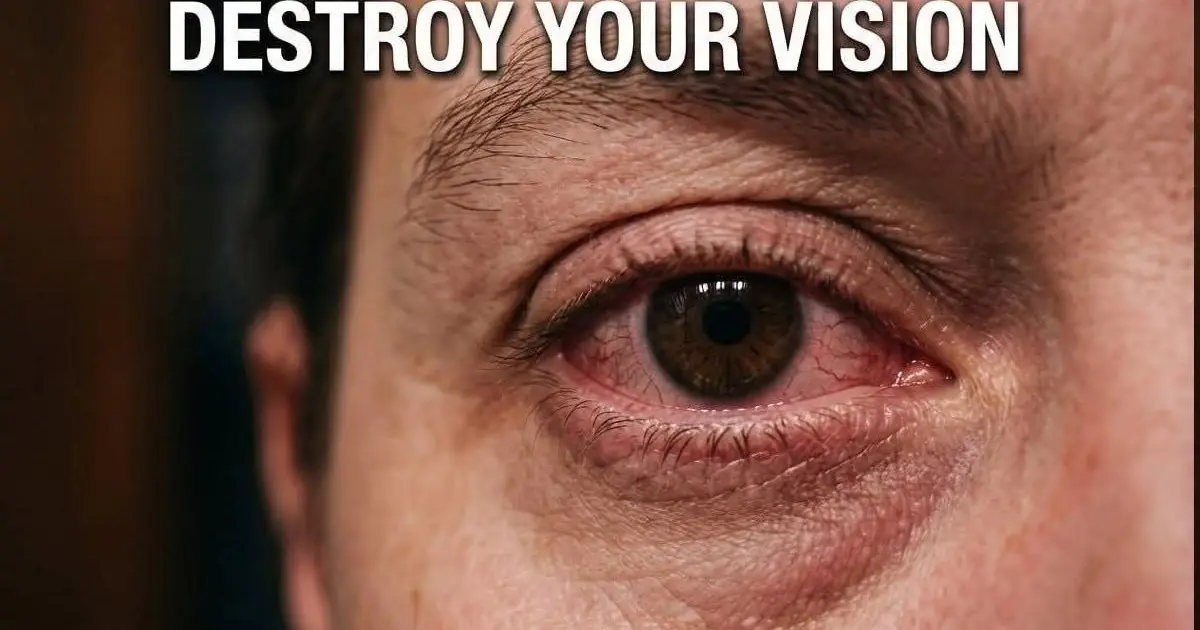
Foods That May Harm Your Eye Health
Health 25/08/2026 20:38
When a child wakes up with a red, expanding ring on the skin that looks like a bullseye, I know how fast a parent’s mind can race. Living out in the country, hours from town some days, I’ve had my share of moments where I stood in the kitchen in my slippers, trying to decide whether something could wait or whether we needed to get moving right then. A rash like that can be important, especially if it’s growing, and one of the first things many of us think about in tick country is Lyme disease.
The short version is this: a bullseye-shaped rash can be a sign of Lyme disease, and it deserves prompt medical attention, even if your son seems mostly fine otherwise. In this article, I’ll walk you through what the rash may mean, what to do in the next hour, what symptoms make this more urgent, what to photograph and write down before you leave, and what treatment often looks like once a clinician evaluates him.
1. Why a bullseye rash matters
An expanding red ring, especially one larger than about 2 inches across and continuing to widen over hours or days, is concerning for erythema migrans, the classic Lyme disease rash. It often starts at the site of a tick bite and can gradually spread to 2, 3, 4, or even more than 8 inches wide. Sometimes it clears a bit in the center, creating that “bullseye” appearance people describe.
Not every Lyme rash looks exactly like a target. Some are evenly red and oval. Some feel warm but are not usually very painful. They also may not itch much. That’s one reason families sometimes dismiss them as a spider bite, ringworm, or skin irritation at first.
2. Is this serious right now?
Yes, it is serious enough that your son should be medically evaluated as soon as practical, ideally the same day if you can manage it, or at least within 24 hours. Lyme disease is usually very treatable, especially early, but delays can allow the infection to spread and cause more symptoms over days to weeks.
If you are truly hours from urgent care, call your pediatrician, family doctor, nurse line, or an available telehealth service now while you prepare. A clinician may be able to advise you based on the rash appearance, your location, possible tick exposure, and his symptoms. In some cases, treatment is started based on the rash alone without waiting for testing.
3. What to do in the next 15 minutes
First, mark the outer edge of the redness with a pen if your son will tolerate it. Write the time next to the mark. That gives you a simple way to tell whether it is expanding by a quarter inch, half inch, or more over the next few hours.
Second, take clear photos in good light. Get one close-up, one from a foot away, and one with a ruler or coin beside it for scale. If the rash is on the calf or thigh, take a full-leg photo too so the location is obvious.
Third, check his temperature. Write down the exact number, such as 99.8°F or 101.2°F. Also note any headache, fatigue, chills, sore muscles, joint pain, neck stiffness, or nausea.
4. Symptoms that mean you should not wait
If your son has trouble breathing, swelling of the lips or tongue, fainting, confusion, severe headache, a stiff neck, vomiting that won’t stop, chest pain, facial drooping, weakness in an arm or leg, or a high fever such as 103°F or above, he needs urgent medical attention immediately. Those symptoms are not the typical “watch and wait” kind.
If he is dizzy, unusually hard to wake, complaining of a pounding headache, or saying his heart feels like it is racing or skipping beats, those are also reasons to seek emergency guidance now. Even if the rash turns out not to be Lyme, those symptoms deserve prompt evaluation.
5. How Lyme disease usually begins
Lyme disease is caused by bacteria spread by certain ticks, most often blacklegged ticks, sometimes called deer ticks. These ticks can be tiny. A young nymph tick may be no bigger than a poppy seed, which is why many people never notice the bite at all.
Early symptoms often appear 3 to 30 days after a tick bite. A rash may be the first sign, but some folks also develop fever, chills, fatigue, body aches, swollen lymph nodes, or a headache that feels a bit like the flu in warm weather. Around our part of the Midwest, families often mistake that combination for exhaustion from mowing, haying, ball games, or too much sun.
6. What else can look similar
There are other possibilities. Ringworm usually forms a round patch too, but it tends to have a scaly border and often itches more. A regular insect bite may be red and puffy, but it usually stays smaller and does not steadily expand day by day. Cellulitis, a skin infection, can spread and become warm, tender, and painful, sometimes with fever.
A spider bite gets blamed for all sorts of rashes, but true spider bites are far less common than people think. If the rash keeps enlarging, especially in a roughly circular pattern, Lyme moves higher up the list and is worth taking very seriously.
7. Do you need to find a tick for this to be Lyme?
No. Many people with Lyme disease never saw a tick attached. Ticks like hidden places: behind the knee, in the groin, at the sock line, around the waistband, under the arms, behind the ears, and along the scalp.
Do a head-to-toe check anyway. Use a flashlight and look carefully at warm, tucked-away areas. If you do find a tick still attached, remove it with fine-tipped tweezers by grasping as close to the skin as possible and pulling straight upward with steady pressure. Do not twist, burn, smother with petroleum jelly, or paint it with nail polish.
8. If you remove a tick, what details matter
Write down when you found it, where it was attached, and whether it looked flat or engorged. An engorged tick looks swollen from feeding. If you can save it in a sealed container or zip bag, some clinicians find that useful, though treatment decisions are usually based more on symptoms and exam than on the tick itself.
If the tick has likely been attached for 24 to 36 hours or longer, that can increase concern. But if there is already an expanding rash, that matters more than guessing the exact attachment time. In plain terms, the rash is the thing not to ignore.
9. Should you get Lyme testing right away?
This surprises many parents, but early blood testing can be negative even when Lyme disease is present. In the first days or couple of weeks, the body may not yet have made enough detectable antibodies. That means a normal early test does not always rule Lyme out.
Because of that, when the rash strongly looks like erythema migrans, clinicians often diagnose Lyme clinically and start treatment based on the appearance and history. That’s another reason your photos and notes are worth their weight in gold.
10. What treatment often looks like
Treatment commonly involves antibiotics prescribed by a clinician, and the exact choice depends on age, allergies, location, and symptoms. A teenager is often treated with an oral antibiotic course lasting about 10 to 14 days, though the exact medication and duration can vary.
Most children and teens do very well when treated early. Fever and aches may improve within days, while the rash can take a little longer to fade. Even after treatment begins, keep an eye on symptoms and follow the prescribing clinician’s instructions carefully.
11. What you can do for comfort while traveling
Have him rest, drink water, and wear loose shorts or soft pants that do not rub the area. If he has a fever or is achy, you can ask a clinician or follow the label directions for an age-appropriate pain reliever such as acetaminophen or ibuprofen, unless he has a reason he should not take them.
Do not put harsh creams, bleach, essential oils, or home remedies on the rash. A plain cool compress for 10 to 15 minutes can be soothing if the area feels warm. The goal is to keep the skin calm and give the medical team a clear look at it.
12. What to tell the clinician
Be ready with five practical details: when you first noticed the rash, how big it was then, whether it has grown, whether there was known tick exposure, and what symptoms he has besides the rash. It helps to say things like, “It was about the size of a quarter at 7 a.m. and by noon it was 3 inches across,” rather than “It looked bigger.”
Also mention where you live or where he’s been outdoors in the last month: woods, tall grass, camping areas, creek banks, deer trails, or dog-walking paths. In rural places, those details matter because they change how likely tick-borne illness is.
13. What happens if Lyme is left untreated
This is the part that makes prompt evaluation worthwhile. Untreated Lyme disease can progress over weeks to months and cause more widespread rash, joint swelling, especially in a knee, severe fatigue, nerve pain, facial palsy, meningitis symptoms, or heart rhythm problems. Not everyone develops those complications, but they are the reason clinicians prefer to catch it early.
I don’t say that to frighten you, only to steady your priorities. This is one of those problems where being cautious early can spare a lot of trouble later.
14. When a rash is probably not Lyme, but still needs care
If the area becomes very tender, hot, swollen, or starts draining pus, a bacterial skin infection may be more likely than Lyme. If it is ring-shaped and scaly, ringworm becomes more likely. If it comes and goes quickly like hives, that suggests an allergic cause. Each of those still deserves medical advice, but the treatment would be different.
In other words, even if this turns out not to be Lyme disease, an expanding rash is still not something I’d brush off, especially in a teenager who may have been outside and may not have noticed a tick at all.
15. A practical country-parent plan for today
If this were my own child and I was hours from urgent care, I would do four things in order: take photos with measurement, mark the border and time, call a medical professional immediately, and start arranging the soonest in-person evaluation available today. If he develops fever, severe headache, vomiting, facial droop, weakness, chest symptoms, or rapidly worsening illness, I would escalate to emergency care.
Out where distance is part of life, we learn to make calm, useful decisions with the tools in front of us. A bullseye rash is one of those signs that earns respect. Early Lyme disease is often very manageable, but it should be treated as time-sensitive rather than something to “see how it looks tomorrow” without medical input.