The Last Secret
Life stories 22/05/2026 02:00
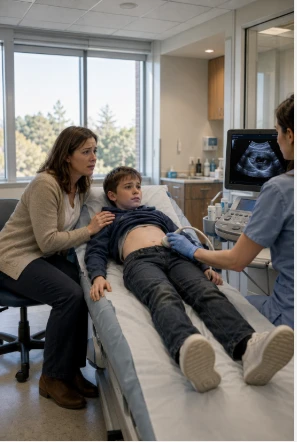
The moment the doctor asked whether Mason’s father was there, I knew she had not found a simple stomachache.
My hands tightened around my son’s small fingers.
Mason lay on the examination bed beneath a thin white sheet, his face pale against the pillow, his brown eyes moving nervously between me and the doctor. The ultrasound machine still hummed beside him, its screen glowing with ghostly gray shadows I could not understand.
But the doctor understood.
And whatever she had seen had drained every trace of comfort from her face.
“Why?” I asked, though my voice barely sounded like mine. “Why do you need his father?”
Dr. Elaine Porter swallowed once. She was a careful woman, the kind of doctor who chose every word like it might break in her mouth.
“Because,” she said softly, “we found something unusual.”
The room seemed to tilt.
Mason squeezed my hand.
“Mom?”
I turned immediately, forcing my face into something calm.
“It’s okay, sweetheart,” I whispered. “I’m right here.”
But it was not okay.
A doctor did not ask for a child’s father during an ultrasound unless something had gone terribly wrong.
“My husband is gone,” I said.
Dr. Porter’s eyes softened. “I’m sorry.”
“No,” I said, shaking my head. “Not dead. Gone.”
The word landed harder than I expected.
Gone.
That was what Ethan had been for ten years. Not dead. Not missing. Not officially anything. Just gone. He had walked out of our lives before Mason could speak full sentences, leaving behind a half-empty closet, an unpaid stack of bills, and a silence so deep I had spent a decade pretending it did not still echo.
Mason knew only pieces. That his father had been complicated. That adults sometimes failed. That love did not always make people stay.
He did not know that Ethan had vanished the same week I learned there were secrets in our marriage I had never been meant to find.
Dr. Porter looked toward the technician.
“Could you give us a moment?”
The technician nodded and left quietly.
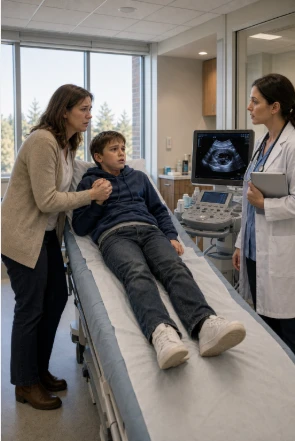
When the door clicked shut, Dr. Porter pulled a stool beside me.
“Mason has a mass in his abdomen,” she said.
The words moved through me like ice water.
“A tumor?” I whispered.
“We don’t know yet. It’s not behaving like a typical tumor. It appears to contain mixed tissue.”
I stared at her.
“What does that mean?”
She hesitated.
“It may be something called a teratoma. Sometimes these masses can contain different types of tissue. Hair. Bone. Teeth.”
Mason’s eyes widened.
“Teeth?” he whispered.
Dr. Porter immediately leaned closer. “It sounds scarier than it is, Mason. We are going to take very good care of you.”
But I could no longer breathe properly.
Hair. Bone. Teeth.
Inside my child.
“How does that happen?” I asked.
“There are several possibilities,” she said. “Most are rare but treatable. We need more imaging and blood tests.”
Then she paused again.
And I hated that pause.
“There’s another reason I asked about his father.”
My stomach sank lower.
“What reason?”
Dr. Porter turned the ultrasound screen slightly. She pointed at a small curved shape inside the gray mass.
“I cannot say for certain without additional scans,” she said. “But this structure appears unusually organized. Not just random tissue.”
I looked at the screen until my eyes burned.
“I don’t understand.”
Her voice dropped.
“Sometimes, very rarely, what appears to be a tumor can be related to a twin that never fully developed during pregnancy.”
The room went silent.
Not the silence of a quiet house.
Not the silence of worry.
This was the silence of the world splitting open.
“A twin?” I repeated.
Mason turned his head toward me.
“Mom, I had a twin?”
“No,” I said too quickly.
But Dr. Porter did not correct him.
She only said, “We need more tests.”
The next forty-eight hours became a nightmare made of fluorescent lights and forms I signed without reading.
Mason was transferred to a children’s hospital in Milwaukee. Specialists came and went. Nurses took blood. Machines scanned him. I slept in a chair beside his bed with my coat over my shoulders, waking every time Mason moved.
He tried to be brave.
That was the part that broke me most.
“Mom,” he said the first night, his voice small in the dark, “if it’s a twin, does that mean I ate him?”
I sat up instantly.
“No, baby. No. Nothing like that.”
“Then why is he inside me?”
I brushed his hair back, the way I had when he was three and feverish.
“I don’t know yet.”
He stared at the ceiling.
“Would he have looked like me?”
I could not answer.
So I leaned over and kissed his forehead.
“Whatever this is,” I whispered, “it does not change who you are.”
The next morning, a pediatric surgeon named Dr. Aaron Kim entered the room with a tablet in his hands and a face too serious for hope.
He showed me the MRI images.
The mass rested near Mason’s intestines, pressing against organs, explaining the nausea, the pain, the exhaustion.
“We recommend surgery,” he said. “Soon.”
“How soon?”
“Tomorrow morning.”
My legs almost failed beneath me.
Dr. Kim spoke gently. “The good news is that the mass appears contained. If pathology confirms what we suspect, surgery may resolve the symptoms.”
“And what exactly do you suspect?” I asked.
He looked at Mason, then back at me.
“We suspect fetus-in-fetu.”
The words were clinical.
Cold.
Impossible.
“A parasitic twin,” he explained quietly. “A malformed twin absorbed during early pregnancy and enclosed inside the surviving twin’s body.”
I heard Mason inhale sharply.
I wanted to cover his ears. Cover his heart. Cover every part of him from this monstrous truth.
But he had already heard.
My son, who still slept with a night-light when storms got bad, was being told he had carried the remains of a twin inside him his entire life.
That afternoon, while Mason slept, I called Ethan.
For the first time in nine years.
My thumb hovered over the old number I had never deleted.
I expected nothing. A dead line. A stranger. Voicemail.
Instead, he answered on the third ring.
“Claire?”
My name in his voice nearly knocked me backward.
For a moment I was twenty-six again, standing in our first apartment while he promised me forever over burnt coffee and cheap takeout.
Then I remembered the empty crib he left behind.
“Mason is in the hospital,” I said.
Silence.
“What happened?”
“They found something in his abdomen. They think it may be a twin.”
The silence changed.
It became heavier.
Alive.
“Ethan?”
His voice came back, low and shaken.
“What did they find exactly?”
I gripped the phone.
“You knew.”
He did not answer.
My blood turned hot.
“You knew something.”
“Claire, listen to me—”
“No. You listen to me. Our son is having surgery tomorrow, and if you know anything, you tell me now.”
His breathing trembled through the phone.
“There was another heartbeat.”
The hallway blurred.
“What?”
“At your first scan,” he said. “Before you remember. You were sick. They gave you medication. You were half asleep. The doctor pulled me aside afterward.”
I pressed my hand against the wall.
“He said there were signs of a second embryo. But at the follow-up, it was gone. He said it was vanishing twin syndrome. Common enough. Nothing to worry about.”
“Why didn’t you tell me?”
“Because you were already terrified,” he whispered. “Because you had miscarried the year before. Because I thought I was protecting you.”
A bitter laugh escaped me.
“Protecting me?”
“There’s more,” he said.
The air left my lungs.
Of course there was more.
“There was a genetic concern,” Ethan continued. “The doctor said if the second embryo didn’t vanish normally, complications could happen. Rare complications. He suggested monitoring.”
“And you said nothing?”
“I wanted to. But then my father got involved.”
I froze.
Ethan’s father.
Walter Rhodes.
A powerful medical investor. A man with money, influence, and the emotional warmth of polished stone. He had never approved of me. Not my job, not my family, not my refusal to become the obedient wife he believed his son deserved.
“What did Walter do?” I asked.
Ethan’s voice cracked.
“He moved your records.”
My fingers went numb around the phone.
“He what?”
“He had contacts at the clinic. He said the pregnancy would be watched privately. He said it was safer. I believed him.”
“You believed him?” I whispered.
“I was weak, Claire.”
“No,” I said, shaking with rage. “You were a coward.”
“Yes,” he said. “I was.”
That stopped me.
Because Ethan had never admitted fault in his life.
“I left because I found out my father had authorized tests without telling us,” he said. “Cord blood. Tissue samples. Genetic analysis. He was obsessed with Mason before Mason was even born.”
I could barely speak.
“Why?”
Ethan’s next words came like a blade.
“Because Mason was not supposed to survive.”
I slid down the wall to the floor.
“What does that mean?”
“My father’s company was funding experimental prenatal research. Early cellular therapy. Regenerative development. They were using private clinics to identify rare pregnancies.”
“No.”
“Claire—”
“No.”
“Mason’s case was extraordinary. Two embryos. One failing. One thriving. My father thought there was something unique in the way Mason’s body absorbed and preserved the other embryo.”
I thought of my little boy asleep in a hospital bed.
My Mason.
My child who loved soccer, dinosaurs, and pancakes with too much syrup.
To me, he was a son. To Walter Rhodes, he had been a specimen.
“I tried to expose it,” Ethan said. “My father threatened to destroy you. He said if I stayed, he would take Mason through legal channels. He had documents. Doctors. Judges. I believed him.”
“So you abandoned us?”
“I thought leaving would make him lose interest.”
I closed my eyes.
“You thought wrong.”
The surgery lasted four hours and seventeen minutes.
Every minute carved something out of me.
I sat in the waiting room with Ethan beside me, older now, thinner, his face lined with guilt. He had arrived before dawn, carrying nothing but a duffel bag and a shame too heavy to hide.
When I saw him, I slapped him.
Hard.
The sound cracked across the hospital lobby.
He did not defend himself.
“I deserved that,” he said.
“You deserved worse.”
“I know.”
Then we sat together beneath the sterile lights, two people connected by a child and divided by a decade of damage.
When Dr. Kim finally appeared, I stood so fast my chair tipped backward.
“Mason is stable,” he said.
I covered my mouth.
Stable.
The most beautiful word I had ever heard.
“The mass was removed completely,” he continued. “He did well.”
Ethan bent forward, hands over his face.
But Dr. Kim was not smiling.
“There is something you need to see.”
He led us to a consultation room and placed photographs on the table.
I thought I was ready.
I was not.
The removed mass was small, curled, and pale. Not a baby. Not truly. But not random tissue either. There was a partial spine. A tiny limb-like structure. A cluster of dark hair.
And around it—
I leaned closer.
“What is that?”
Dr. Kim pointed.
“A capsule. Artificial, from the look of it.”
Ethan stood abruptly.
“No.”
Dr. Kim looked at him. “You recognize it?”
Ethan’s face had gone gray.
“My father’s company developed biodegradable containment mesh for fetal tissue studies.”
My knees weakened.
“That thing was put inside him?”
Dr. Kim’s jaw tightened.
“We cannot confirm without laboratory analysis. But this does not look naturally formed.”
The next days unfolded like a crime being exhumed.
Hospital administrators became nervous. Lawyers appeared. A state investigator visited Mason’s room. Ethan handed over old emails, hidden files, clinic names, payment records—everything he had gathered and been too afraid to use.
Then pathology confirmed the impossible.
The mass inside Mason was not a naturally absorbed twin. It had been surgically manipulated before birth.
During my pregnancy, while I believed I was receiving routine prenatal care, someone had performed an unauthorized fetal procedure. The failing twin’s tissue had been encapsulated and preserved inside Mason, not to save him, but to study him.
Walter Rhodes had not just watched my pregnancy.
He had owned it.
Or thought he did.
When the police arrested him, he did not look frightened. He looked offended, as if the world had misunderstood genius.
He requested to see Mason.
I refused.
Then Mason asked to see him.
“No,” I said immediately.
But Mason looked at me with those tired brown eyes, older now in a way no child should be.
“Please, Mom. I want to ask him something.”
So under strict supervision, Walter Rhodes was brought into a hospital conference room in handcuffs.
He looked at Mason with fascination.
Not love.
Fascination.
“My remarkable boy,” he said.
Mason sat in a wheelchair beside me, thin but upright, a blanket over his lap.
“I’m not your boy,” Mason said.
Walter smiled faintly. “You are more important than you understand.”
Mason tilted his head.
“Did my twin have a name?”
For the first time, Walter’s expression shifted.
“Names are sentimental.”
Mason nodded slowly.
Then he reached into his pocket and pulled out a folded piece of paper.
It was a drawing.
Two boys standing side by side beneath a bright yellow sun.
One was Mason. The other was smaller, faded, almost like a shadow.
“I named him Noah,” Mason said.
My throat closed.
Walter stared at the drawing.
“You are wasting your emotion on tissue.”
Mason’s hand trembled, but his voice did not.
“No,” he said. “You wasted your whole life because you couldn’t see people.”
The room went completely still.
Even Walter had no answer.
Months passed.
Mason healed slowly. His appetite returned first. Then his color. Then, one chilly October afternoon, I heard a sound I thought I might never hear again.
A soccer ball bouncing down the hallway.
Thump. Thump. Thump.
I stood in the kitchen and cried into a dish towel.
Ethan stayed in Madison after the trial began. I did not forgive him quickly. Maybe I never fully would. But he showed up every day. He drove Mason to therapy. Sat through nightmares. Answered hard questions. Took every bit of Mason’s anger without flinching.
One evening, Mason asked him, “Why did you leave me?”
Ethan broke in a way I had never seen.
“Because I was afraid,” he said. “And that is not an excuse. It is the truth. I should have been braver for you.”
Mason thought about that.
Then he said, “Be braver now.”
And Ethan did.
Walter Rhodes was convicted the following spring.
The story spread everywhere. Reporters called Mason “the miracle child,” “the boy with the hidden twin,” “the child who exposed a medical empire.”
But Mason hated those names.
“I’m just Mason,” he told me one morning over pancakes.
“Yes,” I said, smiling. “You are.”
Then came the final twist.
The one none of us expected.
A letter arrived from a court-appointed medical archive examiner. Inside was a sealed file recovered from Walter’s private storage. It contained one last piece of evidence: the original genetic report from my pregnancy.
I read it at the kitchen table while Mason built a cardboard rocket in the living room.
At first, I did not understand what I was seeing.
Then I did.
And the paper slipped from my hand.
Ethan picked it up.
His face went white.
The failing embryo—the one Walter had preserved inside Mason—had not been Mason’s twin brother.
It had been Mason’s biological father.
The clinic had made an error during an illegal experimental procedure years earlier, using genetic material Walter had stored from Ethan’s childhood illness. The embryo they created was not a sibling.
It was a partial clone.
Walter Rhodes had tried to recreate his own son.
But the experiment failed.
And somehow, impossibly, Mason—the child they considered secondary, ordinary, disposable—had survived instead.
The monster had tried to manufacture a legacy. Instead, he created the boy who destroyed him.
I looked into the living room.
Mason had taped cardboard wings to his rocket and was making explosion sounds under his breath.
Alive.
Laughing.
Free.
He looked nothing like an experiment.
Nothing like a scandal.
Nothing like a secret.
He looked like my son.
That night, after Mason fell asleep, I stood in his doorway and listened.
Not to silence.
To breathing.
Soft, steady, miraculous breathing.
For years, I thought our house was haunted by everything Ethan left behind.
But I was wrong.
It had been protected by the one thing Walter Rhodes never understood.
Love.
And in the morning, when Mason woke up hungry and asked for pancakes, I made the biggest stack of his life.