The millionaire stood behind the restaurant's busiest kitchen counter with a dish towel over his shoulder, his expensive watch hidden beneath a rolled-up sleeve, while the young waitress pointed toward a mountain of dirty plates, and ordered him to start scrubbing before the lunch rush got any worse. She had no idea that the man she had mistaken for a dishwasher owned the building, the restaurant, and the company that had been quietly deciding its future for weeks. But what happened after he obeyed her order would change both of their lives forever. The restaurant was called the Copper Willow, a beautiful little place tucked between polished office buildings on a crowded downtown street. And every weekday afternoon, it came alive with the sound of clinking glasses, sizzling pans, hurried footsteps, and people laughing over expensive lunches.
The dining room looked elegant without feeling cold, with hanging lamps glowing above wooden tables, shelves filled with bottles, and green plants climbing along the walls. Behind the counter, the kitchen was even more beautiful in its own way, filled with fresh herbs, copper pans, baskets of bread, and the comforting smell of garlic, rosemary, and warm butter. At 31, Marlo Bennett had worked there for almost 4 years, and she knew every corner of the place. She also knew how hard it was to survive on a waitress's salary while raising her 8-year-old son, Toby, alone. She arrived early every morning, packed Toby's lunch before school, worked through the busiest hours, and rushed home in the afternoon whenever her schedule allowed.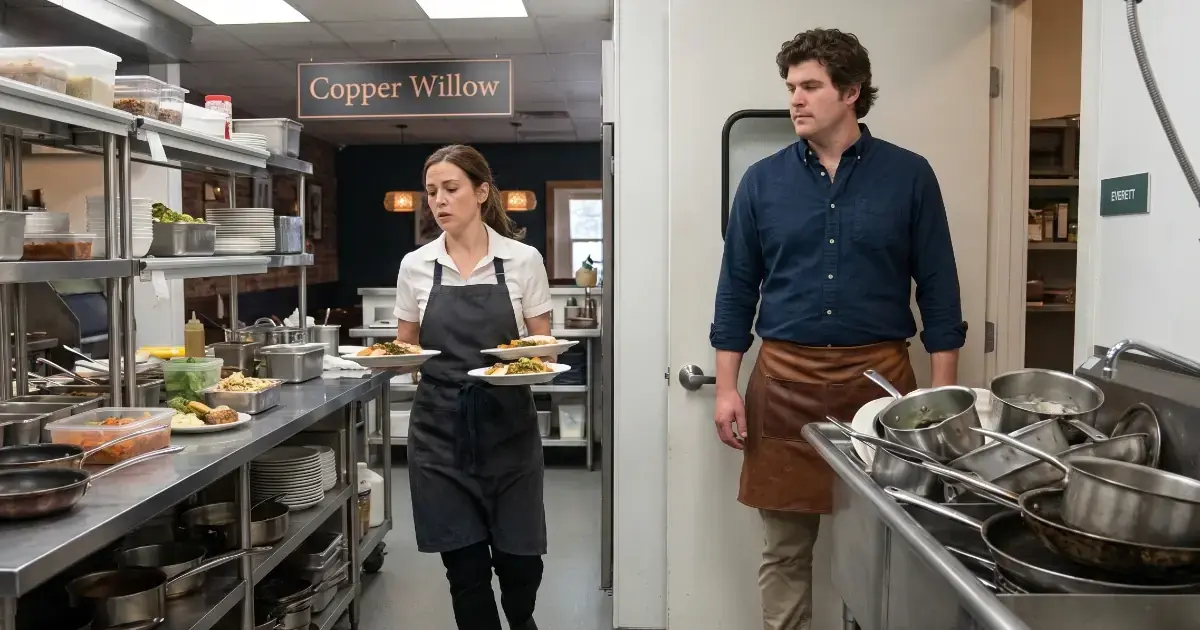
She was exhausted most days, but exhaustion had taught her to move quickly, think quickly, and never waste a minute. That particular afternoon had already gone terribly wrong before the mysterious man walked through the kitchen door. Two employees had called in sick. The dishwasher had left after an argument with the manager, and the lunch crowd had arrived earlier than expected. Marlo was carrying three plates in one hand and balancing a tray against her hip when she noticed a tall man standing near the service entrance.
He was wearing a simple dark blue shirt, beige trousers, and an old-looking leather apron that someone had apparently handed him when he entered. He had thick brown hair, a calm expression, and the kind of posture that made him look comfortable wherever he stood. He wasn't dressed like the wealthy businessmen who usually ate at the Copper Willow. In fact, with his sleeves rolled up and a plain apron hanging from his waist, he looked exactly like someone who had come in to help with the dishes. Marlo barely had time to look at him before she hurried past, but then she saw the overflowing sink and realized there was nobody left to deal with it.
Without thinking twice, she pointed toward the dishes and motioned for him to get started. In the chaos of the kitchen, she assumed he was the replacement dishwasher. The man looked at the sink, then at Marlo, and then quietly nodded. He placed his jacket on a nearby chair, rolled his sleeves higher, and began washing plates. His name was Everett Hail, though Marlo would not learn that for quite some time.
Everett was 42, the founder and majority owner of Hail Hospitality Group, a company that owned restaurants, hotels, and several commercial properties across the state. The Copper Willow had been one of his first investments, but he had never wanted the employees to know who he was. For months, he had been hearing reports about declining morale, unfair scheduling, and management problems at the restaurant. Instead of sending another corporate consultant, Everett had decided to visit personally. He wanted to see what happened when employees believed nobody important was watching.
That morning, he had walked through the front entrance dressed simply, introduced himself only as Everett, and asked to speak with the manager. The manager had not yet arrived, so Everett had gone toward the kitchen to observe the operation. Then Marlo had mistaken him for the dishwasher. What surprised him was not the mistake. It was the fact that she never treated him cruelly.
She was simply overwhelmed. Every few minutes, she rushed back to the sink, grabbed another stack of plates, thanked him with a quick nod, and disappeared again. When a tray crashed in the dining room, she was the first person to run toward it. When an elderly customer nearly slipped, she abandoned her order and helped him into a chair. When a young mother realized she had forgotten her wallet, Marlo quietly paid for the child's meal from the cash in her own apron.
Everett noticed everything. He noticed the small things most people ignored. Then came the moment that changed his understanding of her completely. Marlo was carrying a tray of sandwiches when she suddenly stopped near the kitchen entrance. Her phone had vibrated inside her apron.
She glanced at the screen and her face changed. The confidence disappeared from her eyes. She stepped into a quiet corner and listened. Everett couldn't hear the conversation, but he could see her shoulders stiffen. After a moment, she wiped her eyes, took a slow breath, and returned to work as if nothing had happened.
Later, when she passed him near the sink, she quietly apologized for ordering him around. She assumed he was new and probably nervous. Everett simply smiled and continued washing dishes. But the real crisis came when the restaurant manager finally arrived. His name was Grant Mercer, a polished man in his 50s who cared more about appearance than people.
He walked through the kitchen complaining about everything from the placement of the utensils to the speed of the wait staff. When he saw Everett washing dishes, he immediately became irritated. Instead of asking who he was, Grant criticized Marlo for making the dishwasher work outside his assigned station. He accused her of creating confusion during the lunch rush. Marlo tried to explain that they were short staffed, but Grant cut her off and threatened to reduce her hours.
Everett quietly put down the plate he was holding. He had spent 2 hours watching Grant blame everyone except himself. He had seen the manager ignore the shortage of staff, speak harshly to employees, and complain about mistakes caused by impossible workloads. But Everett still said nothing. He wanted to know how far the situation had gone.
Then Grant made a mistake that even Everett hadn't expected. He pulled a folded document from his office and told Marlo that her employment would be terminated at the end of the week because she had been unreliable. The reason was simple. She had recently asked for a slightly adjusted schedule so she could pick up Toby from school on days when his after-school program ended early. Marlo's face went pale.
She had been working there for 4 years. She had never missed a shift without notice. She had covered other people's emergencies countless times. She had worked holidays, weekends, and double shifts. Yet one request to spend more time with her son had been enough to make her disposable.
She quietly removed her apron and placed it on the counter. Everett watched her fight back tears. She didn't beg. She didn't scream. She simply nodded, collected her belongings, and walked toward the exit.
But before she could leave, a little boy appeared at the front door. Toby had gotten out of school early because his teacher had a meeting and Marlo had forgotten the change in schedule. He stood there holding his backpack looking tired and confused. Marlo immediately knelt down and hugged him. That was when Everett saw the truth behind her strength.
She wasn't trying to be heroic. She was simply a mother who had spent years carrying more weight than anyone should have to carry alone. Toby looked toward the kitchen and noticed Everett washing dishes. With the innocent honesty only children possess, he asked whether the man worked there. Marlo smiled sadly and said she thought he did.
Everett laughed softly. Then Toby thanked him for helping his mother. Those words hit Everett harder than any corporate meeting ever had. Because for the first time that day, he realized that his restaurant wasn't failing because of food, location, or competition. It was failing because people had forgotten that every employee had a life beyond the uniform they wore.
Everett reached into his pocket and pulled out his phone. He made one call. Within minutes, the restaurant's regional director arrived, followed by two members of the company's executive team. Grant's confidence disappeared when he saw them. Then Everett calmly walked toward the dining room, removed the apron from his waist, and handed it to the stunned manager.
He introduced himself as Everett Hail, owner and founder of Hail Hospitality Group. The entire restaurant seemed to freeze. Marlo stood near the doorway with Toby beside her, staring at the man she had ordered to wash dishes. Everett didn't embarrass her. He didn't make a joke about her mistake.
Instead, he told everyone that she had done exactly what he hoped someone would do in a crisis. She had seen a problem and solved it. She had not asked whether he was important enough to deserve respect. She had simply needed help. So, she asked for help.
Then, Everett turned toward Grant. He explained that he had spent the day watching the restaurant operate from the lowest position in the building. He had washed dishes, carried trash, wiped counters, and listened to employees who thought nobody powerful was nearby. What he had discovered was unacceptable. Grant had created an environment where hard-working people were afraid to ask for basic consideration.
He had punished employees for problems caused by poor management and had treated the staff as replaceable. Grant tried to defend himself, but the evidence was already clear. His position was terminated that afternoon. But Everett wasn't finished. He turned to Marlo and offered her something she never expected.
He wanted her to become the restaurant's new floor supervisor with better pay, reliable scheduling, and the authority to make decisions about staff welfare. He told her he wasn't giving her the position because he felt sorry for her. He was offering it because he had watched her lead during the hardest lunch rush the restaurant had seen in months. She knew how to serve customers, but more importantly, she knew how to see people. Marlo couldn't immediately answer.
She looked at Toby, who was smiling for the first time that afternoon. She accepted. Over the next several months, the Copper Willow changed. Marlo introduced fairer schedules. Employees were given proper breaks.
Staff members could request schedule adjustments without fear of punishment. Everett visited regularly, but he never announced himself with an entourage. Sometimes he still walked into the kitchen wearing an apron and helped wash dishes. The employees eventually learned that the millionaire owner didn't believe leadership meant standing above people. He believed leadership meant being willing to stand beside them.
Marlo also changed. For years, she had believed asking for help was a sign of weakness. Now she understood that strength wasn't carrying everything alone. Strength was knowing when to let someone share the weight. Toby grew especially fond of Everett.
He began calling him Uncle Everett, and Everett quietly accepted the title. He helped Toby build a small wooden birdhouse one Saturday afternoon in the restaurant's garden, laughing when the pieces didn't fit correctly. Marlo watched them from the doorway and felt something inside her soften. She had spent years protecting her son from disappointment, never realizing that sometimes the greatest protection was allowing good people into their lives. One afternoon, almost a year after the day Marlo had mistaken a millionaire for a dishwasher, Everett arrived at the restaurant carrying the same old leather apron.
Marlo recognized it immediately. He tied it around his waist and walked toward the kitchen. The dishwasher was already working, but Everett picked up a towel and started drying plates anyway. Marlo smiled. She finally understood that the most important thing she had learned that day wasn't that the dishwasher had been a millionaire.
It was that she had judged a person by his appearance and yet he had chosen to judge her by her character. That distinction changed everything. Everett had every reason to punish her for the mistake. Instead, he gave her dignity. Marlo had every reason to feel embarrassed by what happened.
Instead, she used the experience to become a better leader. Grant had lost his position because he forgot that employees were human beings. Marlo earned hers because she never forgot. And sometimes the greatest transformations begin with the smallest misunderstandings. A waitress thought she was ordering a dishwasher to work.
Instead, she accidentally showed a millionaire exactly what kind of leader his company needed. Just before the restaurant closed for the afternoon, Marlo stood outside with Toby and Everett, watching sunlight fall across the street. She looked at the building that had once represented nothing but long hours and financial stress. And now it felt like the place where her life had finally turned in a different direction. She realized that the moment she thought had humiliated her had actually opened a door she never knew existed.
Because sometimes the person we underestimate is the person who changes our life. Sometimes the hand we mistake for ordinary is the hand reaching out to lift us. And sometimes all it takes is one difficult day, one unexpected act of kindness, and one second chance to remind us that a person's true worth has never been measured by the clothes they wear, the job they perform, or the money in their bank account. It is measured by what they do when nobody is watching. And Everett Hail had walked into his own restaurant expecting to discover what was wrong with his business.
Instead, he discovered something far more valuable. The people who needed to be seen. The woman who deserved a chance. And the simple truth that the best leaders don't ask, "Who is important here? " They ask, "Who needs help?
Waitress Mistook the Millionaire Owner for a Dishwasher — Then Her Manager Tried to Fire Her
Theme:
Font Size:
24px