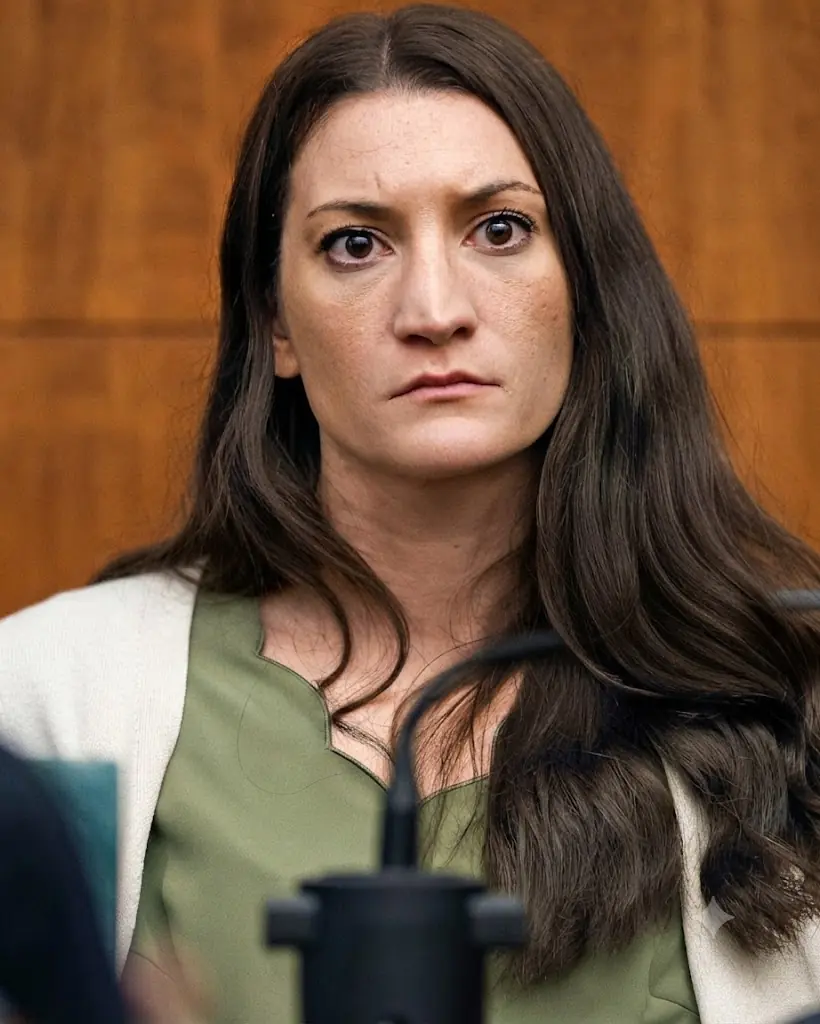
Blaire White’s Viral Lindsay Clancy Comment: A Real Quote, a Tragic Case, and a Much Bigger Mental Health Debate
News 08/09/2026 15:52
The murder trial of Lindsay Clancy has ended without a verdict, but the fierce debate surrounding the Massachusetts mother is far from over.
After nearly six weeks of testimony and seven days of jury deliberations, a Plymouth County Superior Court judge declared a mistrial on September 4, 2026, after jurors failed to reach a unanimous decision on whether Clancy was criminally responsible for the deaths of her three young children in 2023. The case had become one of the most closely watched criminal trials in the United States, drawing intense attention to postpartum psychosis, maternal mental health, criminal responsibility and the difficult boundary between illness and accountability. (AP News)
The mistrial immediately reignited an already emotional public argument. Among those reacting forcefully was conservative commentator Laura Loomer, who condemned people she believed were defending or sympathizing with Clancy. In a social-media post following the jury deadlock, Loomer questioned how anyone could describe Clancy as “innocent” and said she never wanted to meet a Lindsay Clancy supporter. (sotwe)
But the legal question at the center of the case is more complicated than a simple choice between “innocent” and “guilty.”
Clancy has not been found innocent by a jury. Nor has she been convicted. Her defense does not dispute that she killed her three children. Instead, it argues that she was experiencing a devastating psychiatric illness—postpartum psychosis—and therefore should not be held criminally responsible for her actions.
Prosecutors have presented a dramatically different interpretation. They argued that Clancy was depressed and struggling, but that she understood what she was doing and deliberately carried out the killings.
With the jury unable to resolve that question, the courtroom battle has temporarily ended without answering the central issue: Was Lindsay Clancy legally responsible for the deaths of her children, or did a severe mental illness render her incapable of understanding the wrongfulness of her actions?
The case began in January 2023, when Clancy's three children—5-year-old Cora, 3-year-old Dawson and 8-month-old Callan—were found strangled at the family's home in Duxbury, Massachusetts.
Clancy had also attempted suicide by jumping from a second-story window. She survived but suffered devastating injuries and has remained paralyzed from the waist down. (The Washington Post)
She was charged with three counts of murder and pleaded not guilty by reason of insanity.
The trial, which finally began years after the deaths, centered less on whether Clancy had physically killed the children than on what was happening inside her mind at the time.
That distinction became crucial.
The defense acknowledged the killings but argued that Clancy was suffering from postpartum psychosis, a rare and potentially devastating psychiatric condition that can cause hallucinations, delusions, severe confusion and a profound break from reality.
The prosecution, meanwhile, argued that Clancy's conduct demonstrated planning and awareness. Prosecutors maintained that she understood the nature and consequences of her actions and should therefore be held criminally responsible.
After weeks of testimony, the case went to the jury.
The deliberations became increasingly tense.
Jurors deliberated for seven days, repeatedly telling the judge that they could not reach a unanimous verdict. On September 4, Judge William Sullivan ultimately declared a mistrial. (AP News)
The decision did not mean Clancy was acquitted.
It also did not mean prosecutors had proved their case.
It meant the jury could not reach the level of agreement required for a verdict.
One of the most important distinctions in the case has sometimes been lost in the emotional reaction online.
There is little dispute over the physical events themselves. Clancy's defense has not centered on a claim that someone else killed the children.
Instead, the legal battle focused on criminal responsibility.
That distinction is essential.
A person can commit a physical act and still raise a legal defense based on severe mental illness. The question becomes whether the person's mental state met the applicable legal standard for insanity or lack of criminal responsibility at the time of the offense.
That is why the courtroom debate became intensely focused on Clancy's psychiatric history.
Her attorneys portrayed a woman whose mental health had deteriorated dramatically following the birth of her youngest child.
They argued that she experienced postpartum psychosis and that her perception of reality had become profoundly distorted.
One defense psychologist testified that Clancy did not appreciate the wrongfulness of killing her children because of her mental illness. The defense also presented evidence concerning bipolar disorder, depression and psychiatric treatment. (The Washington Post)
Her medical and personal history became a central part of the trial.
Evidence presented during the proceedings described anxiety, depression, sleep problems and increasing emotional distress after Callan's birth. Her diary entries also documented feelings of desperation, “brain fog,” difficulties with motherhood and concerns about returning to work as a labor-and-delivery nurse. (The Washington Post)
For the defense, these details formed part of a larger picture.
They argued that the tragedy was not the result of an ordinary decision made by a mentally healthy person, but of a catastrophic psychiatric crisis that had overwhelmed Clancy's ability to perceive reality.
Postpartum psychosis became perhaps the most widely discussed medical issue in the entire case.
Unlike the much more commonly discussed “baby blues” or postpartum depression, postpartum psychosis is rare and can involve a severe loss of contact with reality.
According to medical experts cited during coverage of the trial, the condition can involve hallucinations, delusions, mania, confusion and dramatic changes in behavior.
The condition is rare but extremely serious. The Associated Press reported that it can affect roughly 1 to 2 women per 1,000 after childbirth. (AP News)
The defense argued that Clancy's symptoms went far beyond ordinary depression.
Her attorneys maintained that she experienced a psychotic episode in which she heard a voice directing her to kill her children.
They argued that her psychiatric deterioration had not been adequately recognized or treated despite attempts to obtain professional help.
Her husband, Patrick Clancy, also testified about changes he observed in her mental health before the killings. Evidence about her treatment and struggles before January 2023 was presented to support the argument that she was experiencing an escalating psychiatric crisis. (The Washington Post)
The defense therefore asked jurors to look beyond the horrific outcome and examine Clancy's mental state at the precise moment the killings occurred.
That became the heart of its case.
The prosecution did not deny that Clancy had experienced serious mental-health problems.
Instead, prosecutors challenged the conclusion that those problems rendered her legally incapable of responsibility.
Their argument was essentially that mental illness does not automatically equal legal insanity.
Prosecutors called forensic experts who questioned Clancy's account of psychosis and the voice she said instructed her to kill.
Dr. Gregory Saathoff, a forensic psychiatrist at the University of Virginia and senior psychiatrist for the FBI's Behavioral Analysis Unit, testified that aspects of Clancy's account raised questions for him. He pointed to what he considered inconsistencies involving the reported voice and its timing. (AP News)
Another prosecution expert, forensic psychologist Kirk Heilbrun, suggested that Clancy's actions were better explained by suicidal thinking and a desire to prevent her children from suffering than by a psychotic delusion.
The prosecution's theory was therefore dramatically different.
Rather than a mother completely detached from reality, prosecutors portrayed Clancy as someone who understood what she was doing and made deliberate choices.
That distinction mattered enormously.
If the jury accepted the prosecution's interpretation, Clancy could be held criminally responsible for murder.
If the jury accepted the defense's interpretation, she could be found not criminally responsible because of severe mental illness.
The jury's inability to reach a verdict demonstrated just how sharply the evidence divided the panel.
As deliberations stretched across multiple days, the jurors repeatedly informed the judge that they remained deadlocked.
At one point, reports indicated an apparent 11-to-1 division among the jurors. However, that breakdown should be treated carefully because the precise reasoning of individual jurors is not fully public, and the jury itself did not issue a public explanation of its deliberations. (WBUR)
The judge encouraged the jurors to continue deliberating.
But eventually, after seven days and more than 38 hours of discussion, the panel still could not reach unanimity.
The result was a mistrial.
For Clancy's defense, the outcome was a significant development because there was no conviction.
For prosecutors, however, the case remains unresolved.
And for the families involved, there was no final answer.
Three children died.
No verdict could change that.
The mistrial quickly spilled from the courtroom into the political and social-media worlds.
Laura Loomer, a conservative political commentator, responded with an especially harsh message aimed at people who sympathize with Clancy.
She wrote that it was “sad and disturbing” that some people did not believe the three children deserved justice and questioned how anyone could regard a woman who admitted killing her children as innocent. She ended by saying she never wanted to meet a Lindsay Clancy fan. (sotwe)
Loomer's comments reflect one side of a much broader public argument.
To critics of Clancy, the deaths of three children should remain the central fact.
They argue that sympathy for mental illness should not become sympathy for the killing itself.
From this perspective, the victims cannot speak for themselves, and the justice system has an obligation to recognize the enormous harm inflicted on them.
But describing Clancy as legally “innocent” is also potentially misleading.
She was not acquitted.
There was no verdict finding her not criminally responsible.
The case ended in a mistrial because the jury could not agree.
That means the legal process remains open.
This distinction is especially important when discussing Loomer's criticism.
In everyday language, “innocent” often means someone did not commit an act.
But a legal finding of not guilty by reason of insanity or not criminally responsible can operate differently.
A defendant may acknowledge the physical act while arguing that a severe mental disorder prevented them from meeting the legal standard for criminal responsibility.
That is essentially what happened in Clancy's case.
Her defense did not need to convince jurors that the children died through some unrelated event.
It needed to convince them that Clancy's mental state at the time of the killings meant she should not be criminally punished in the same manner as someone who knowingly and deliberately commits murder while understanding the wrongfulness of the act.
That is a difficult legal and moral distinction.
It is also why reducing the entire case to “she killed her children, so she must be guilty” does not fully address the question the jury was legally required to answer.
At the same time, saying “she had postpartum psychosis, so she was innocent” would also go beyond what the evidence and legal process establish.
The jury never reached that conclusion.
Whatever one's position on Clancy's mental state, the deaths of Cora, Dawson and Callan remain the irreversible center of the case.
Their ages—5, 3 and just 8 months—have contributed to the extraordinary emotional response to the tragedy.
Their deaths also explain why public discussions about the case have become so emotionally charged.
For many observers, the idea of focusing heavily on the mother's suffering can feel as though the children are being pushed into the background.
For others, ignoring the mother's severe psychiatric condition risks reinforcing a dangerous misunderstanding about mental illness.
The challenge is recognizing both realities.
The children were victims of a devastating crime.
And postpartum psychosis is a real medical emergency that can radically alter a person's perception of reality.
Acknowledging the second fact does not require minimizing the first.
Another important lesson from the case is the difference between postpartum depression and postpartum psychosis.
Postpartum depression is relatively common and can cause persistent sadness, anxiety, exhaustion, hopelessness and difficulty bonding with a baby.
Postpartum psychosis is far rarer and much more severe.
Medical experts have emphasized that it can involve a loss of contact with reality and requires urgent psychiatric intervention. (AP News)
The Clancy case has therefore renewed questions about how quickly postpartum psychiatric emergencies are recognized.
Experts and people with lived experience have used the case to argue that families and healthcare professionals need better awareness of warning signs.
The goal of such awareness is not to excuse violence.
It is prevention.
Recognizing a psychiatric emergency early can allow a mother to receive immediate treatment and protect both her and her children.
That distinction is crucial because cases like Clancy's are extraordinarily rare, while postpartum mental-health struggles themselves are not.
Evidence presented during the trial described a woman who had struggled significantly after giving birth.
Her family described changes in behavior, sleep and mood.
She sought psychiatric treatment and was prescribed medication.
Her defense argued that these efforts demonstrated someone desperately trying to find help while her condition deteriorated.
The prosecution's interpretation was different, emphasizing evidence it believed showed awareness, planning and deliberate behavior.
The disagreement illustrates one of the hardest problems in psychiatric criminal cases: people can suffer from genuine mental illness while still retaining varying degrees of awareness and decision-making ability.
Mental illness exists on a spectrum.
So does impairment.
And the legal system ultimately has to draw a line.
That line cannot simply be determined by how shocking the crime is.
Nor can it be determined solely by whether a defendant has a psychiatric diagnosis.
The jury must evaluate the evidence and apply the legal standard.
In Clancy's case, twelve jurors could not agree.
A mistrial does not necessarily end a criminal case.
Because there was no unanimous verdict, prosecutors may seek to retry the defendant before a new jury.
Reuters reported that Clancy remains in custody at a state psychiatric hospital and that prosecutors had not immediately announced a final decision on whether to pursue another trial. A September 29 hearing is scheduled to address the next steps. (Reuters)
Several possibilities remain.
A retrial is one.
A negotiated resolution is another.
The defense could continue pursuing arguments based on Clancy's mental state.
The prosecution could also reassess the strength of its case after seeing how the first jury responded to the evidence.
What happens next will depend on legal strategy, the court's rulings and decisions by prosecutors and defense counsel.
But one thing is certain: the mistrial does not erase the charges.
And it does not establish Clancy's innocence.
That is perhaps why Loomer's comments resonated so strongly with some people and angered others.
The word “justice” means different things to different people.
For some, justice means a murder conviction and the harshest punishment allowed by law.
For others, justice means recognizing that a person experiencing profound psychiatric illness may require treatment rather than conventional punishment.
For still others, justice means confronting the failures that may allow severe postpartum mental illness to go untreated until tragedy occurs.
These positions do not necessarily have to be mutually exclusive.
A society can demand accountability for the deaths of children while also acknowledging the reality of psychiatric illness.
It can honor victims without stigmatizing every mother who experiences postpartum mental-health problems.
And it can demand better mental-health care without assuming that every person who commits a violent act while mentally ill is automatically legally insane.
The Clancy case forces all of those questions into the same conversation.
The Lindsay Clancy case began as an unimaginable family tragedy in a Massachusetts community.
It has since become a national conversation about motherhood, mental illness, criminal responsibility and the limits of sympathy.
The mistrial has only intensified that discussion.
Loomer's reaction represents one particularly uncompromising side of the debate: the belief that sympathy for Clancy risks overshadowing the three children whose lives were taken.
The defense represents another: the argument that Clancy's actions cannot be understood without examining the severe psychiatric illness it says destroyed her connection to reality.
The prosecution presents a third critical perspective: that mental illness, even serious mental illness, does not automatically eliminate criminal responsibility.
The jury's failure to reach a verdict shows that these competing interpretations were not easily resolved by the evidence presented in court.
That is not necessarily evidence that the justice system failed.
A unanimous verdict requires agreement among all jurors, and when that agreement cannot be reached, the law provides mechanisms for moving forward.
The mistrial leaves the central question unanswered.
Was Lindsay Clancy a mother who deliberately murdered her three children and understood the wrongfulness of what she was doing?
Or was she experiencing a catastrophic psychiatric break that fundamentally altered her ability to understand reality and responsibility?
The first trial did not settle that question.
And until the legal process reaches its conclusion, neither side of the public debate can honestly claim that the final answer has already been established.
For the families, however, there is a truth that no verdict can change: Cora, Dawson and Callan are gone.
Their deaths remain the most devastating fact in the case.
The challenge now is to pursue justice without allowing outrage, political commentary or social-media arguments to replace the careful legal and medical questions that the court was asked to answer.
As the September 29 hearing approaches, the case remains unresolved—and the debate over justice, mental illness and accountability is likely to continue long after the courtroom doors close. (AP News)
Associated Press — coverage of the mistrial, jury deliberations and postpartum psychosis. (AP News)
Reuters — mistrial, possible retrial and the legal status of the case. (Reuters)
The Washington Post / AP — defense evidence and psychiatric testimony. (The Washington Post)
WBUR — reporting on the apparent jury split and deliberations. (WBUR)
CNN transcript — court confirmation that the matter was continued to September 29, 2026. (CNN Transcripts)
Laura Loomer's social-media statement, as reproduced by social-media indexing services. (sotwe)


Thomas Massie Takes the Epstein Files Fight to the House Floor
Ohio Dad Posed as His 11-Year-Old Daughter on TikTok to Lure Her Alleged Assailant

Miriam Rodríguez: The Mother Who Refused to Stop Searching for Her Daughter














Thomas Massie Takes the Epstein Files Fight to the House Floor
Ohio Dad Posed as His 11-Year-Old Daughter on TikTok to Lure Her Alleged Assailant
Miriam Rodríguez: The Mother Who Refused to Stop Searching for Her Daughter