The Solar-Powered Sea Slug: Nature’s Living Solar Panel
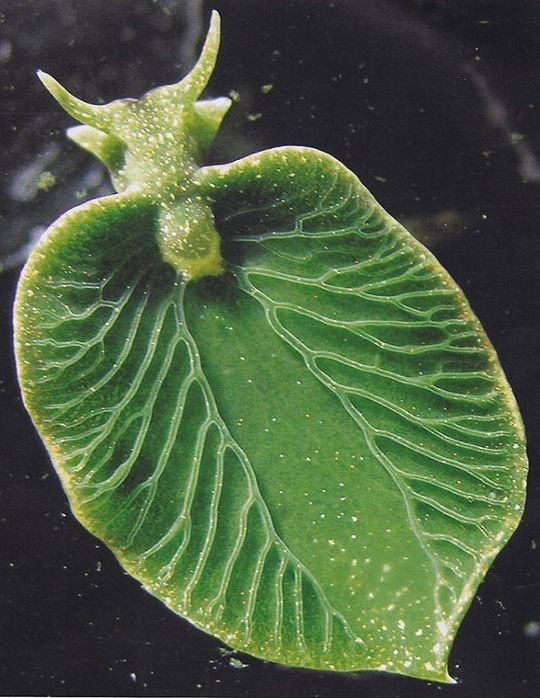
One of the most extraordinary creatures in the animal kingdom is the Elysia chlorotica, also known as the Eastern Emerald Elysia, a type of sea slug. This remarkable organism has the unique ability to photosynthesize, a trait typically associated with plants and some types of bacteria. By harnessing solar energy in this way, Elysia chlorotica has stunned scientists and blurred the lines between the animal and plant kingdoms.
Found along the coastlines of North America, the Eastern Emerald Elysia has developed an incredible survival strategy. When it feeds on algae, specifically Vaucheria litorea, it takes an ingenious step: it absorbs chloroplasts — the cellular structures responsible for photosynthesis — from the algae and incorporates them into its own cells. This process, known as kleptoplasty, allows the sea slug to continue photosynthesizing even after it has digested its food, much like a plant. As a result, the sea slug can survive for extended periods, relying primarily on sunlight for its energy, without needing to consume additional food sources. In fact, some individuals can live for up to a year without eating at all, solely depending on photosynthesis for sustenance.
This ability to photosynthesize is not only fascinating but is a survival adaptation that provides the slug with an important evolutionary advantage. The green chloroplasts inside the slug give it a vibrant green hue, helping it blend in seamlessly with its seaweed environment. This camouflage is an essential defense mechanism, allowing the sea slug to evade predators, particularly in its natural habitat of salt marshes and tidal pools, where sunlight is abundant. The coloration serves both as a tool for self-preservation and as a visual testament to the slug's plant-like energy production system.
Measuring up to 2.6 inches (60 millimeters) in length, the Elysia chlorotica thrives in environments rich in sunlight, which is essential for its photosynthetic processes. This unique ability to function like a plant in the animal world has raised questions about energy efficiency, evolution, and the potential for future scientific applications.
What makes this discovery particularly exciting for scientists is the potential for future research into how energy efficiency works on a cellular level. The Elysia chlorotica offers an unprecedented opportunity to study photosynthesis in animals, potentially leading to advancements in bioengineering and energy production.
In summary, the Eastern Emerald Elysia, or Elysia chlorotica, is more than just an animal; it is a living solar-powered organism that demonstrates the astonishing adaptability of life. By incorporating photosynthesis into its biology, this sea slug challenges our conventional understanding of life forms and opens up new possibilities for studying energy conversion and efficiency in nature. As research continues, this remarkable animal may unlock further insights into the complex mechanisms of photosynthesis and provide inspiration for innovative technologies in renewable energy.
References:
-
Pierce, S. K., & O'Leary, M. A. (2005). Kleptoplasty in the Eastern Emerald Elysia: Harnessing solar energy. Marine Biology Journal.
-
Allen, T. J., & Hamilton, L. (2019). Photosynthetic Sea Slug Offers Insights Into Animal-Plant Energy Conversion. Journal of Evolutionary Biology.
-
National Oceanic and Atmospheric Administration (NOAA), Research on Photosynthesis in Marine Organisms. NOAA Marine Ecosystems.